
‘There was never a better time to have been born an Indian’: KV Kamath
The Indian growth story clearly has a 25-year runway ahead, says veteran banker and financial expert KV Kamath.
- Economy News
- 9 min read

;'%3e%3cpath%20d='m8,15.99c4.41,0,7.99-3.58,7.99-7.99S12.41,0,8,0,0,3.59,0,8s3.58,7.99,7.99,7.99Z'%20style='stroke:%23fff;%20stroke-miterlimit:10;%20stroke-width:.02px;'/%3e%3cpath%20d='m3.08,3.37l3.82,5.11-3.84,4.15h.87l3.37-3.64,2.72,3.64h2.94l-4.04-5.39,3.58-3.87h-.86l-3.1,3.35-2.5-3.35h-2.94Zm1.27.64h1.35l5.97,7.99h-1.35l-5.97-7.99Z'%20style='fill:%23fff;'/%3e%3c/g%3e%3c/svg%3e)


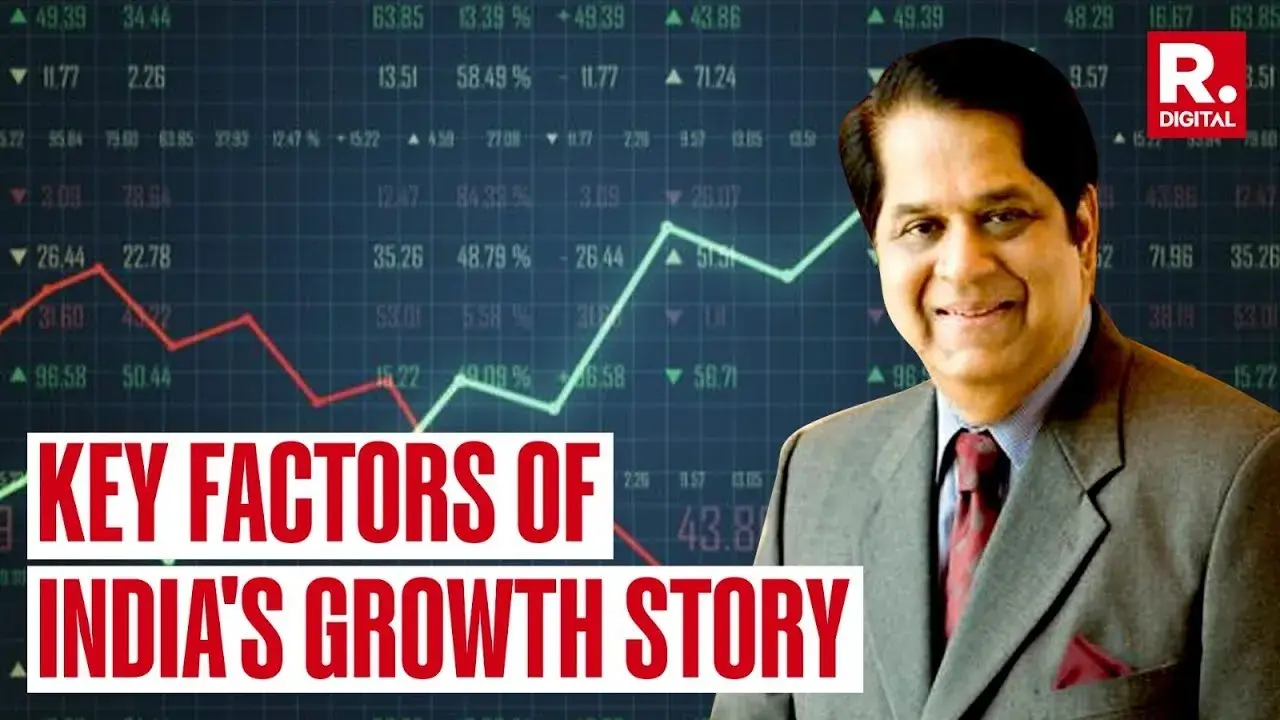
The Indian economic growth story, will it sustain? Will the bull run continue beyond a decade? What are the essential bulwarks that need to be raised to insulate the growth against external threats? Veteran banker and financial expert, KV Kamath shares his key insights with Republic in an exclusive interview.
Republic: What were the fundamental principles that guided your approach to business leadership?
I think I go back to the late 90s when we saw that the aspirations of young Indians were changing. This was consequent to white-collar jobs being created, particularly in the IT sector. As a result, there was a demand for retail products. So my journey, in a way, apart from the development banking journey which started in 71, the recent journey in 96.
When I took over as the CEO of ICICI Bank, the opportunity in retail India whether it was a home, whether it was a car, whether it was a motorcycle or something to put into your home, that became the opportunity. That was one trend. The other trend that we leveraged was technology because we could see that technology was going to drive everything that everybody did in any line of business. And of course, we in the banking business had no technology those days. So, we overlaid it with technology. So, if I were to sum it up, it was a resurgent India.
Advertisement
If you remember the 2001-2002 period, India was in a resurgent mood. The aspirations of young people and the technology revolution, all three put together actually drove business. And I remain focused on those primary drivers throughout my career.
Republic: Drawing from your wealth of experience, how would you assess the current economic landscape in India?
Advertisement
Let me put it in one phrase. I have never been more optimistic than now. And I also would like to put it this way, that there was never a better time to have been born an Indian. And I mean it with all sincerity because no other country has today a runway of another 25 years, whether it is in infrastructure, whether it is in manufacturing, whether it is in every area of operations. And all this happening at a time when technology is changing at a dramatic pace and will drive everything that we do.
So a runway of 25 years, a momentum that we can clearly see. When I say momentum, I'm talking about the growth that we see in the economy. We are growing. As per the latest report, we should grow at 6.75 or 6.8 this year. Later on, when we talk of maybe digital, I'll talk about how I expect this economy to probably grow even faster. So to me, this is the India that we are driving and of course, driven by young people who are enjoying the use of technology.
Young people today have access to data and have access to data at a cost that is not possible anywhere else in the world. The cheapest access to data and broadband and we are the largest consumers of data. All these to me are underlying drivers for the new India, where I say that probably there has never been a better time to have been born an Indian.
Republic: What, according to you, are the pivotal factors that will shape its growth trajectory in the foreseeable future?
I think let me put just two or three. One. I think the vast unfinished agenda on infrastructure. No country can grow without hard infrastructure going on the ground. And we have in the past been slow so that infrastructure is now going on. Whether you see roads, whether you see ports, airports, telecommunication at all, you see that going on at a great pace.
So that will drive growth for a very long period. Along with infrastructure. I also use urban rejuvenation as an example. That is, every town, and every city will need to get its infrastructure underpinnings rebuilt. Now, we are seeing it in some areas where you see rail systems and metro systems coming up. But I would think that that is going to be a major driver of what is going to happen then. If you look at the number of people who need to be housed, housing is a great opportunity in India. So typically when housing starts, you then have other things that go along with it.
Housing is the engine of growth for certain core industries, whether it is steel, cement and so on. So the industry side of it starts kicking up. So I think we are in a very sweet spot where you got infrastructure growing, where you got housing going, you got core industries going, and we are leaders in technology where we will have technology growing also. So I see that this is a very long runway for a sustained high rate of growth.
Republic: How do you personally navigate the challenges of adaptability and innovation to ensure sustained growth, particularly within the dynamic context of the Indian market?
What I see happening is that every leader, not just me, every business leader, whichever area he is in, whether it is manufacturing, whether it is in technology, whether it is in the digital universe, whether it is a startup today has to be current in everything he or she does.
By current I mean that on top of what is happening around you in a global context. And that starts, of course, today's hot topic today which is AI. Well, I'm not talking of all the negatives of AI, but in a deeper context.
Republic: What could new technology that is available do to you to serve your customers better? What are the aspirations of the new India? Are they the same as that of their parents or grandparents?
I clearly believe that they are not. So I would think that there are a whole lot of new things that this leader, a young leader or an older leader, to be current needs to be aware of. And how do you do this? In my own case, I am always a learner. In fact, from my active days when I used to manage a company, I used to give myself seven to ten days a year where I would go out and try to learn from professors, seminars and other things.
And not necessarily in my area of work, not necessarily in financial services, but I would do it across to be current and to be up the curve. So every leader today will have to do this. So sometimes when people ask me, I put it this way today's business leader, a CEO, has not only to know about his business, but he must be also the technology architect of his company. Because the intertwining of your business and technology has never been closer anytime in the past.
Republic: Given the recent adjustment by the RBI to raise risk weights for unsecured lending in both banks and non-banking finance companies, what is your opinion on the appropriateness of this decision, particularly in the context of the Indian credit card market, which seems to exhibit lower risk compared to developed economies?
Yes, I think, again a very good question that you have asked. See, I have in a way been in the market for now 52 years. Central banks act in different ways. They have several tools that are available. They could put quantitative control on how much you could lend to a particular business or industry.
They could put controls on excise control through interest rate increases. Or they could, as been done now, gently increase risk weights so that in a way behaviour changes. The behaviour of both the lender and the borrower changes. To me, it's a very appropriate solution. Let me explain to you in 30 seconds. If interest rates were hiked, the hike in interest rate would have affected everybody in the system.
But today, when the risk weight for a class of assets has been hiked, it affects people who are lending for that type of asset accumulation or borrowers who are borrowing for that sort of asset accumulation. And since this was unsecured credit primarily which attracts this higher risk weight, I think it then acts in what I would call a salutary manner to make or affect behaviour change as appropriate. So I would actually laud and commend the Reserve Bank for having done it in this way without impacting the overall system and creating consequential challenges in the economy. I hope that banks learn from this and when the central bank signals something, there is a deep thought, deep observation and deep analysis that has gone behind it. So I hope that banks and NBFCs take this on board in the decision-making that they are doing in terms of lending.
You specifically mentioned credit cards. Now, a credit card is a part of this whole process of unsecured credit and that is where I would think probably the highest caution has to be exercised because historically credit card is a type of debt where you are paying the highest, and the borrower is paying the highest. And why does a borrower pay the highest and why does a bank charge higher than otherwise? Basically because the assessment of inherent risk in that product is higher. For any product which you charge more than for some other product, the underlying assumption is that risk is higher. So if it is a risky product, then indeed you would need to have a higher charge in terms of risk weight. So I think it's a very appropriate move.