
Rebuked by India, Vance Admits He Went Too Far with 'Indentured Servants' Rhetoric
The MEA said the remarks ignored the contributions of Indian professionals to the US economy and innovation ecosystem, while asserting that talent mobility benefits both countries.
- World News
- 3 min read

;'%3e%3cpath%20d='m8,15.99c4.41,0,7.99-3.58,7.99-7.99S12.41,0,8,0,0,3.59,0,8s3.58,7.99,7.99,7.99Z'%20style='stroke:%23fff;%20stroke-miterlimit:10;%20stroke-width:.02px;'/%3e%3cpath%20d='m3.08,3.37l3.82,5.11-3.84,4.15h.87l3.37-3.64,2.72,3.64h2.94l-4.04-5.39,3.58-3.87h-.86l-3.1,3.35-2.5-3.35h-2.94Zm1.27.64h1.35l5.97,7.99h-1.35l-5.97-7.99Z'%20style='fill:%23fff;'/%3e%3c/g%3e%3c/svg%3e)


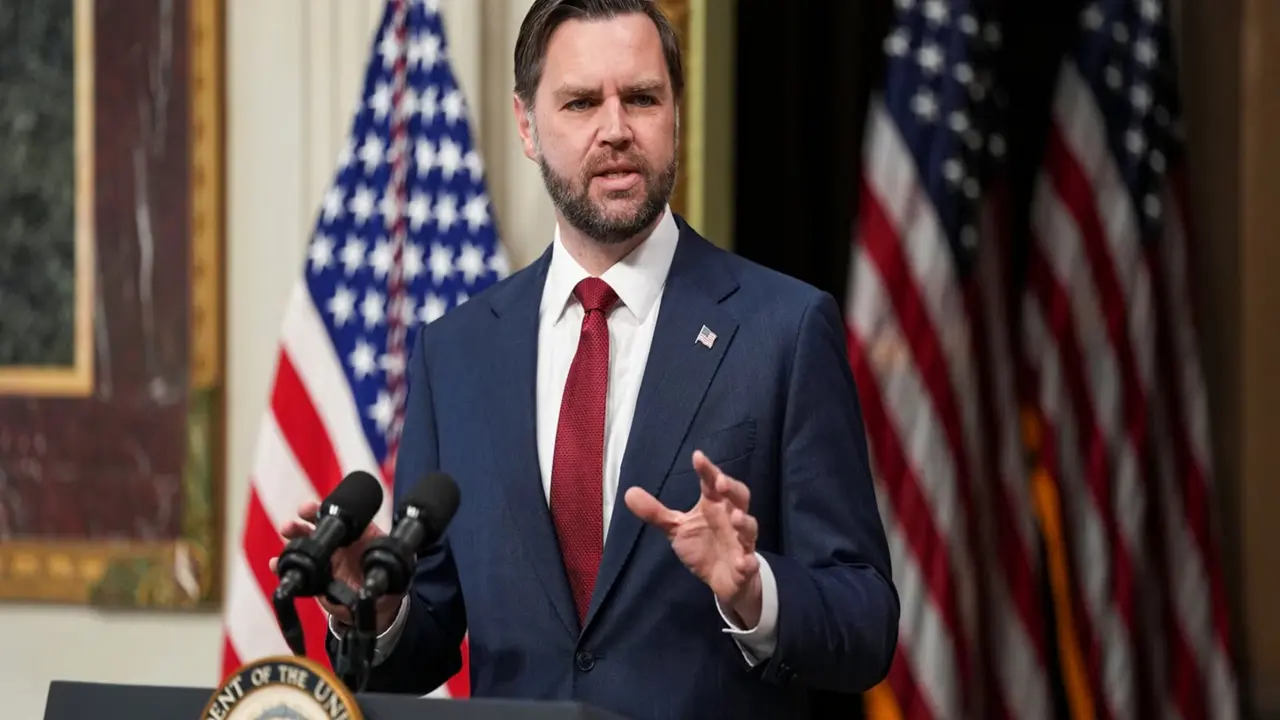
Washington: Following criticism, US Vice President JD Vance admitted that his “indentured servants” rhetoric was imperfect, and he wanted to aim at the US companies and the visa system, not the H-1B visa holders. India had condemned JD Vance’s description of H-1B visa workers as “indentured servants”, calling the terminology “deeply offensive” and saying it carries painful historical and colonial legacy connotations.
Speaking at a CBS Town Hall, JD Vance clarified that his criticism was directed at US firms and the visa system, allowing H-1B holders to be shipped back to their country of origin. He said, “To the extent my rhetoric has been imperfect, that's on me. What I said about certain Visa holders, certain H-1B (holders), is not (for) the entire category. This is what happens often… when they come in with an H1B and the company is certifying that they are doing a job that they cannot find an alternative American labourer apt for it. Importantly, their visa is their only lifeline to the United States of America.”
“So, when I say indentured servitude, that is not a criticism of H1B visa holders; that is the criticism of the company, which brings a person who sometimes will lay off an American worker and knows that if they complain, if they have disagreement with the boss, they could just lose their job… They can be shipped back, which I think gives way too much power to the employer. Maybe my rhetoric has been imperfect here… it is the criticism of the visa system that allowed people to be treated as indentured servants, as they can be shipped to their countries of origin,” Vance added.
Earlier this month, while addressing a news conference on visa fraud, Vance had described H-1B visa workers as “indentured servants” and accused foreign outsourcing firms of undercutting American workers' wages. “If you are working as an H-1B visa in the United States of America, you’re earning USD 20,000 less than an American citizen hired in the same position. If you were brought in by one of these foreign outsourcing firms, you’re making USD 48,000 less than an American citizen in a similar position,” Vance said.
Advertisement
“So, I’m sure that everybody here understands the game that is being played. You bring in indentured servants from outside the country, you lay off American workers and, if you’re a corporation, you make a ton of money by undercutting the wages of American workers, replacing them with people who frankly shouldn’t be in the United States of America to begin with,” he added.
Criticising his remarks, the MEA said the remarks ignored the contributions of Indian professionals to the US economy and innovation ecosystem, while asserting that talent mobility benefits both countries. “We have also seen some comments in this context by the US Vice President. We believe that such descriptions are unwarranted and ignore the fact that Indian professionals in the United States are highly educated and skilled contributors to its economy and innovation ecosystem,” the MEA said in a statement.
Advertisement
“Indeed, the history of the United States itself has been shaped by generations of immigrants whose labour, enterprise and innovation have contributed to its growth and prosperity. Resorting to terminology that carries painful historical and colonial legacy connotations is deeply offensive,” it added.