
Updated 9 March 2026 at 11:11 IST
Dalal Street’s Dark Monday: Sensex Plunges 2,300 Points as Oil Shock Sparks ₹15 Lakh Crore Wealth Erosion
Indian equity markets witnessed a sharp sell-off on Monday as geopolitical tensions in West Asia triggered a massive surge in global crude oil prices. Benchmark indices plunged nearly 3% in early trade, erasing close to ₹15 lakh crore in investor wealth within the first 90 minutes. The spike in oil prices, concerns over supply disruption in the Strait of Hormuz, and rising inflation risks triggered a broad-based market rout across sectors, including banking, aviation, auto, and metals.
- Republic Business
- 5 min read

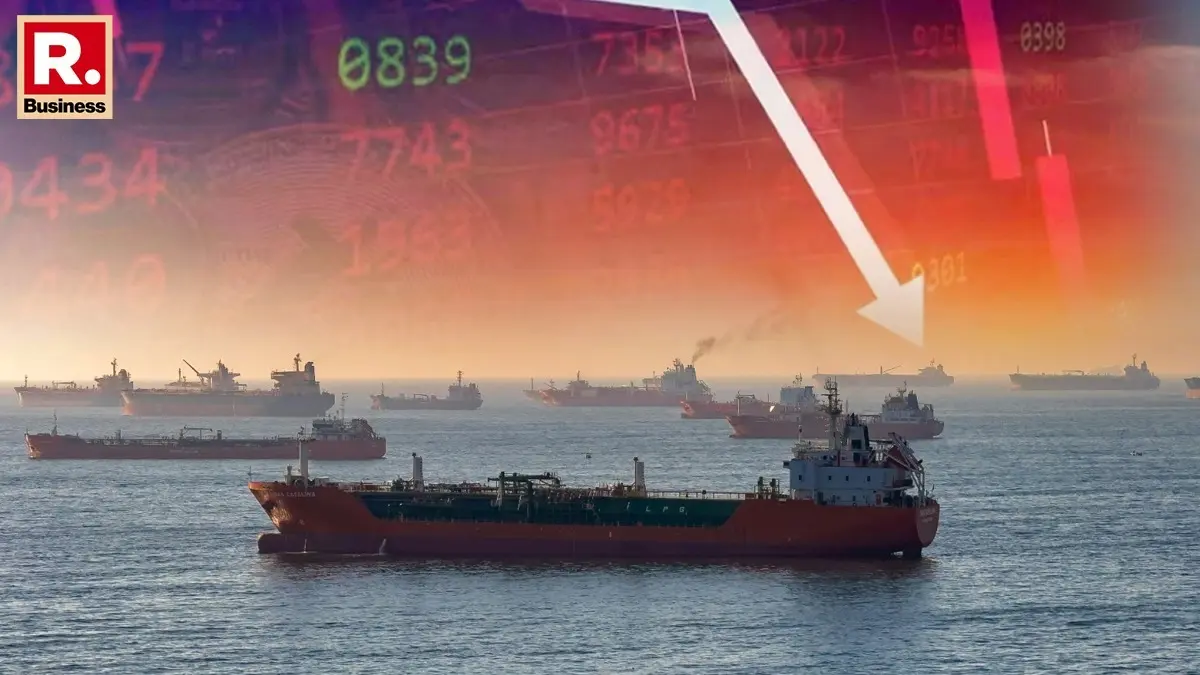
Indian benchmark indices opened sharply lower on Monday, tracking a global risk-off sentiment triggered by a dramatic spike in crude oil prices and escalating geopolitical tensions in West Asia. The benchmark BSE Sensex crashed 2,300 points, or 2.91%, to hit an intraday low of 77,057, compared with its previous close near 79,350. The broader Nifty 50 slumped 750 points, or 3.07%, to trade around 23,700, down from the previous session’s closing level of approximately 24,450.
The decline triggered a massive erosion in investor wealth, with the total market capitalisation of companies listed on the BSE falling by nearly ₹15 lakh crore within the first 90 minutes of trading. Market breadth remained negative, with 49 of the 50 stocks on the Nifty index trading in the red, while only one stock managed marginal gains.
The fall also pushed several index heavyweights lower, with multiple stocks falling between 2% and 5% in early trade. This reflects broad-based selling pressure across sectors.
Brent Crude Surges 25% in a Single Session
The primary driver of the market rout has been the sharp surge in global oil prices. The international benchmark Brent Crude jumped nearly $25 per barrel, or roughly 25%, to trade around $118 per barrel. Thus marking one of the steepest single-session increases in recent years. Reports are increasingly warning that crude prices could surge toward $140–$150 per barrel if geopolitical tensions escalate further.
Advertisement
The spike in oil prices follows disruptions around the Strait of Hormuz, a maritime passage that handles nearly 20 million barrels of crude oil per day. This accounts for approximately 20% of global oil consumption and nearly one-third of seaborne oil trade.
Any sustained disruption to shipments through this route could severely tighten global energy supplies and drive crude prices even higher in the coming weeks.
Advertisement
India imports approximately 85–90% of its crude oil requirements, making it highly sensitive to global oil price movements. According to market estimates, every $1 increase in crude prices adds nearly ₹16,000 crore to India’s annual import bill, meaning the recent $25 jump in oil prices could potentially increase the import bill by nearly ₹4 lakh crore annually if sustained.
Higher crude prices also pose inflationary risks. Economists warn that sustained oil prices above $100 per barrel could push consumer price inflation toward the upper limit of the 2–6% inflation band set by the Reserve Bank of India. This will further complicate expectations of interest rate cuts in the coming quarters.
Piyush Jhunjhunwala, Founder & CEO, Stockify, notes, “The stock market’s decline demonstrates how sensitive global equity markets can be to events occurring in overseas countries that generate instability and uncertainty. As events happen within countries significant to oil production, such as Iraq and Iran, investors react by becoming very cautious about their investments.” He adds, “These recent increases in crude prices, along with the geopolitical unrest in these areas, have created fears regarding inflation and the economic future. An increase in crude oil prices has a higher effect on India’s economy, considering that India is one of the largest consumers of imported oil. An increase in crude prices results in higher expenses for businesses and, likewise, has repercussions on the economic growth within India as well as the global economy.”
Aviation, Banking and Autos Lead the Sell-Off
The spike in oil prices triggered heavy selling across fuel-sensitive sectors. Aviation stocks were among the worst affected as fuel accounts for nearly 35–40% of airline operating costs. Shares of InterGlobe Aviation fell more than 5% in early trade, making it one of the top losers on the benchmark indices.
Banking stocks also faced significant selling pressure, dragging the Nifty Bank down by nearly 1,200 points, or around 2.1%, during the morning session. Among major lenders, ICICI Bank declined around 3.8%, while State Bank of India fell roughly 2.5%.
Automobile and metal stocks also witnessed declines as investors priced in the possibility of rising input costs and supply chain disruptions. Shares of Tata Motors and Tata Steel dropped between 3% and 4%, reflecting concerns that higher energy prices could squeeze margins across manufacturing industries.
Among sectoral indices, most traded lower by 2–4%.
Volatility Jumps as India VIX Surges 25%
Market volatility also spiked alongside the sell-off, with the India VIX rising more than 25% to cross the 22 level, compared with levels near 17–18 in the previous session. The rise in the volatility index shows heightened uncertainty and risk aversion among investors.
Asian Markets Also Witness Sharp Declines
The panic on Dalal Street mirrored broader weakness across Asian markets as investors globally moved away from riskier assets. Japan’s Nikkei 225 fell nearly 7%, while South Korea’s Kospi triggered its lower circuit limit, highlighting the intensity of the sell-off across regional markets.
The decline across Asian equities suggests that global investors are rapidly reducing exposure to emerging markets amid fears that rising energy prices could slow global economic growth and intensify inflationary pressures. Jhunjhunwala says, “With excessive profit taking after many months of strong gains, many foreign investors are becoming more cautious and are taking steps to decrease their exposure over the short run. Collectively, these variables create pressure to sell on the stock market. Although this type of downward movement in the stock market is part of a typical correction cycle, downward stock prices create temporary volatility due to investor perceptions versus long-term fundamental value. Historically, the global stock market will stabilise back to its normalised values over time once global geopolitical factors settle down and investor confidence in the marketplace begins to rebuild.”
Published By : Shourya Jha
Published On: 9 March 2026 at 11:11 IST