
Japan first country to introduce dual-mode vehicles; Know all about it
The dual-mode vehicle or DMV is a diesel-powered bus fitted with an extra set of wheels on its undercarriage to help it to operate on both roads and rail tracks
- Republic Business
- 2 min read

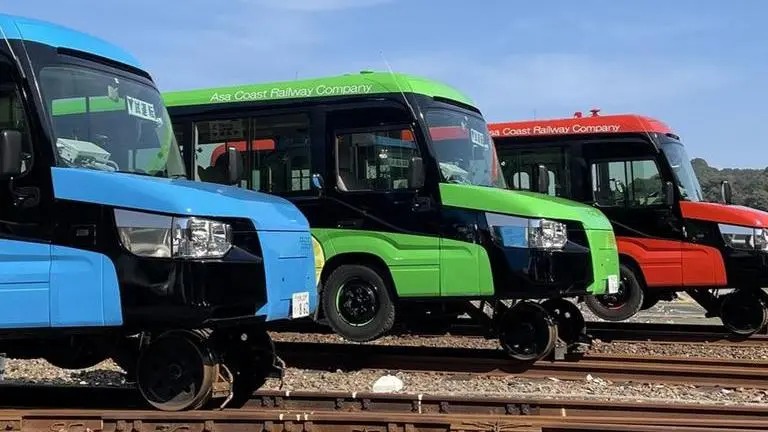
Vehicles that are capable of operating on both conventional road surfaces, as well as railway tracks, have recently started gaining the attention of several countries that are willing to introduce these vehicles on their roads. These vehicles which were originally studied as a way to make electric cars suitable for intercity travel were initially introduced in Japan in December 2021 following which it presently runs on both road and rail connecting several places including Tokushima and Kochi on Shikoku island.
The first of its kind in the world, the dual-mode vehicle (DMV) took to the street in December in the town of Kaiyo, Japan. At that time, it used to run along the part of the coast of Shikoku island in southern Japan further connecting several small towns and offering seaside views to passengers.
The world’s first dual-mode vehicle (DMV) that can run freely on both road and rail now connects #Tokushima and #Kochi in #Shikoku. Its road/rail transport capabilities will deliver #RegionalRevitalization and also play a role when disaster strikes.https://t.co/SkwDJENxn3 pic.twitter.com/er1BByU7a1
— japan (@japan) January 24, 2022
While other countries are yet to adopt the model of the vehicle, Japan which continues to remain a step ahead in terms of technology has thus opted for another convenient way of travelling.
What is a dual-mode vehicle (DMV)?
The dual-mode vehicle or DMV is a diesel-powered bus fitted with an extra set of wheels on its undercarriage to help it to operate on both roads and railway tracks. The recent dual-mode transit system which was put into operation on December 25, 2021, was initiated by Asa Seaside Railway Company in the Shikoku region.
Advertisement
The vehicle looks like a minibus and runs on normal rubber tires on the road. However, what makes it different from others is its steel wheels which descend on hitting the rail tracks. In that case, the front tires are lifted off the track while the rear wheels stay down which helps to propel the DMV on tracks.
Also, while it can carry up to 21 passengers, the vehicles can run at a good speed on both roads and rail tracks.
Advertisement
As stated by the company, the dual-mode vehicle is lighter than a traditional train and will also use less fuel. Additionally, it is also easy to maintain.
Notably, the company had earlier planned to introduce the service of the dual-mode vehicles during the Tokyo Olympics and Paralympics but had to postpone the operation of the vehicle after the Transport ministry recommended they rebuild the welding on the arm that holds the retractable wheels.