
India’s Alternatives To Strait Of Hormuz Beyond Panama Canal, Senior VP ASSOCHAM Amitabh Chaudhry Weighs In
"My view is that at some stage, we need to find a way to get ships going in and coming out of Strait of Hormuz," Amitabh Chaudhry, Senior VP ASSOCHAM, noted.
- Republic Business
- 4 min read

;'%3e%3cpath%20d='m8,15.99c4.41,0,7.99-3.58,7.99-7.99S12.41,0,8,0,0,3.59,0,8s3.58,7.99,7.99,7.99Z'%20style='stroke:%23fff;%20stroke-miterlimit:10;%20stroke-width:.02px;'/%3e%3cpath%20d='m3.08,3.37l3.82,5.11-3.84,4.15h.87l3.37-3.64,2.72,3.64h2.94l-4.04-5.39,3.58-3.87h-.86l-3.1,3.35-2.5-3.35h-2.94Zm1.27.64h1.35l5.97,7.99h-1.35l-5.97-7.99Z'%20style='fill:%23fff;'/%3e%3c/g%3e%3c/svg%3e)


Amid the ongoing West Asia crisis, which has severely impacted oil and gas transits from the Strait of Hormuz, Amitabh Chaudhry, Senior VP ASSOCHAM, noted the potential of Saudi Arabia's use of pipelines to bring oil tankers toward Red Sea.
"Everyone is exploring alternate routes. It is not just, you know, India alone. Saudi Arabia is trying to use the pipeline to make the tankers come on the Red Seaside and see whether they can export something from there or not," he noted.
"But it is not going to be sufficient to take out 30% of the world's oil using that route. My view is that at some stage, we need to find a way to get ships going in and coming out of Strait of Hormuz in some form or the other," he added.
The banking veteran's statement comes amid volatile oil prices, and panic LPG booking being reported across key cities in India such as Nagpur, Delhi, and Bangalore.
Advertisement
Meanwhile, LPG tanker Shivalik, which has transited the Strait of Hormuz, is set to arrive on Monday, March 16 at Mundra Port in Gujarat.
Key Alternatives To Strait Of Hormuz
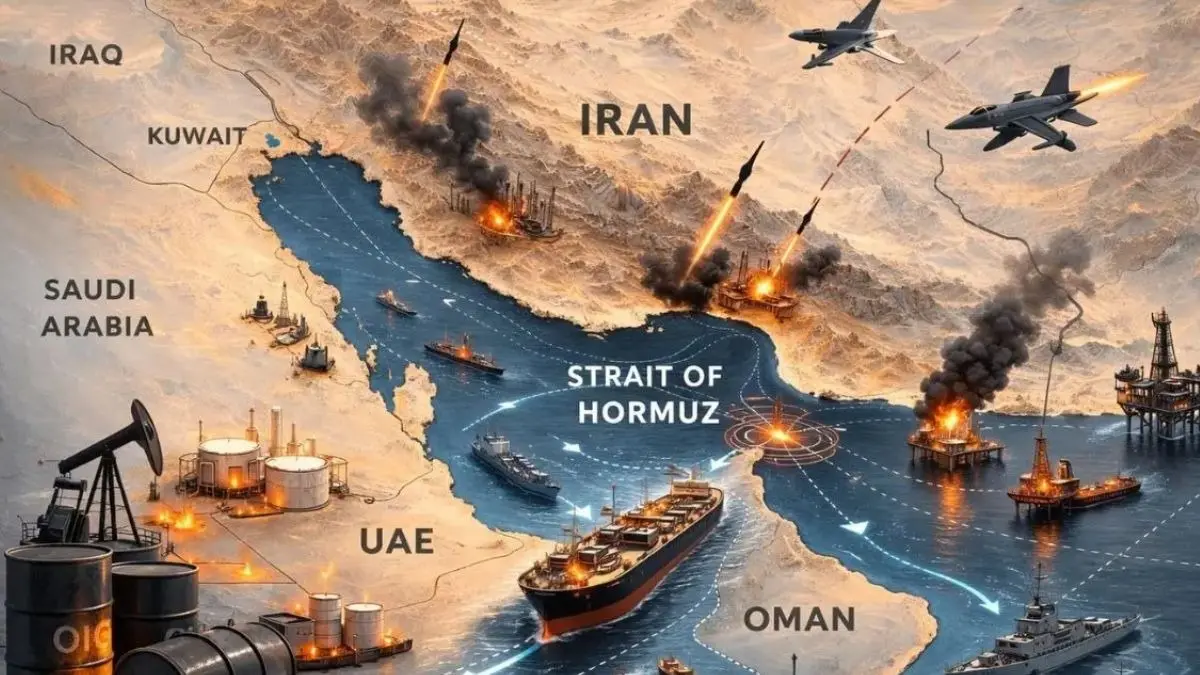
While the Strait of Hormuz remains blocked amid rising tensions between Israel-US and Iran, Saudi Arabia’s East West pipeline network called Petroline is expected to play a significant role in mitigating the energy security concerns.
Advertisement
Petroline stretches about 750 miles across Saudi Arabia and transports crude from Abqaiq on the kingdom’s eastern Gulf coast to the Red Sea port of Yanbu. It has a capacity of carrying seven million barrels of oil per day.
The other alternative is the UAE’s Abu Dhabi Crude Oil Pipeline, also known as the Habshan Fujairah pipeline. It runs about 248 miles from oil facilities in Habshan to the port of Fujairah on the Gulf of Oman.
It can transport nearly 1.5 million barrels of oil per day and has a total capacity of about 1.8 million barrels per day.
On the other hand, External Affairs Minister S Jaishankar noted that there was no blanket arrangement between India, and Iran on allowing safe-passage of Indian-flagged ships to transit, however, diplomacy has resulted in LPG carrier Nanda Devi, and Shivalik enroute to India.
While Shipping Corporation of India's LPG tanker Shivalik, carrying over 40,000 MT of cargo, is headed towards Mundra Port, Gujarat, the Nanda Devi carrier, with a capacity of over 46,000 metric tonnes of cargo, is likely to arrive at the Kandla Port, Gujarat.
Is India Well-Positioned To Handle Strait Of Hormuz Crisis?
Amitabh Chaudhry noted, "India has always been reliant on oil. So, in comparison to lot of the economies around Asia, India is reliant on oil. And specially imported oil is more than some of the others."
"But please give full credit to the government that the kind of relationship they have been able to create on both sides, as I said, is also pretty incredible. Our neighbors are asking India to supply oil to them. Obviously, they don't have those relationships. So, my view is that I think India, as they have shown that they can manage in the past, obviously it will be difficult. It will not be easy. All of us have to put our mind together. But I do believe that we will be able to manage through the crisis, even if it lasts longer," he said.
Further, he mentioned that while some sacrifice that might be required, alternate routes will be found.
Earlier, industrialist Harsh Goenka suggested offloading oil before reaching the Strait of Hormuz, transporting the crude oil across Oman utilising trucks and loading them onto a different tanker on the Arabian Sea coast. From there, the oil could be transited safely via the Indian Ocean.
This comes after the Union Petroleum Minister Hardeep Singh Puri had noted India has “actively” diversified its liquefied petroleum gas (or cooking gas) imports to alternative suppliers like the US, Norway, Canada, Algeria, and Russia, among available gulf sources.