
Budget 2026: FM Sitharaman Lays Out Growth Roadmap Based On Three ‘Kartavyas’; What They Mean?
In Budget 2026, Finance Minister Nirmala Sitharaman unveiled India’s growth strategy built around three key ‘Kartavyas’. Here’s a detailed look at what these duties are and how they aim to shape India’s economic future.
- Republic Business
- 2 min read

;'%3e%3cpath%20d='m8,15.99c4.41,0,7.99-3.58,7.99-7.99S12.41,0,8,0,0,3.59,0,8s3.58,7.99,7.99,7.99Z'%20style='stroke:%23fff;%20stroke-miterlimit:10;%20stroke-width:.02px;'/%3e%3cpath%20d='m3.08,3.37l3.82,5.11-3.84,4.15h.87l3.37-3.64,2.72,3.64h2.94l-4.04-5.39,3.58-3.87h-.86l-3.1,3.35-2.5-3.35h-2.94Zm1.27.64h1.35l5.97,7.99h-1.35l-5.97-7.99Z'%20style='fill:%23fff;'/%3e%3c/g%3e%3c/svg%3e)


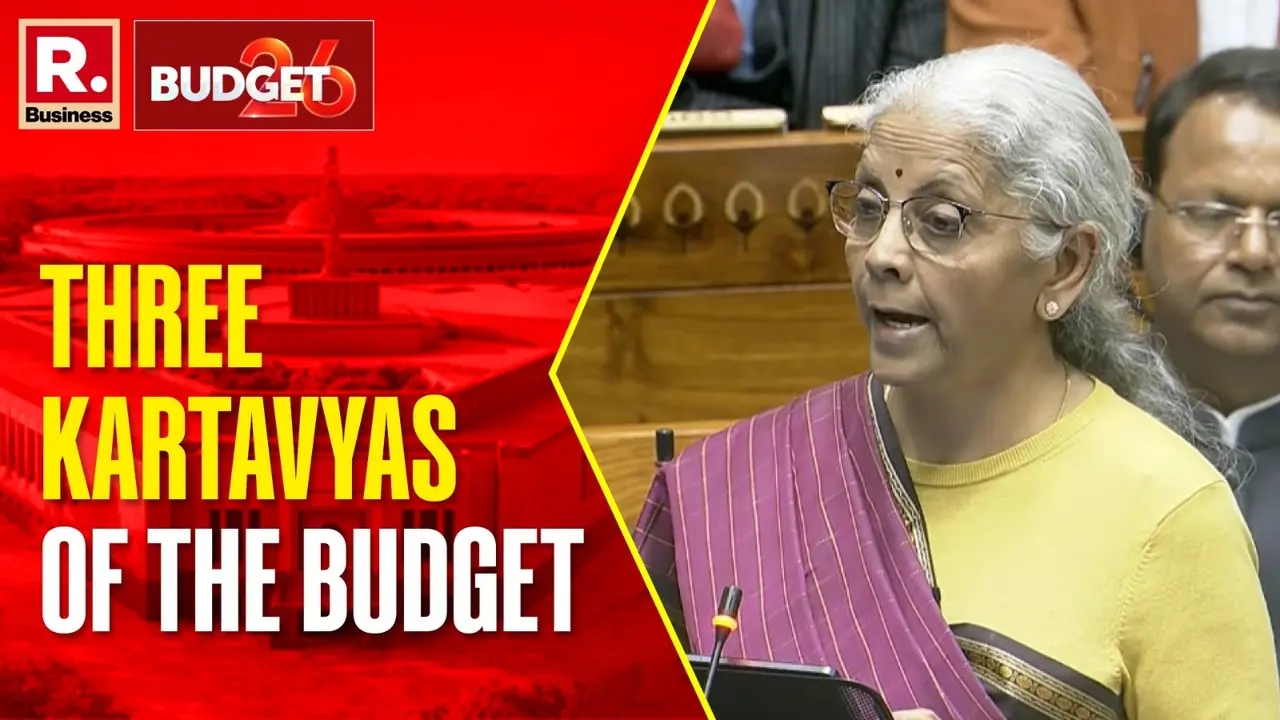
New Delhi: In a historic Sunday session of Parliament, Finance Minister Nirmala Sitharaman presented the Union Budget 2026, stating the nation’s economic strategy on three core ‘Kartavyas’ (responsibilities).
Delivering her ninth consecutive budget speech, the first to be prepared at the newly relocated Ministry of Finance in Kartavya Bhavan, FM Sitharaman outlined a vision for a "Viksit Bharat" (Developed India) driven by youth power and fiscal discipline.
The Finance Minister emphasised that these three pillars are designed to shield the Indian economy from volatile global dynamics while ensuring that the "dividends of growth" reach the last mile.
The Three Pillars of 'Kartavyas'
The 2026 Budget is structured around an approach intended to create a supportive ecosystem for long-term prosperity:
Advertisement
1. Enhancing Competitiveness:
The first kartavya is to accelerate and sustain economic growth by boosting domestic productivity. The FM highlighted the need for building resilience against global supply chain disruptions and external trade pressures.
Advertisement
2. Fulfilling Aspirations:
The second kartavya focuses on empowering citizens. By building the capacity of the people, the government aims to transform them into active partners in the nation’s journey toward becoming the world's third-largest economy.
3. Equitable Access:
Aligned with the vision of Sabka Saath, Sabka Vikas, the third kartavya ensures that every family, community, and region has access to essential resources and opportunities for participation in the modern economy.
"We aim to transform aspiration into achievement and potential into performance," Sitharaman stated during her speech, noting that the budget is fundamentally Yuva Shakti-driven.
A Stabilising Force in Global Turbulence
Despite a challenging international environment marked by protectionist trade policies and fluctuating energy demands, Sitharaman noted that India’s economic trajectory has remained a beacon of stability.
The Economic Survey 2026 projected a growth rate of 7.4%, supported by robust GST collections, which hit a staggering Rs 1.93 lakh crore in January 2026.
Key Points From the Speech
1. Technology & AI:
The establishment of new Centres of Excellence for AI and the rollout of the India Semiconductor Mission 2.0.
2. Energy Security:
A renewed push for "Aatmanirbharta" in critical minerals like lithium and cobalt to power the EV revolution.
3. Infrastructure:
Continued expansion of capital expenditure (Capex) is likely to cross the Rs 12 lakh crore mark.
The Finance Minister concluded that while the global landscape remains uncertain, the "Kartavya Mantra" provides a clear, disciplined path forward for a resilient India.