
Capex Push, No Change In Tax Slabs, Good News For NRIs...Key Takeaways From Union Budget 2026
Union Finance Minister Nirmala Sitharaman presented her ninth consecutive Budget on Sunday, February 1, where she made several key announcements while charting out the comprehensive financial roadmap for the country.
- Republic Business
- 7 min read

;'%3e%3cpath%20d='m8,15.99c4.41,0,7.99-3.58,7.99-7.99S12.41,0,8,0,0,3.59,0,8s3.58,7.99,7.99,7.99Z'%20style='stroke:%23fff;%20stroke-miterlimit:10;%20stroke-width:.02px;'/%3e%3cpath%20d='m3.08,3.37l3.82,5.11-3.84,4.15h.87l3.37-3.64,2.72,3.64h2.94l-4.04-5.39,3.58-3.87h-.86l-3.1,3.35-2.5-3.35h-2.94Zm1.27.64h1.35l5.97,7.99h-1.35l-5.97-7.99Z'%20style='fill:%23fff;'/%3e%3c/g%3e%3c/svg%3e)


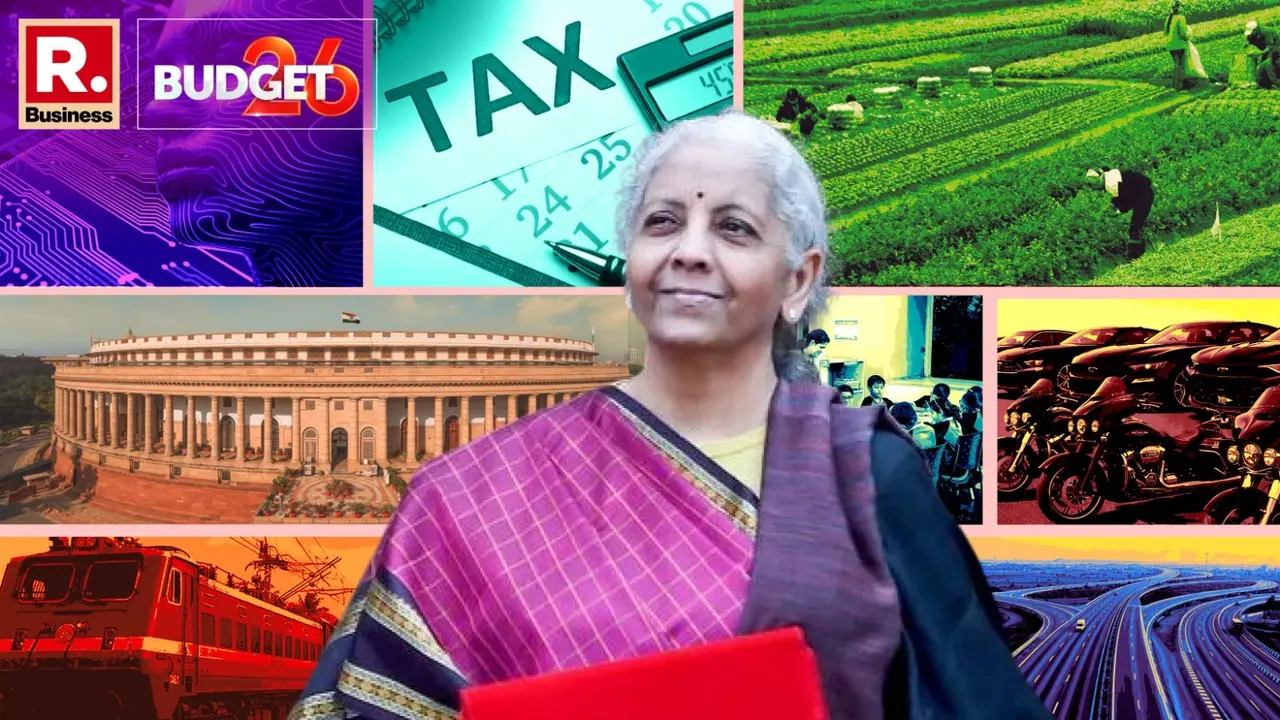
New Delhi: Union Finance Minister Nirmala Sitharaman presented her ninth consecutive Budget on Sunday, February 1, where she made several key announcements while charting out the comprehensive financial roadmap for the country.
Declaring important aspects of the government's economic agenda, the Finance Minister said, "We have ensured that citizens benefit from every action of the Government, undertaking reforms to support employment generation, agricultural productivity, household purchasing power and universal services to people."
Three Kartavyas
Sitharaman began her speech by charting out the three 'Kartavyas' of the Budget, including sustainable economic growth, resilience towards global dynamics, and contributing to the prosperity of people.
Capex Hike
The FM proposed to increase the government capital expenditure to Rs 12.2 lakh crore for FY27 from Rs 11.2 lakh crore in FY26.
Advertisement
"We shall continue to focus on developing infrastructure in cities with over 5 lakh population, that is, tier 2, tier 3 cities, which have expanded to become growth centres. Public capital expenditure has increased manifold from Rs 2 lakh crore in 2014-15 to an all-occupation of Rs 11.2 lakh crore in BE 25-26. In this coming year, that is, the financial year 2026-27, I propose to increase it to Rs 12.2 lakh crores to continue the momentum,” announced the Finance Minister.
Fiscal Deficit
The Budget estimate of the fiscal deficit for FY 2027 has been announced to be 4.3% of GDP, while the revised estimate for FY26 stands at 4.4%.
Advertisement
“In RE 2025-26, the fiscal deficit has been estimated at par with the BE (Budget estimates) of 2025-26 at 4.4% of GDP. In line with the new fiscal prudence path of debt consolidation, the fiscal deficit in BE 2026-27 is estimated to be 4.3% of GDP,” the Finance Minister said.
Manufacturing Push
Biopharma: The FM proposed 10,000 crore for the biopharma manufacturing sector and announced the expansion of Ayurveda institutions to meet growing global demand for traditional medicine.
Semiconductor: She also announced the India Semiconductor Mission 2.0, which would focus on industry-led research, on setting up training centres for semiconductors with the aim of strengthening India’s semiconductor ecosystem and talent pipeline.
Electronic components: The Budget proposes increasing the Electronics Components Manufacturing Scheme outlay from Rs 22,999 crore to Rs 40,000 crore, alongside new initiatives such as ISM 2.0, rare earth corridors, and dedicated chemical parks.
MSME Support
In a boost to micro, small, and medium enterprises in the country, the Budget declared a Rs 10,000 crore SME growth fund to create champions among MSMEs.
"I also propose to top up the Self-Reliant India Fund set up in 2021 with 2000 crores to continue supporting micro enterprises and maintain their access to risk capital. Liquidity support with trends, more than seven lakh crore has been made available to MSMEs," the FM further said.
It was also announced that the government plans to link the Government e‑Marketplace with the Trade Receivables Discounting System for information sharing, giving MSME suppliers more transparency.
Initiatives for the textile sector
"For the labour-intensive textile sector, I propose an integrated programme with five sub-parts," the Fm said.
She suggested the National Fibre Scheme for self-reliance in natural fibres such as silk, wool and jute, man-made fibres, and new-age fibres, and the Textile Expansion and Employment Scheme to modernise traditional clusters with capital support for machinery, technology upgradation, and common testing and certification centres.
The National Handloom and Handicraft Programme, which aims to integrate and strengthen existing schemes and ensure targeted support for weavers and artisans, was also announced subsequently.
Next was the Text-ECON initiative announcement to globally promote competitive and sustainable textiles and apparel.
SAMARTH 2.0, with the aim to modernise and upgrade the textile skilling ecosystem through collaboration with industry and academic institutions, will also be prioritised, she added.
The finance minister also proposed to set up mega textile parks through a "challenge mode" selection process.
She announced the Mahatma Gandhi Gram Swaraj initiative, which is aimed at strengthening Khadi, handloom and handicrafts. "I also propose to launch the Mahatma Gandhi Gram Swaraj initiative to strengthen handloom and handicrafts. This will help in global market linkages and branding. It will streamline and support training, skilling, and quality processes in production. These measures will benefit our weavers, village industries, the One District, One Product (ODOP) initiative, and our rural youth," she said.
Transport developments
Amid major announcements in the transport sector, a Coastal Cargo Promotion Scheme will aim to raise the share of inland waterways and coastal shipping from 6 per cent to 12 per cent by 2047, the budget said.
It also proposed 7 high-speed rail corridors: Mumbai to Pune, Pune to Hyderabad, Hyderabad to Bengaluru, Hyderabad to Chennai, Chennai to Bengaluru, Delhi to Varanasi, and Varanasi to Siliguri. The plan to set up training institutes, such as Regional Centres of Excellence, to build skilled manpower for the sector, was also disclosed.
An allocation of Rs 5,000 crore has also been proposed for the development of City Economic Regions.
Medical tourism push
The Budget announced plans to establish five regional hubs in partnership with the private sector for medical tourism in the country. "To promote India as a medical tourism hub, I propose a scheme to support states to set up 5 regional hubs in the country," the finance minister said.
"These Hubs will serve as integrated healthcare complexes that combine medical, educational and research facilities. They will have AYUSH centres, medical value tourism facilitation centres and infrastructure for diagnostics, post-care and rehabilitation. These Hubs will provide diverse job opportunities for health professionals, including doctors and AHPs," she added.
Increase in Securities Transaction Tax
The Budget proposed increasing the Securities Transaction Tax (STT) on commodity futures from 0.02 per cent to 0.05 per cent.
"I propose to raise the STT on Futures to 0.05% from the present 0.02%. STT on options premium and exercise of options are both proposed to be raised to 0.15% from the present rate of 0.1% and 0.125%, respectively," the FM said.
No change in income tax slabs
Nirmala Sitharaman proposed extending the time limit for filing revised income-tax returns from December 31 to March 31, allowing taxpayers to revise returns on payment of a nominal fee.
She also announced that there would be no changes to the existing income tax slabs for FY 2026-27. The current rates and structure under the new tax regime remain unchanged for individual taxpayers. The new Income Tax Act, 2025, will come into effect from April 1.
Custom duty relief
Nirmala Sitharaman announced a reduction in customs duty on dutiable goods imported for personal use. The tariff rate has been cut from the existing 20% to 10%, aimed at rationalising the customs duty structure and easing the burden on individual importers.
She also declared the extension of basic customs duty exemption on capital goods used for manufacturing lithium-ion cells to include those used for battery energy storage systems, and proposed exempting basic customs duty on sodium antimonate imports used in the manufacturing of solar glass, boosting clean energy manufacturing.
Increased investment limit for NRI
The government has reduced TCS on overseas tour packages to 2%, down from earlier rates of 5% and 20%, with no minimum amount condition, lowering the upfront tax burden on foreign travel.
Under the Liberalised Remittance Scheme (LRS), TCS for education and medical expenses abroad has also been cut from 5% to 2%, easing remittances for students and patients.
The investment limit for NRIs has also been increased from 5% to 10%, and the overall investment limit has been increased to 24% from 10%.
This was the first Budget in India's fiscal history to be presented on a Sunday, and the speech lasted for one hour and 25 minutes.