
Can The Global Economy Absorb $150 Oil Shock?
In a scenario where the Strait of Hormuz continues to remain largely closed, Investment Strategist Lyn Alden that poor nations are consistently outbid for scarce energy by wealthier ones.
- Republic Business
- 3 min read

;'%3e%3cpath%20d='m8,15.99c4.41,0,7.99-3.58,7.99-7.99S12.41,0,8,0,0,3.59,0,8s3.58,7.99,7.99,7.99Z'%20style='stroke:%23fff;%20stroke-miterlimit:10;%20stroke-width:.02px;'/%3e%3cpath%20d='m3.08,3.37l3.82,5.11-3.84,4.15h.87l3.37-3.64,2.72,3.64h2.94l-4.04-5.39,3.58-3.87h-.86l-3.1,3.35-2.5-3.35h-2.94Zm1.27.64h1.35l5.97,7.99h-1.35l-5.97-7.99Z'%20style='fill:%23fff;'/%3e%3c/g%3e%3c/svg%3e)


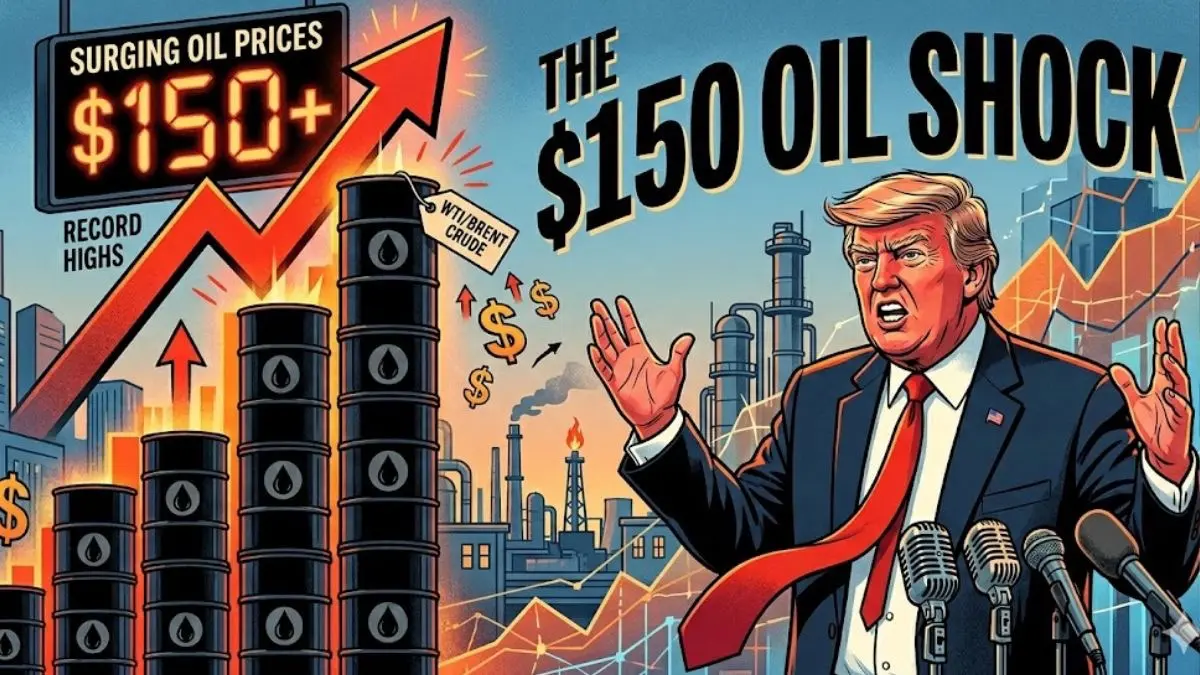
Amid the constant surging tendency in oil prices, and the adverse toll its already taken across several nations, including India, investment strategist Lyn Alden on the Macro Voices podcast noted that the current economy is resilient enough to absorb oil in the $150 range.
Historically, oil prices well above $100 per barrel have been damaging to the global economy, though these nominal figures must be inflation-adjusted to compare meaningfully across decades.
Alden noted that the current economy is resilient enough to absorb oil in the $150 range.
"It would be painful and require adjustment, but not catastrophic. The key distinction is whether prices approach new inflation-adjusted all-time highs," she said.
Advertisement

Meanwhile, Brent oil prices are set to witness their biggest surge on record since inception in 1988. The Brent crude futures with May delivery surged 0.19% recently. During the same period, the US West Texas Intermediate (WTI) futures with May delivery rose 3.25%, to settle at $102.88.
As of 3:42 PM on Tuesday, the WTI crude oil prices stood 1.13% at Rs 104.3 per barrel, while the cost of Brent crude oil prices stood 1.92% higher at Rs 115 per barrel.
Advertisement
How Are Global Economies Reacting To Surging Oil Prices?
China: The East Asian country has over the years built strong oil reserves, nearly 9000 million barrels, making it the world's largest oil reserves. Meanwhile, the Chinese administration has reportedly ordered its oil refineries to halt exporting fuel.
India: The Ministry of Petroleum and Natural Gas (MoPNG) recently noted that the South Asian nation has oil reserves for the next 60 days, while advocating for stopping panic buying of LPG. The burden on India's import bill is higher given the Strait of Hormuz linked dependency on crude oil imports, and LPG and LNG, which transit through this vital chokepoint.
Egypt: Given its reliance on imported oil, Egypt introduced temporary measures to reduce fuel consumption and keep public finances in order. However, the second-largest economy in Africa has already tripled its natural gas import bill, forcing rolling power rationing and early business closures.
Australia: The schemes to reduce fuel consumption includes making public transport free, including Victoria's trains, buses, and trams. Tasmania's Transport Minister noted also that paid-for school buses will be free, helping commuters save A$20 (£10.40) a week.
US-Iran War: Key Global Drawbacks Due To Hormuz Closure
- If the Strait of Hormuz remains substantially closed, analysts Alden follows suggest prices of $200 or more per barrel become plausible, possibly probable. At that level, significant parts of the global economic system begin to break down.
- Younger workers, first-time homebuyers, and lower-to-middle income households are already squeezed by high mortgage rates, elevated home prices, rising insurance costs, and flat payroll growth.
- Poorer nations are consistently outbid for scarce energy by wealthier ones.