
Diwali Cheer for Buyers? Govt Mulls GST Cut on Cars and Two-Wheelers
The government is considering slashing GST on cars and two-wheelers from 28% to 18%, making entry-level cars like Maruti Alto, WagonR, and Tata Tiago, and two-wheelers like Hero Splendor and Honda Activa cheaper. Luxury cars may face higher taxes. The move could boost demand this festive season.
- Republic Business
- 4 min read

;'%3e%3cpath%20d='m8,15.99c4.41,0,7.99-3.58,7.99-7.99S12.41,0,8,0,0,3.59,0,8s3.58,7.99,7.99,7.99Z'%20style='stroke:%23fff;%20stroke-miterlimit:10;%20stroke-width:.02px;'/%3e%3cpath%20d='m3.08,3.37l3.82,5.11-3.84,4.15h.87l3.37-3.64,2.72,3.64h2.94l-4.04-5.39,3.58-3.87h-.86l-3.1,3.35-2.5-3.35h-2.94Zm1.27.64h1.35l5.97,7.99h-1.35l-5.97-7.99Z'%20style='fill:%23fff;'/%3e%3c/g%3e%3c/svg%3e)


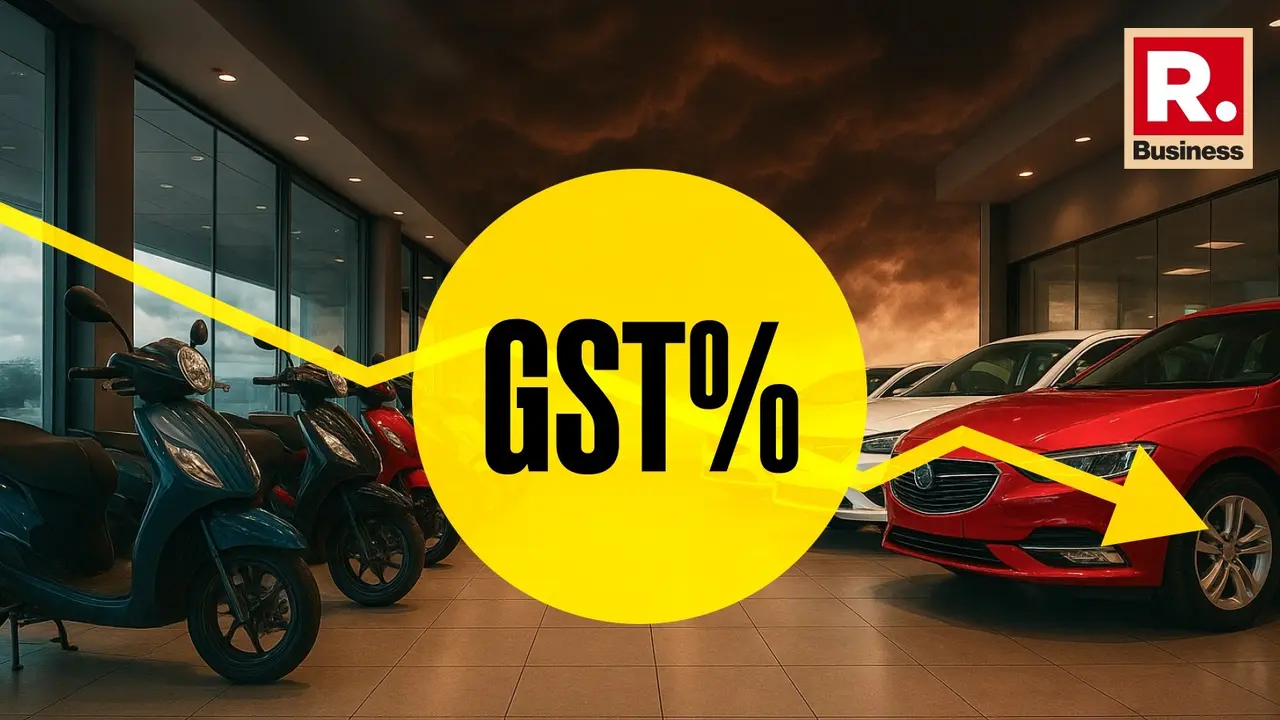
Consumers may get a festive surprise this Diwali, with the Union government considering a major cut in Goods and Services Tax (GST) on automobiles. According to officials familiar with the matter, the Centre is considering cutting GST on certain cars and two-wheelers from the current 28% to 18%—a move aimed at making vehicles more affordable and boosting mass-market sales.
The proposal forms part of a wider effort to rationalize India’s tax structure. Introduced in July 2017, GST currently operates across four slabs—5%, 12%, 18%, and 28%. Under the new plan, only the 5% and 18% categories may be retained, while the higher and intermediate slabs could gradually be phased out.
Who Stands to Gain?
If the change goes through, the biggest beneficiaries will be buyers of small cars and commuter two-wheelers, which together account for a large chunk of sales in India. Analysts suggest that the cost of entry-level cars could drop by about Rs 20,000–25,000, a meaningful relief for price-sensitive households. Premium and luxury vehicles, however, may not see such benefits, as they could be shifted to a new 40% tax bracket.
Advertisement
Impact on Buyers
Models that could become more affordable include popular hatchbacks and compact sedans such as the Maruti Alto K10, WagonR, Swift, Baleno, Dzire, Hyundai Grand i10 Nios, Tata Tiago, and Tigor. Compact SUVs like the Maruti Brezza, Hyundai Venue, Kia Sonet, and Tata Nexon may also see price cuts, further boosting demand in urban as well as rural markets.
“If implemented without additional levies, the proposed GST cut should meaningfully lift demand for entry-level models by improving affordability, particularly in small hatches and compact SUVs,” said Ravi Bhatia, MD of JATO Dynamics India. “The bigger near-term risk, however, is the lack of clarity from the government, which could prompt buyers to delay purchases until there is firm guidance. This uncertainty may soften sales trends over the next couple of months.”
Advertisement
Two-wheelers, especially commuter-focused models, could also see sharper demand in rural and semi-urban markets. “The segments best placed to benefit are small cars and CNG variants, given their price sensitivity and importance in mass mobility,” Bhatia added. “Lower taxes could also be a catalyst for first-time purchases, especially among younger buyers and rural households, where affordability has been a key constraint.”
Revenue Concerns
The flip side of the proposal is a potential short-term hit to government revenues. Passenger vehicles currently generate $14–15 billion in GST annually, while the two-wheeler segment contributes another $5 billion, according to HSBC Global Investment Research. However, industry watchers believe that increased demand and higher volumes could eventually make up for this dip by spurring consumption, manufacturing, and employment.
“A GST cut from 28% to 18% on cars and two-wheelers could be the single biggest festive booster for the auto sector in years,” stated Nikhil Dhaka, Vice President at Primus Partners. “For mass-market buyers, the impact is immediate—an entry-level hatchback or compact sedan could become cheaper by Rs 40,000–60,000, while a mid-size SUV like the Hyundai Creta could see savings upwards of Rs 1.5 lakh. The larger story is about unlocking pent-up demand at the bottom and middle of the pyramid, which in turn supports volumes, localisation, and jobs across the automotive value chain.”
Automakers in Focus
Among carmakers, Maruti Suzuki is expected to be the biggest beneficiary, given its dominance in the small-car segment with models such as the Alto K10, Celerio, WagonR, Swift, Baleno, and Dzire. Hyundai Motor India and Tata Motors could also gain significantly due to their strong line-up of sub-4 metre cars and SUVs.
In the two-wheeler segment, industry leaders like Hero MotoCorp, Honda Motorcycle & Scooter India, TVS Motor Company, and Bajaj Auto would be the prime winners, thanks to their extensive commuter-focused portfolios that dominate Indian roads.
Current GST Structure
At present, GST rates vary widely depending on vehicle type. EVs attract just 5%, while two-wheelers up to 350cc and small cars are taxed at 28% plus cess. Larger cars and SUVs face the heaviest burden, with total levies ranging between 45% and 50%.
Bottomline
If the GST cut goes through, this Diwali could prove to be a game-changer for India’s auto sector. While the government weighs revenue against growth, carmakers and buyers alike are optimistic that lower tax rates will make vehicles more affordable for millions of families, sparking fresh demand nationwide, as per auto industry observers.