
INDIA-EU Trade Deal on January 27? Von der Leyen Says Pact Will Exclude Farming
A forthcoming trade agreement between the European Union and India will exclude agriculture, European Commission President Ursula von der Leyen has said, underscoring the political sensitivity surrounding farm sectors on both sides. While the carve-out narrows the scope of the deal, EU officials say the agreement would still mark a significant step forward in bilateral trade ties, covering a wide range of goods, services, and investment provisions.
- Republic Business
- 2 min read

;'%3e%3cpath%20d='m8,15.99c4.41,0,7.99-3.58,7.99-7.99S12.41,0,8,0,0,3.59,0,8s3.58,7.99,7.99,7.99Z'%20style='stroke:%23fff;%20stroke-miterlimit:10;%20stroke-width:.02px;'/%3e%3cpath%20d='m3.08,3.37l3.82,5.11-3.84,4.15h.87l3.37-3.64,2.72,3.64h2.94l-4.04-5.39,3.58-3.87h-.86l-3.1,3.35-2.5-3.35h-2.94Zm1.27.64h1.35l5.97,7.99h-1.35l-5.97-7.99Z'%20style='fill:%23fff;'/%3e%3c/g%3e%3c/svg%3e)


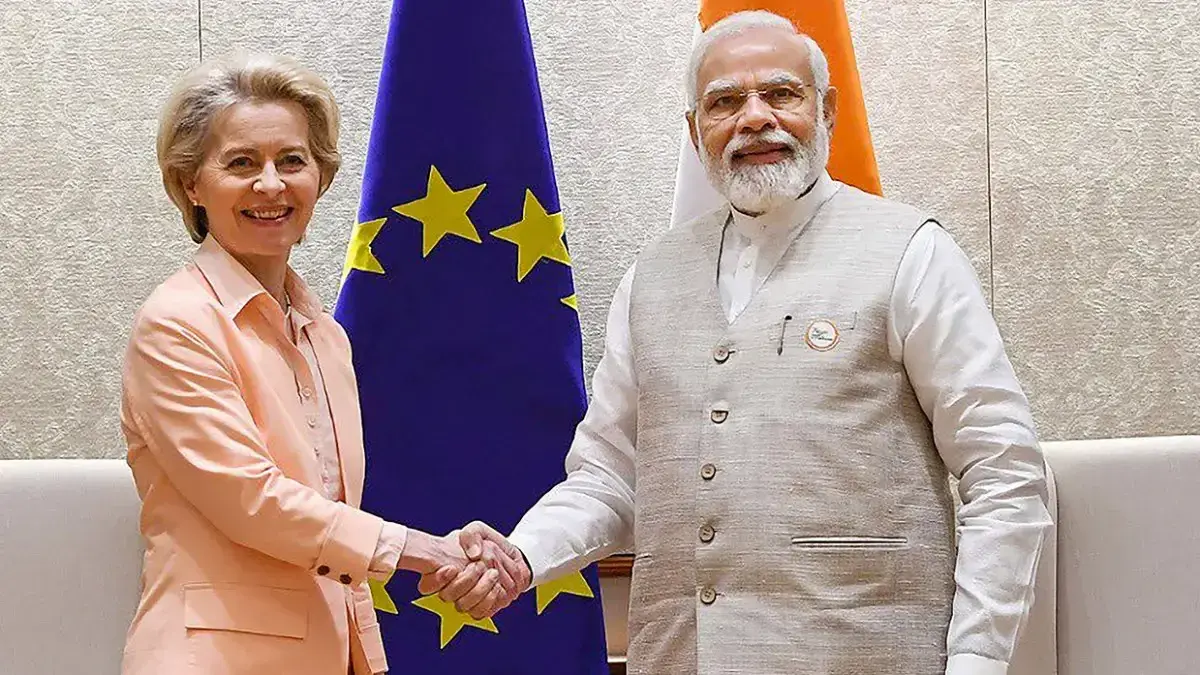
The European Union’s long-negotiated trade agreement with India will move forward without agriculture, European Commission President Ursula von der Leyen has said, confirming that one of the most contentious sectors has been left out of the final package, according to a report by Euractiv.
Von der Leyen made the remarks while addressing members of the European Parliament, saying the agreement is being concluded “without agriculture,” reflecting the political and economic sensitivities attached to the sector in both India and the EU.
The trade deal is expected to be formally concluded around a high-level EU-India summit in New Delhi on January 27. The summit will bring together European Council President António Costa, European Commission President Ursula von der Leyen, and Prime Minister Narendra Modi. They will also be the chief guests for the Republic Day celebrations. While officials have not formally confirmed whether the trade deal will be signed at the summit, the meeting is seen as a key moment in efforts to conclude negotiations.
Commerce Secretary Rajesh Agrawal revealed on Thursday that as many as 20 out of 24 chapters of the pact have been officially closed.
Advertisement
Why Was Agriculture Left Out?
Agriculture has long been a red line in EU-India negotiations. In India, farming employs a significant share of the population and remains politically sensitive, with successive governments resisting market openings that could expose farmers to foreign competition.
Advertisement
On the European side, agricultural trade is also tightly regulated, shaped by subsidy regimes, food safety standards, and strong domestic farm lobbies. These factors have made reciprocal concessions difficult, leading negotiators to ring-fence the sector from the current deal.
The Deals Expected To Cover
Despite the exclusion, the agreement is expected to span a broad range of areas, including:
- Trade in non-agricultural goods
- Services and investment
- Regulatory cooperation
- Market access for industrial products
EU officials have indicated that, even without agriculture, the pact would rank among the bloc’s most significant trade agreements due to the size and growth trajectory of the Indian economy.
For the EU, closer trade relations with India are part of a broader effort to diversify partnerships beyond traditional markets. For India, the agreement aligns with its push to expand exports and attract investment, while maintaining protections for sensitive domestic sectors.