
Explained: How the US Russian Oil Waiver Could Impact India’s Inflation, Rupee and Import Bill
The US has granted a 30-day waiver allowing Indian refiners to process Russian crude already in transit, unlocking about 20 million barrels of oil. The move may help stabilise energy prices, support the rupee and limit pressure on India’s import bill as global oil markets face disruption from the Hormuz crisis.
- Republic Business
- 3 min read

;'%3e%3cpath%20d='m8,15.99c4.41,0,7.99-3.58,7.99-7.99S12.41,0,8,0,0,3.59,0,8s3.58,7.99,7.99,7.99Z'%20style='stroke:%23fff;%20stroke-miterlimit:10;%20stroke-width:.02px;'/%3e%3cpath%20d='m3.08,3.37l3.82,5.11-3.84,4.15h.87l3.37-3.64,2.72,3.64h2.94l-4.04-5.39,3.58-3.87h-.86l-3.1,3.35-2.5-3.35h-2.94Zm1.27.64h1.35l5.97,7.99h-1.35l-5.97-7.99Z'%20style='fill:%23fff;'/%3e%3c/g%3e%3c/svg%3e)


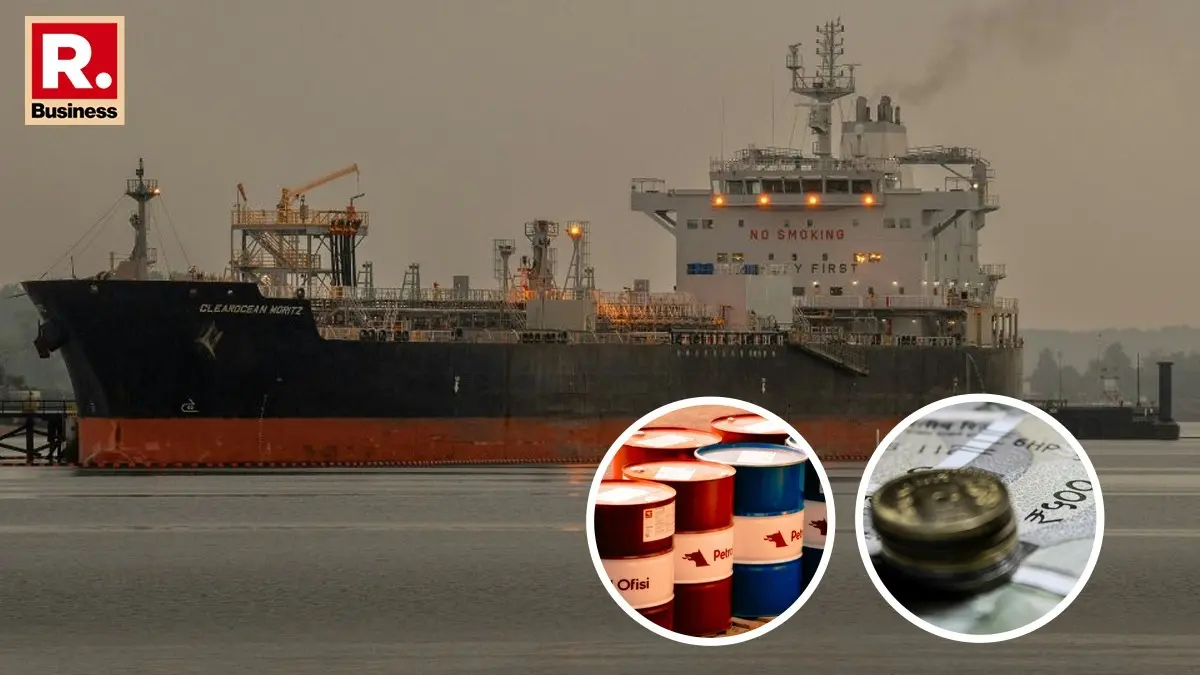
The United States has issued a temporary 30-day waiver allowing Indian refiners to purchase Russian crude oil already in transit, offering short-term relief to India’s energy supply and import costs amid escalating geopolitical tensions in West Asia.
The exemption, which was announced by Scott Bessent of the United States Department of the Treasury, will remain valid until April 4, 2026. It applies only to Russian crude shipments that were loaded on vessels as of March 5, 2026, which are currently stranded due to tightening sanctions and supply disruptions.
The policy decision comes at a time when global oil markets are under pressure following Iran’s move to block the Strait of Hormuz, through which nearly 20% of the world’s crude oil shipments normally pass.
The waiver could help India manage energy inflation, import costs, and currency stability, at least in the near term.
Advertisement
30-Day Window Unlocks 20 Million Barrels for Indian Refiners
Under the waiver, Indian refiners will be able to receive roughly 20 million barrels of Russian crude that had already been shipped before sanctions tightened.
State-run refiners expected to benefit include:
Advertisement
- Indian Oil Corporation
- Bharat Petroleum Corporation Limited
- Hindustan Petroleum Corporation Limited
The cargoes were previously at risk of being stranded at sea, forcing refiners to turn to higher-priced spot purchases from alternative suppliers. For India, which imports around 88% of its crude oil requirements, securing these shipments could significantly reduce short-term supply risks.
Oil Price Relief After 15% Weekly Surge
Global oil prices have been extremely volatile over the past week. Benchmark Brent crude oil had surged nearly 15% during the past week, driven by fears that disruptions near Hormuz could remove millions of barrels of daily supply from global markets.
Following the waiver announcement, Brent prices fell about 1–2%, providing temporary relief to energy-importing economies such as India. Even a $10 rise in crude oil prices can increase India’s annual import bill by $15–$17 billion, according to economists.
Higher crude oil prices typically translate into increased fuel and transportation costs across the economy.
India currently holds about 50 days of petroleum reserves, including:
- 25 days of crude oil reserves
- 25 days of refined fuels such as petrol and diesel
With the additional Russian cargoes now expected to reach Indian ports, officials say there are no immediate plans to raise retail petrol or diesel prices, which could help contain inflation pressures in the near term.
Oil prices are a key driver of India’s external balance. Economists have warned that if Brent crude crosses $90 per barrel, India’s current account deficit (CAD) could widen to around 1.4% of GDP. Such a scenario could also weaken the Indian currency, potentially pushing the rupee toward ₹95 per US dollar.
By allowing Indian refiners to access discounted Russian crude instead of expensive spot cargoes, the waiver could help limit the pressure on both the trade deficit and the rupee.
Energy Diplomacy and Shift Toward US Supplies
While the waiver provides short-term relief, the US has indicated that it expects India to gradually diversify its energy imports. Officials have signalled that India may need to increase purchases of US crude oil as part of a broader energy and trade framework linked to the U.S.–India Interim Trade Agreement.
The shift could gradually reduce India’s reliance on Russian supplies, which expanded significantly after 2022 due to discounted pricing. The 30-day waiver until April 4 addresses the immediate supply disruption but does not eliminate the structural risks facing global oil markets.
With 88% import dependence, 40% of shipments typically moving through Hormuz, and oil prices still above $80 per barrel, India remains highly exposed to geopolitical shocks in the region.