
Explainer: Why the Federal Reserve Cut Rates for the First Time in 2025
The Federal Reserve cut its key interest rate by a quarter-point, shifting its focus from inflation to a weakening job market. Chair Jerome Powell cited rising risks to employment as the key driver, while internal divisions and political tensions added layers of uncertainty to the Fed’s path ahead.
- Republic Business
- 4 min read

;'%3e%3cpath%20d='m8,15.99c4.41,0,7.99-3.58,7.99-7.99S12.41,0,8,0,0,3.59,0,8s3.58,7.99,7.99,7.99Z'%20style='stroke:%23fff;%20stroke-miterlimit:10;%20stroke-width:.02px;'/%3e%3cpath%20d='m3.08,3.37l3.82,5.11-3.84,4.15h.87l3.37-3.64,2.72,3.64h2.94l-4.04-5.39,3.58-3.87h-.86l-3.1,3.35-2.5-3.35h-2.94Zm1.27.64h1.35l5.97,7.99h-1.35l-5.97-7.99Z'%20style='fill:%23fff;'/%3e%3c/g%3e%3c/svg%3e)


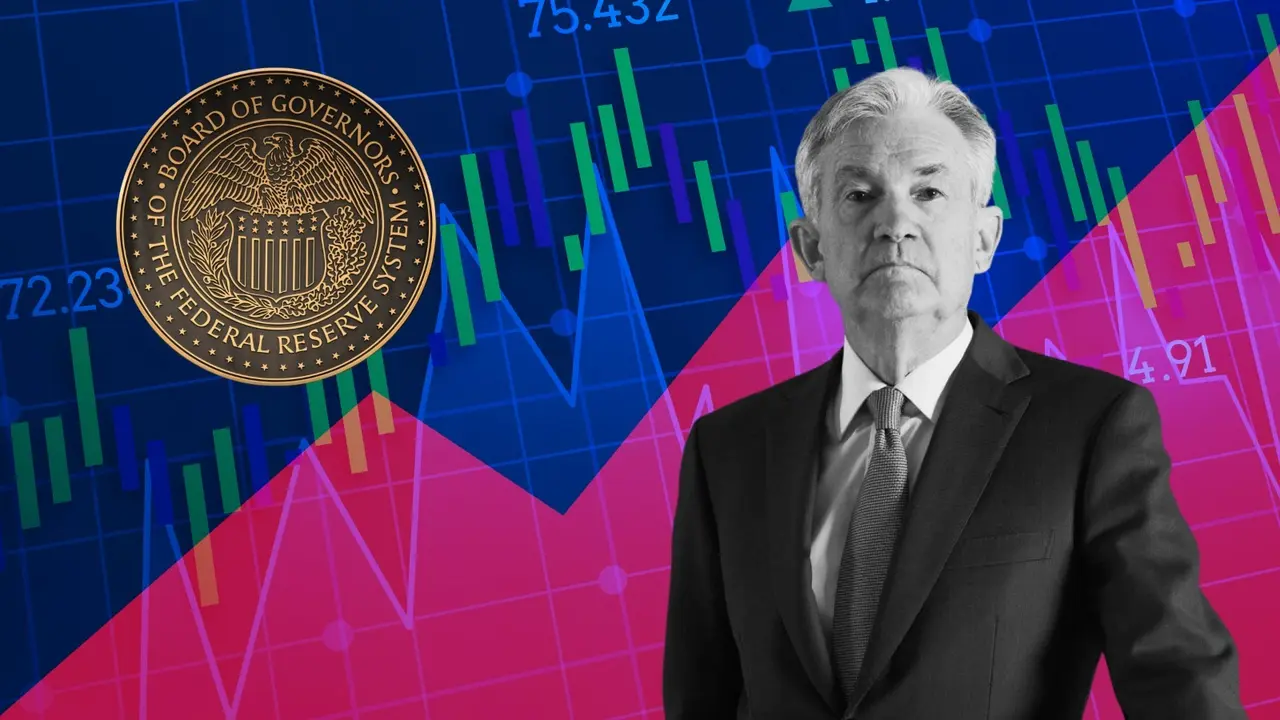
The Federal Reserve cut its key interest rate by a quarter-point on Wednesday, marking its first reduction of 2025. The move lowered the central bank’s benchmark rate to about 4.1% from 4.3%, and policymakers projected two more cuts before year’s end.
The decision reflects a significant shift in the Fed’s priorities, as Chair Jerome Powell and his colleagues now place greater weight on a cooling labor market than on inflation, which remains above the central bank’s 2% target.
Why the Fed Shifted Focus: Jobs VS Inflation
For much of this year, Powell and the Federal Open Market Committee (FOMC) resisted adjusting rates, weighing the impact of tariffs, tighter immigration enforcement, and other Trump administration policies. But the Fed’s concern has pivoted toward hiring, which has slowed almost to a halt in recent months.
“It’s really the risks that we’re seeing to the labor market that were the focus of today’s decision,” Powell said at a press conference following the Fed’s two-day meeting.
Advertisement
While inflation rose to 2.9% in August, slightly above July’s 2.7%, the uptick did not deter the Fed from cutting. Instead, Powell emphasized that weaker hiring presented a more immediate risk to the U.S. economy.
Impact of Lower Rates
Lower interest rates directly reduce borrowing costs on mortgages, auto loans, and business loans, potentially stimulating consumer demand and corporate investment. By cutting rates, the Fed hopes to encourage growth and stabilise hiring.
Advertisement
Yet Powell cautioned against expecting an aggressive cutting cycle. “There are no risk-free paths now,” he said. “It’s not incredibly obvious what to do.”
Investors Wanted More, Fed Stayed Cautious
Investors on Wall Street had anticipated up to five cuts this year and next. Instead, the Fed signalled just two more for 2025 and only one in 2026.
Powell explained that the projections should be read as “probability” rather than “certainty,” noting that the committee was split almost evenly between one or two additional cuts.
Matt Luzzetti, chief U.S. economist at Deutsche Bank, described Powell’s stance: “They wanted to be noncommital, wanted to be careful, and wanted to be data dependent and keep all their options open for future policy.”
Internal Divisions Within the Fed
The FOMC decision was not unanimous. Only one policymaker dissented, Stephen Miran, a recent Trump appointee confirmed by the Senate just hours before the meeting. Miran pushed for a larger half-point cut, but Powell said there wasn’t “very much support” for that move among other Fed officials.
Behind the headline decision, however, lies considerable disagreement. Out of 19 policymakers:
- Seven opposed any further cuts this year.
- Two supported just one more.
- Ten favored at least two more.
- One, likely Miran, argued for several large cuts to bring rates down to 2.9% by year’s end.
Stocks React as Markets Digest Decision
The Fed’s cautious stance left markets mixed. The S&P 500 slipped 0.1% by the close of trading, while the Nasdaq also ended lower. The Dow Jones industrial average, however, climbed 0.5%.
Investors’ disappointment reflected expectations of a more aggressive easing path that did not materialize.
Politics and Fed Independence Under Strain
The decision also played out against a politically charged backdrop. Trump’s appointment of Miran and his administration’s attempt to fire Fed Governor Lisa Cook have raised questions about the central bank’s independence.
Trump’s move to oust Cook, the first attempt in the Fed’s 112-year history to remove a governor, has been blocked by the courts. Both a lower court and an appeals court ruled that the firing violated due process.
Meanwhile, Trump has continued to criticize the Fed for not cutting more aggressively. “They should listen to smart people like me,” he said Tuesday, calling for rates to be slashed by three full percentage points.
Powell, however, pushed back: “I don’t believe we’ll ever get to that place. We’re doing our work exactly as we always have now.”
An Unusual Economic Mix
The Fed faces an unusual combination: slowing job growth alongside elevated inflation. Typically, weaker hiring cools consumer spending and tempers price hikes. But tariffs and policy shifts have complicated the equation.
Powell acknowledged the difficulty of striking a balance. “There are no risk-free paths now,” he reiterated.
A Global Contrast
The Fed’s move contrasts with other major central banks. The European Central Bank left its benchmark rate unchanged last week, citing cooling inflation and limited damage from U.S. tariffs. Similarly, the Bank of England is expected to hold its rate steady on Friday, with U.K. inflation still higher than in the U.S.
The Road Ahead
Looking forward, the Fed has left its options open, stressing a data-driven approach. The split among policymakers and Powell’s cautious tone indicate that rate decisions in the months ahead will hinge on incoming labour market and inflation data.
For now, the Fed’s first cut of 2025 highlights a critical turning point: a central bank that, under political scrutiny and economic uncertainty, is prioritising jobs over inflation risks.
(With Inputs From AP)