
Gold to Soar, Markets to Plunge: The Price of Donald Trump’s Trade War!
The tariffs imposed by Donald Trump on India and other countries aim to address US trade imbalances, also factor in elements like currency manipulation.
- Republic Business
- 3 min read

;'%3e%3cpath%20d='m8,15.99c4.41,0,7.99-3.58,7.99-7.99S12.41,0,8,0,0,3.59,0,8s3.58,7.99,7.99,7.99Z'%20style='stroke:%23fff;%20stroke-miterlimit:10;%20stroke-width:.02px;'/%3e%3cpath%20d='m3.08,3.37l3.82,5.11-3.84,4.15h.87l3.37-3.64,2.72,3.64h2.94l-4.04-5.39,3.58-3.87h-.86l-3.1,3.35-2.5-3.35h-2.94Zm1.27.64h1.35l5.97,7.99h-1.35l-5.97-7.99Z'%20style='fill:%23fff;'/%3e%3c/g%3e%3c/svg%3e)


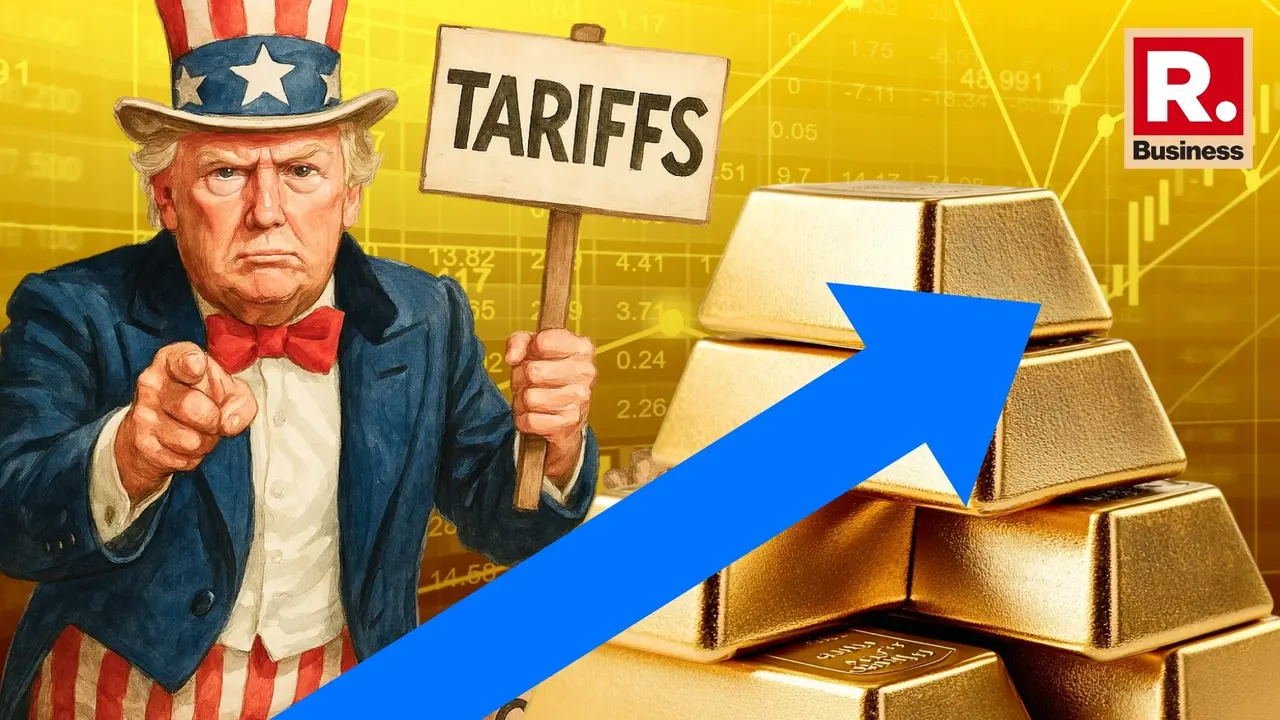
US President Donald Trump on Wednesday sent shockwaves through the global economy as he imposed a sweeping 26% tariff on imports from India, as part of a broader crackdown targeting over 180 countries and territories. The unprecedented move has raised concerns about the long-term impact on global trade dynamics, competitiveness, and economic stability. Rahul Ahluwalia, Founding Director of the Foundation of Economic Development, described the 26% tariff as "extremely high" and "much higher than most observers were expecting," pointing to the Trump administration’s unique approach of calculating tariffs based on trade deficits rather than sector-specific measures. "It’s an across-the-board tariff, something people did not anticipate," he told Republic Business.
The tariffs, which aim to address US trade imbalances, also factor in elements like currency manipulation and non-tariff barriers. Ahluwalia noted, "They’ve looked at the trade deficit with each country, divided it by the total imports, and used that percentage as the tariff rate. It’s a novel approach—nobody’s ever done this before."
Winners and Losers in Global Trade
While India’s 26% tariff rate is daunting, some of its competitors face even harsher penalties. Nations like Vietnam and Cambodia have been hit with tariffs as high as 90%, potentially making India a more attractive destination for manufacturers. However, Ahluwalia cautioned that investors may hesitate due to the unpredictable nature of Trump’s policies. "Investors dislike uncertainty more than competitive pressures. If you can’t predict the environment for ten years, you won’t invest," he warned. The tariffs notably exempt sectors like pharmaceuticals, semiconductors, and steel, sparing India’s pharma industry from a feared blow. However, Ahluwalia highlighted potential ripple effects: "Our competitiveness remains unchanged, but countries like Mexico may become relatively more competitive."
Economic Fallout
Ahluwalia predicted volatility in the financial markets, including a likely depreciation of the rupee, an appreciating dollar, and rising gold prices as investors seek stability. "Historically stable assets will rise, and stock markets will likely drop," he stated. He also emphasized the urgent need for India to use this crisis as an opportunity for comprehensive economic reform. "Crises are fantastic opportunities for reform. We can reform capital markets, labor markets, agriculture, and land markets. Instead of protecting products, we should protect people through direct benefit transfers and social insurance," he urged.
A Looming Trade War?
As the global community grapples with the impact of Trump’s tariffs, fears of a full-blown trade war loom large. Ahluwalia noted, “It’s very likely. Countries like Canada and Brazil are already hinting at retaliatory measures. It would be great if this didn’t happen, but politics often prevails over sound economics.” India, meanwhile, is in the midst of negotiating a bilateral trade agreement with the US. Ahluwalia expressed optimism, saying, “If we can negotiate lower tariffs for India in exchange for concessions, it would be a win-win. Free trade benefits us more than protectionism.” The dust from Trump’s tariff blitz is far from settling, and the global economy braces for turbulent times. As Ahluwalia aptly put it, "Volatility and uncertainty are here to stay."