
Govt Weighs Higher GST Cess On Petrol, Diesel Cars; Relief Likely for CNG, Hybrid Vehicles
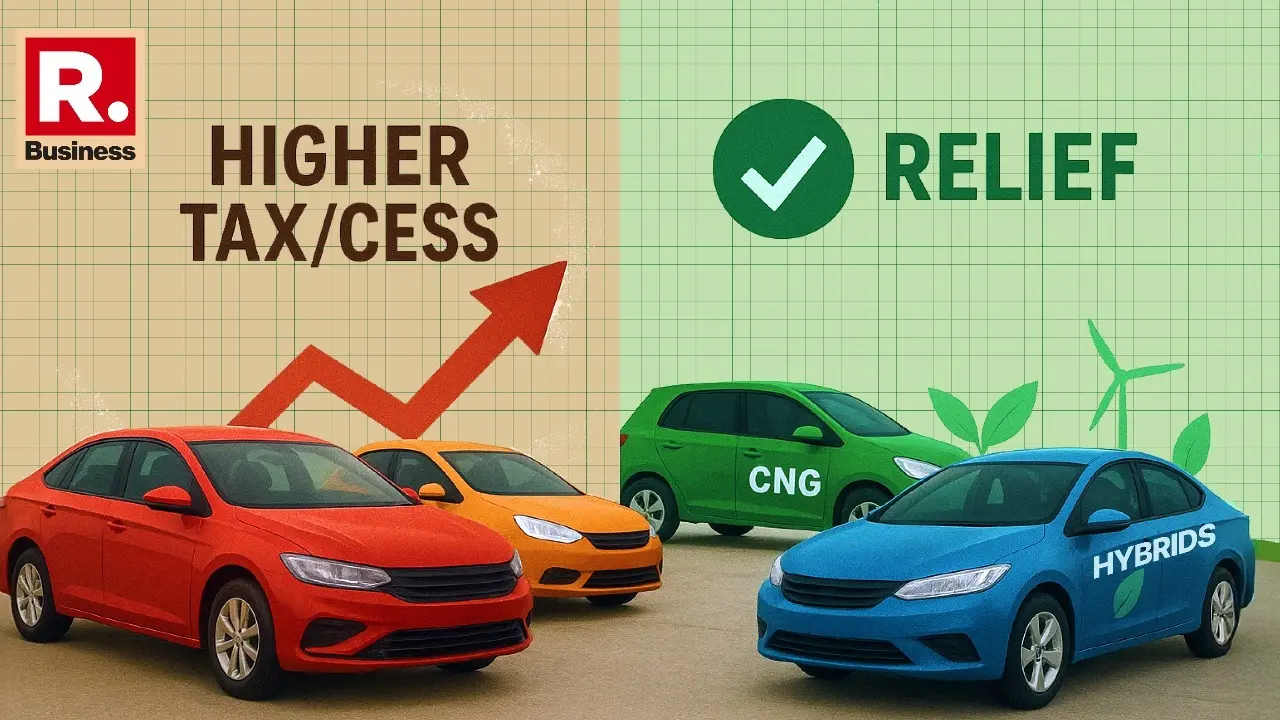
The government is considering higher GST cess on petrol and diesel cars, while hybrids, CNG vehicles, and 100–125 cc motorcycles may get relief. Luxury cars and sin goods could face 40% GST, as part of a broader GST overhaul to simplify slabs and promote cleaner mobility.
- Republic Business
- 3 min read

;'%3e%3cpath%20d='m8,15.99c4.41,0,7.99-3.58,7.99-7.99S12.41,0,8,0,0,3.59,0,8s3.58,7.99,7.99,7.99Z'%20style='stroke:%23fff;%20stroke-miterlimit:10;%20stroke-width:.02px;'/%3e%3cpath%20d='m3.08,3.37l3.82,5.11-3.84,4.15h.87l3.37-3.64,2.72,3.64h2.94l-4.04-5.39,3.58-3.87h-.86l-3.1,3.35-2.5-3.35h-2.94Zm1.27.64h1.35l5.97,7.99h-1.35l-5.97-7.99Z'%20style='fill:%23fff;'/%3e%3c/g%3e%3c/svg%3e)


The government is examining a major revamp of cess and tax rates under the Goods and Services Tax (GST) regime, with the twin aims of encouraging cleaner mobility and simplifying India’s indirect tax system, according to people aware of the matter.
Push for green mobility
Policy discussions underway suggest that small cars powered by petrol or diesel may attract a higher cess. By contrast, vehicles using hybrid technology or compressed natural gas (CNG) could benefit from lower levies, in line with the government’s climate goals.
“Petrol and diesel cars are likely to see an additional cess burden, while cleaner alternatives such as hybrids and CNG models may be incentivised,” a source familiar with the deliberations said. The proposal is yet to be placed formally before the GST Council.
Currently, passenger vehicles draw a 28% GST, on top of which a cess of 1% to 22% is charged depending on the engine size and fuel type. Any change in rates could significantly impact the small car segment, which remains the largest contributor to passenger vehicle sales in India.
Queries emailed to the GST Secretariat and the Ministry of Commerce and Industry remained unanswered until the time of publishing this story.
Relief for commuter motorcycles
The government is also weighing a reduction in GST for entry-level motorcycles. Saources have indicated that two-wheelers powered by petrol or CNG in the 100–125 cc range may see tax lowered from the existing 28% to 18%.
“A uniform 18% slab for mass-market bikes is under consideration, as part of broader efforts to streamline GST into fewer rate categories,” as per sources.
At present, two-wheelers under 350 cc are taxed at 28%, while larger-capacity bikes attract an effective rate of 31% due to an additional cess. Two-wheeler makers such as Hero MotoCorp, Bajaj Auto, etc., and industry associations have long argued that commuter motorcycles should not be treated as luxury products, given their role as essential transport for millions of households.
Advertisement
Luxury cars and sin goods under review
In another significant move, a panel of state finance ministers has also proposed a special 40% GST for high-end luxury cars. The same rate has been recommended for so-called “sin goods” including tobacco and related products. The suggestion is part of a broader plan to overhaul the GST structure, which currently consists of multiple slabs and is often criticised for being overly complex.
Advertisement
Industry reaction and next steps
Industry executives believe that while the new structure could ease the burden on small cars, hybrids, and two-wheelers, a steep tax on luxury vehicles would send a clear signal of progressive taxation.
“For mass-market vehicles, lower rates will improve affordability and support demand. For luxury cars, higher taxation is consistent with global practice,” an auto industry official stated requesting anonymity.
The GST Council is expected to take up the proposals ahead of Diwali as part of a broader “GST 2.0” package. Alongside auto-related changes, the package is also likely to rationalise slabs into two main categories—5% for essentials and 18% for standard goods—while applying special rates to luxury and harmful products.If cleared, the overhaul would mark one of the most sweeping tax reforms for the auto sector in recent years, balancing revenue needs with environmental and equity considerations.