
How US President Donald Trump’s Kharg Island Strategy Could Push Oil Past $120
US President Donald Trump publicly suggested taking over Iran's Kharg Island, the West Asian country's primary offshore oil export terminal, in the Persian Gulf,
- Republic Business
- 2 min read

;'%3e%3cpath%20d='m8,15.99c4.41,0,7.99-3.58,7.99-7.99S12.41,0,8,0,0,3.59,0,8s3.58,7.99,7.99,7.99Z'%20style='stroke:%23fff;%20stroke-miterlimit:10;%20stroke-width:.02px;'/%3e%3cpath%20d='m3.08,3.37l3.82,5.11-3.84,4.15h.87l3.37-3.64,2.72,3.64h2.94l-4.04-5.39,3.58-3.87h-.86l-3.1,3.35-2.5-3.35h-2.94Zm1.27.64h1.35l5.97,7.99h-1.35l-5.97-7.99Z'%20style='fill:%23fff;'/%3e%3c/g%3e%3c/svg%3e)


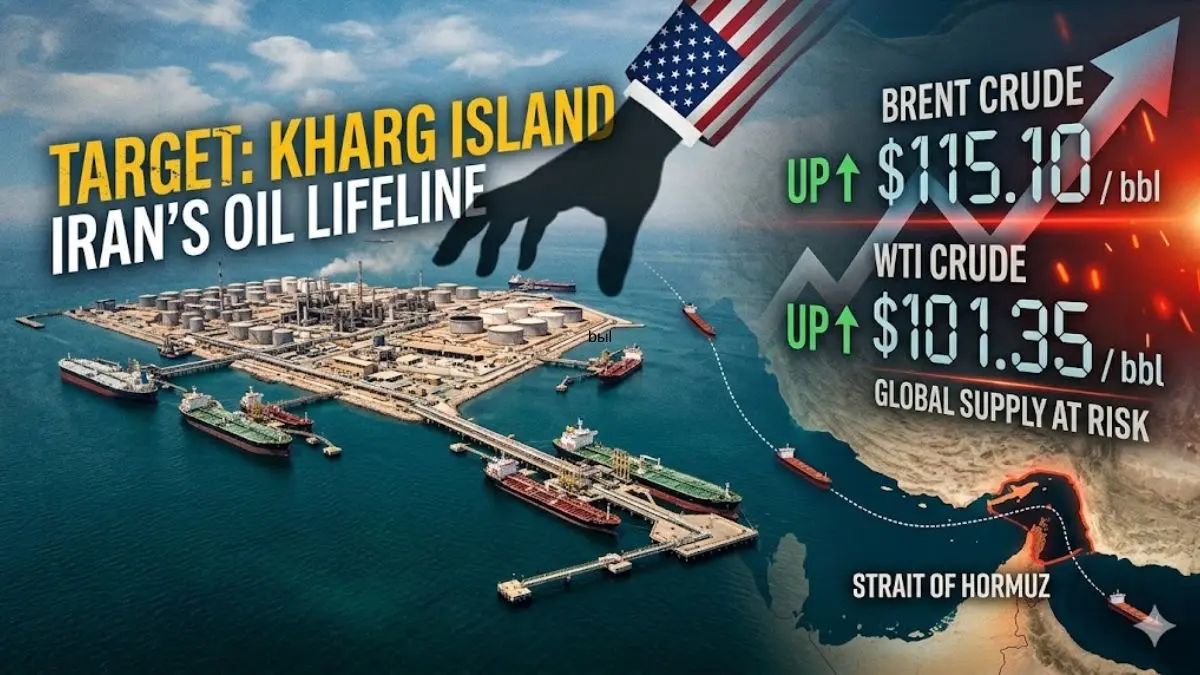
After US President Donald Trump publicly suggested taking over Iran's Kharg Island, the West Asian country's primary offshore oil export terminal, in the Persian Gulf, it raised concerns over further disruptions linked to global crude oil supply.
This comes after Trump noted that Iran agreed to permit 20 oil tankers to transit via the Strait of Hormuz with effect from March 30 as a gesture of goodwill.
In the backdrop of heightened oil and gas supply chain disruption caused by the US-Iran war, the energy markets would find themselves under intensified pressure if Trump seizes Iran's Kharg Island oil terminal.
US President Donald Trump said, “Maybe we take Kharg Island, maybe we don't,” whilst adding, “We have a lot of options," citing The Financial Times report.
Advertisement
Since the war began on February 28, Iran’s control over export infrastructure, combined with its influence over the Strait of Hormuz, a key chokepoint for transit of global oil and gas has already placed oil prices on boil.
Advertisement
Brent crude prices have increased sharply in recent weeks, with analysts indicating scenarios where oil rates could surge to $200 per barrel. At the time of writing this report, the Brent crude prices surged 2.15% to 114.99, while the WTI crude prices stood 1.57% higher at 101.20.
Meanwhile, Trump also suggested that a longer-term presence would be required if such an operation were pursued, saying it “would mean we had to be there for a while.”
An act of exalting tensions linked to Iran's Kharg Island would further restrict exports, tighten global supply, and increase oil prices.