
Here’s Why Donald Trump’s Factually Baseless and Unrealistic Oil Trade Remark With Terror State Pakistan a Diplomatically Reckless Provocation
Just hours after slapping 25% tariffs on Indian imports, Donald Trump claimed a new U.S.-Pakistan oil partnership might one day supply oil to India, ignoring the fact that India cut all trade ties with Islamabad over terror links. Here's what Trump said, and what he seems to have overlooked.
- Republic Business
- 5 min read

;'%3e%3cpath%20d='m8,15.99c4.41,0,7.99-3.58,7.99-7.99S12.41,0,8,0,0,3.59,0,8s3.58,7.99,7.99,7.99Z'%20style='stroke:%23fff;%20stroke-miterlimit:10;%20stroke-width:.02px;'/%3e%3cpath%20d='m3.08,3.37l3.82,5.11-3.84,4.15h.87l3.37-3.64,2.72,3.64h2.94l-4.04-5.39,3.58-3.87h-.86l-3.1,3.35-2.5-3.35h-2.94Zm1.27.64h1.35l5.97,7.99h-1.35l-5.97-7.99Z'%20style='fill:%23fff;'/%3e%3c/g%3e%3c/svg%3e)


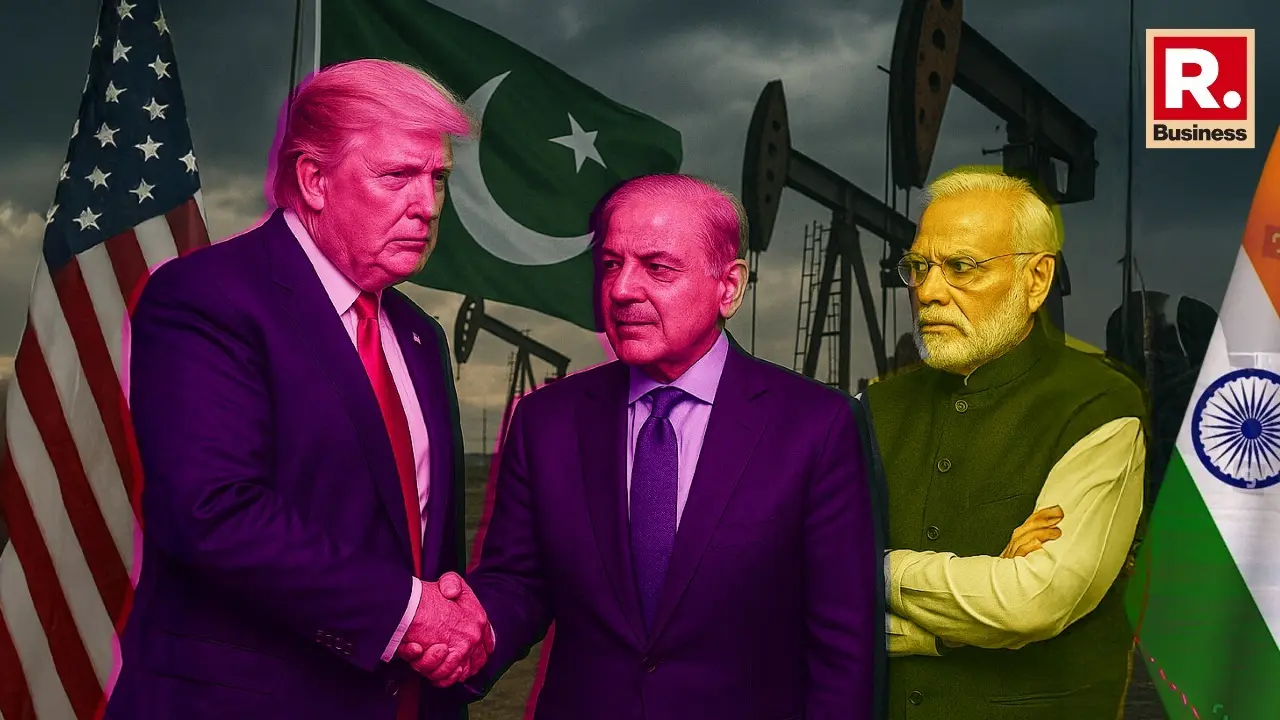
Hours after announcing a sharp 25 per cent tariff hike and additional penalties on Indian imports, US President Donald Trump on Wednesday (local time) claimed to have finalised a trade deal with Pakistan, focused on developing its "massive oil reserves."
In a social media post that stunned diplomatic observers, Trump even floated the idea that "maybe" Pakistan could sell that oil to India in the future.
“We have just concluded a Deal with the Country of Pakistan, whereby Pakistan and the United States will work together on developing their massive Oil Reserves. We are in the process of choosing the Oil Company that will lead this Partnership. Who knows, maybe they'll be selling Oil to India some day!" Trump wrote on Truth Social.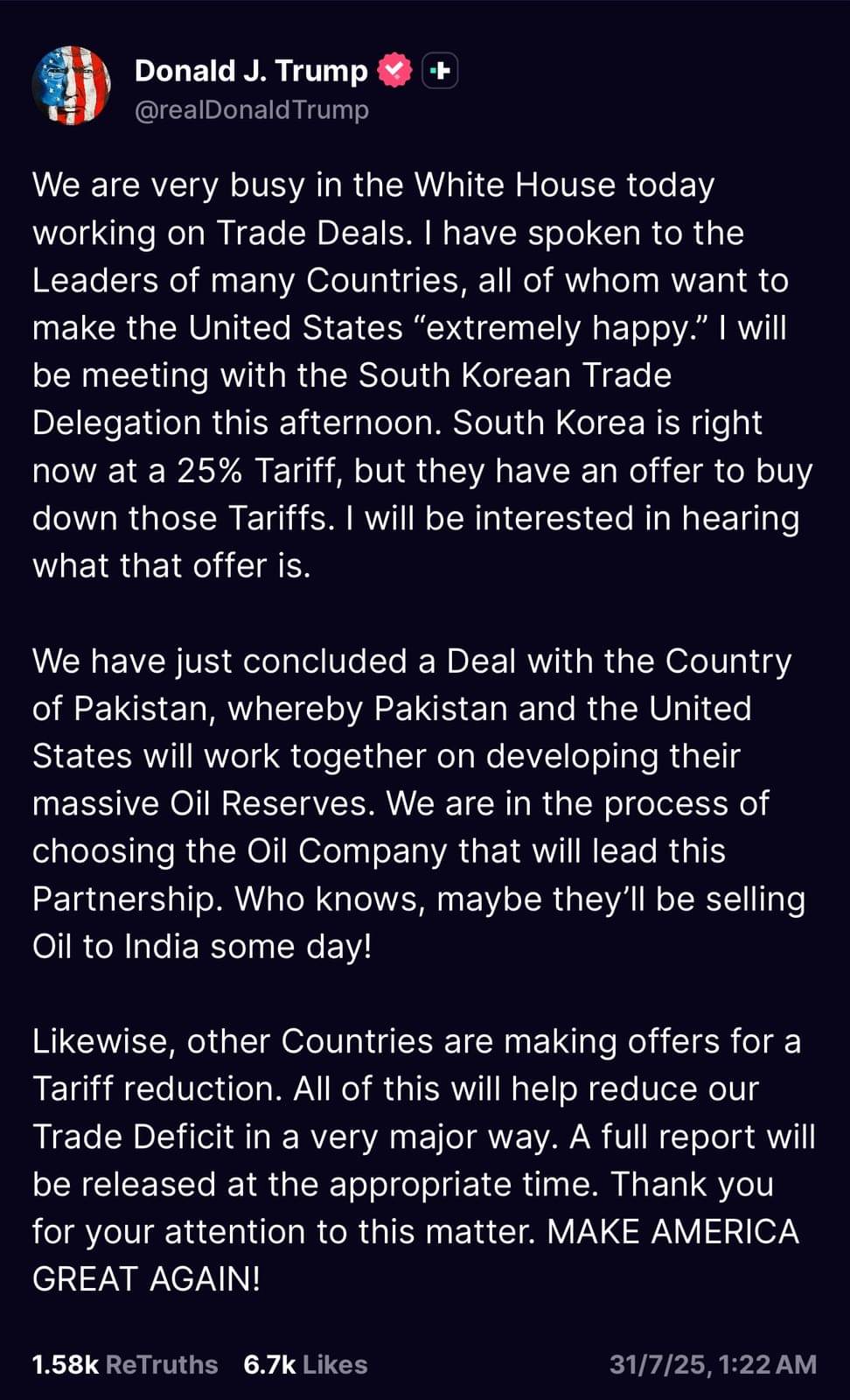
The announcement came in the wake of escalating trade tensions between the US and India, as Trump reinstated steep tariffs starting August 1, citing Washington’s rising trade deficit with New Delhi and its continued import of Russian oil.
But Trump’s offhand suggestion about India potentially buying oil from Pakistan overlooks a glaring geopolitical fact: India has completely snapped trade ties with Islamabad since 2019, citing Pakistan’s support for cross-border terrorism.
Trade Ties Severed After Pulwama Attack
India suspended all trade relations with Pakistan following the February 2019 Pulwama terror attack, which killed 40 Indian security personnel and was claimed by Pakistan-based terror outfit Jaish-e-Mohammed.
The Indian government responded by withdrawing Pakistan’s Most Favoured Nation (MFN) status and imposing a 200 per cent customs duty on goods from across the border.
By August 2019, Pakistan had also unilaterally downgraded diplomatic ties, suspended bilateral trade, and stopped all rail and bus services between the two countries, after India revoked Article 370 and reorganized Jammu and Kashmir.
Since then, formal trade between the two nuclear-armed neighbours has remained completely frozen, with both countries standing firm on their political positions. India has repeatedly stated that any resumption of trade would require a reversal of the hostile environment created by Pakistan’s continued support for terrorism.
Against this backdrop, Trump’s comment about potential oil sales from Pakistan to India appears not just uninformed, but diplomatically tone-deaf.
The US-Pakistan Deal: Vague but Strategic?
Trump’s post offered no further details on the oil development deal with Pakistan,such as the size of the reserves, investment figures, or project timelines. Nor did it clarify which US oil companies might be involved.
The Pakistani embassy in Washington had no immediate comment on the supposed agreement, according to a report by Reuters.
However, Pakistan’s Foreign Minister Ishaq Dar recently said the two countries were “very close” to finalising a trade deal, following a meeting with US Secretary of State Marco Rubio. Talks have reportedly covered not only hydrocarbons but also critical minerals and mining, key sectors in the global energy transition.
With China’s growing influence in the region and its own deep energy partnerships with Pakistan under CPEC (China-Pakistan Economic Corridor), the US may be trying to expand its economic footprint in Islamabad. Pakistan is already designated a "major non-NATO ally" by Washington.
India Hit by Trump Tariffs Amid Russia Oil Tensions
Trump’s remarks on Pakistan came the same day he targeted India with steep trade penalties. Announcing a 25 per cent tariff on all Indian goods starting Friday, Trump cited the trade imbalance and India’s continued purchase of Russian oil.
“We are very busy in the White House today working on Trade Deals. I have spoken to the Leaders of many Countries, all of whom want to make the United States ‘extremely happy,’” Trump said in another post.
“Likewise, other Countries are making offers for a Tariff reduction. All of this will help reduce our Trade Deficit in a very major way… MAKE AMERICA GREAT AGAIN!”
According to the U.S. Trade Representative’s website, the United States had a $45.7-billion goods trade deficit with India in 2024, making India the fifth-largest trade gap for the U.S. That figure has continued to rise amid strong Indian demand for energy imports, including crude from Russia.
Despite that, India remains a strategic partner for Washington in its Indo-Pacific framework, and the two democracies have been working toward a “fair, balanced, and mutually beneficial” bilateral trade agreement, according to India’s Ministry of Commerce.
Ceasefire Claims and Diplomatic Confusion
In a further twist, Trump also took credit for what he called a U.S.-brokered ceasefire between India and Pakistan earlier this year, after the two countries clashed following an April 22 terror attack in Kashmir. The White House had said both sides had been spoken to, and a ceasefire was declared on May 10.
India, however, has disputed Trump’s version of events, asserting that bilateral issues with Pakistan will be resolved directly and without foreign mediation.
Meanwhile, Pakistani officials praised Trump's and Rubio’s roles in “de-escalating tensions,” highlighting Islamabad’s willingness to court Washington as a key trade and security partner.
The Bigger Picture: Tariffs, Trade Wars, and Geopolitics
Trump’s strategy appears consistent: use tariffs to strong-arm countries into deals favorable to the US, while asserting leadership on global security issues. He claimed to have finalized or begun deal discussions with Britain, Vietnam, Japan, Indonesia, the Philippines, and the 27-member EU.
“Other countries are making offers for a tariff reduction. A full report will be released at the appropriate time,” he said.
However, his suggestion that India, a country that has cut all formal trade with Pakistan over state-sponsored terror, would buy oil from Islamabad in the foreseeable future appears detached from on-ground realities and potentially insensitive to Indian and diplomatic sentiment.
Advertisement
In pitching a "massive oil partnership" with Pakistan and hinting at future sales to India, Trump not only revealed scant understanding of the subcontinent's tense geopolitics but also managed to provoke concern on both sides. While the US may be deepening its engagement with Islamabad, India's red lines on terrorism remain non-negotiable.
(With Inputs From Reuters)