
India, EU Move to Deepen Strategic Partnership with New Security and Defence Framework
India and the European Union are set to elevate their partnership at the 16th India-EU Summit with a new Security and Defence Partnership, alongside progress on a free trade agreement and a broader strategic agenda. The move reflects a shift toward deeper cooperation on defense, trade, climate action, and global governance amid changing geopolitical realities.
- Republic Business
- 4 min read

;'%3e%3cpath%20d='m8,15.99c4.41,0,7.99-3.58,7.99-7.99S12.41,0,8,0,0,3.59,0,8s3.58,7.99,7.99,7.99Z'%20style='stroke:%23fff;%20stroke-miterlimit:10;%20stroke-width:.02px;'/%3e%3cpath%20d='m3.08,3.37l3.82,5.11-3.84,4.15h.87l3.37-3.64,2.72,3.64h2.94l-4.04-5.39,3.58-3.87h-.86l-3.1,3.35-2.5-3.35h-2.94Zm1.27.64h1.35l5.97,7.99h-1.35l-5.97-7.99Z'%20style='fill:%23fff;'/%3e%3c/g%3e%3c/svg%3e)


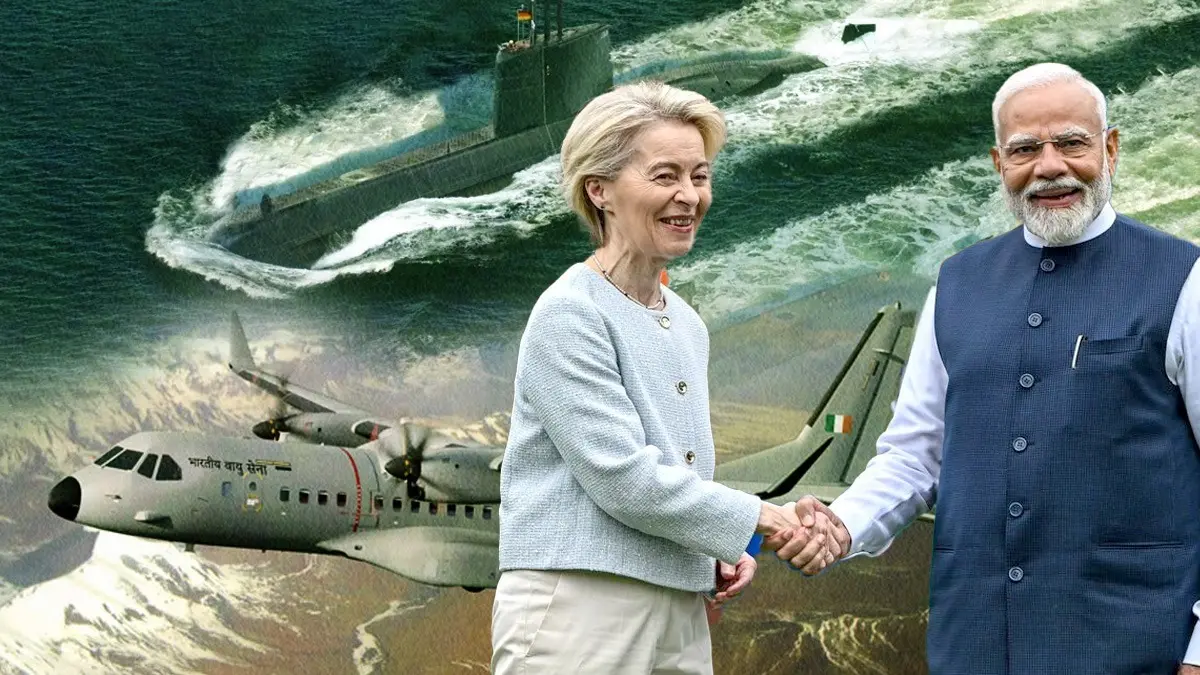
India and the European Union took a decisive step toward deepening their strategic partnership on Tuesday with the signing of a Defence and Maritime Security Partnership Agreement, signalling a sharper focus on security cooperation amid growing global instability and shared concerns across the Indo-Pacific and Europe. The agreement was signed by Defence Minister Rajnath Singh and EU High Representative for Foreign Affairs and Security Policy Kaja Kallas, alongside the 16th India–European Union Summit.
The India-EU strategic partnership was first formalized in 2004, but today’s summit is expected to mark one of its most consequential upgrades.
What the Defence and Security Pact Covers?
The newly signed partnership outlines a comprehensive framework for cooperation across traditional and emerging security challenges. According to official briefings, the agreement covers:
• Maritime security, including coordination in critical sea lanes
• Cybersecurity and cyber resilience
• Hybrid threats, including disinformation and non-traditional warfare
• Protection of critical infrastructure
• Counter-terrorism cooperation
• Combating organised crime
• United Nations peacekeeping operations
• Non-proliferation and disarmament
• Space security and defence cooperation
• Interoperability between Indian and European armed forces
The breadth of the agreement reflects the evolving nature of security threats and underlines a shared commitment to safeguarding the rules-based international order.
Advertisement
Institutionalising Defence Dialogue
A key feature of the partnership is the decision to institutionalise engagement through an annual Defence Dialogue, to be held at the level of Defence and Home Secretaries. Officials say this mechanism will help ensure regular coordination, faster response to emerging threats, and alignment on regional and global security priorities.
The structured dialogue is expected to complement existing military-to-military exchanges and joint naval engagements, particularly in the Indo-Pacific region.
Advertisement
Building on the momentum of the defence pact, India and the EU are also preparing to sign a Security of Information Agreement, which will establish formal protocols for intelligence sharing and handling of classified information. Officials see this as a critical enabler for deeper cooperation on counter-terrorism, cyber threats, and hybrid warfare.
The defence and maritime security partnership comes at a time when both India and the EU are reassessing their strategic posture in response to geopolitical tensions, supply-chain vulnerabilities, and security challenges across maritime domains.
For India, the agreement strengthens its engagement with European partners beyond trade, aligning with its broader push to diversify strategic relationships. For the EU, the partnership reflects a growing recognition of India’s role as a key security actor in the Indo-Pacific.
The pact also complements ongoing discussions at the summit on trade, technology, climate action, and defence industrial cooperation, reinforcing the ambition to elevate India-EU ties into a comprehensive strategic partnership.
High-Level Talks at the 16th India-EU Summit
Prime Minister Narendra Modi is holding restricted and delegation-level discussions with European Commission President Ursula von der Leyen and European Council President António Costa as part of the summit proceedings. The meeting is being co-chaired by the three leaders, underlining the political weight both sides are attaching to the engagement.
Alongside the leaders’ talks, an India-EU Business Forum is also being held, bringing together policymakers, industry leaders, and investors to align commercial priorities with the evolving strategic agenda.
Trade Remains the Backbone of the Relationship
Even as security cooperation gains prominence, trade and investment continue to anchor India-EU ties. The European Union is India’s largest trading partner in goods, with bilateral merchandise trade crossing $130 billion annually. Services trade adds significantly to this figure, driven by IT, business services, and professional mobility.
The EU is also among India’s top sources of foreign direct investment, with thousands of European companies operating across manufacturing, automobiles, renewable energy, pharmaceuticals and financial services in India.
FTA and Defence Framework to Advance in Parallel
In addition to security cooperation, the summit is expected to push forward the long-negotiated India-EU Free Trade Agreement (FTA), alongside a defence framework pact and a forward-looking strategic agenda.
Negotiations on the FTA, which were relaunched in 2022 after a long pause, aim to create one of the world’s largest free-trade arrangements, covering a combined market of nearly 2 billion people and roughly a quarter of global GDP. The agreement is expected to improve market access, reduce tariff and non-tariff barriers, and strengthen supply-chain integration.
Taken together, the FTA and defence framework reflect a deliberate effort to synchronise economic, strategic, and security interests rather than treat them as separate tracks.