
India Transitions To Energy Surplus With Non-Fossil Fuel Capacity At 50%, First G20 Country To Achieve Paris Agreement Goals: Piyush Goyal
Union Minister of Commerce and Industry Piyush Goyal highlighted the transformation of India’s energy sector over the past 11 years, stating that bold vision and relentless execution have shifted the country from power scarcity to surplus and sustainability
- Republic Business
- 3 min read

;'%3e%3cpath%20d='m8,15.99c4.41,0,7.99-3.58,7.99-7.99S12.41,0,8,0,0,3.59,0,8s3.58,7.99,7.99,7.99Z'%20style='stroke:%23fff;%20stroke-miterlimit:10;%20stroke-width:.02px;'/%3e%3cpath%20d='m3.08,3.37l3.82,5.11-3.84,4.15h.87l3.37-3.64,2.72,3.64h2.94l-4.04-5.39,3.58-3.87h-.86l-3.1,3.35-2.5-3.35h-2.94Zm1.27.64h1.35l5.97,7.99h-1.35l-5.97-7.99Z'%20style='fill:%23fff;'/%3e%3c/g%3e%3c/svg%3e)


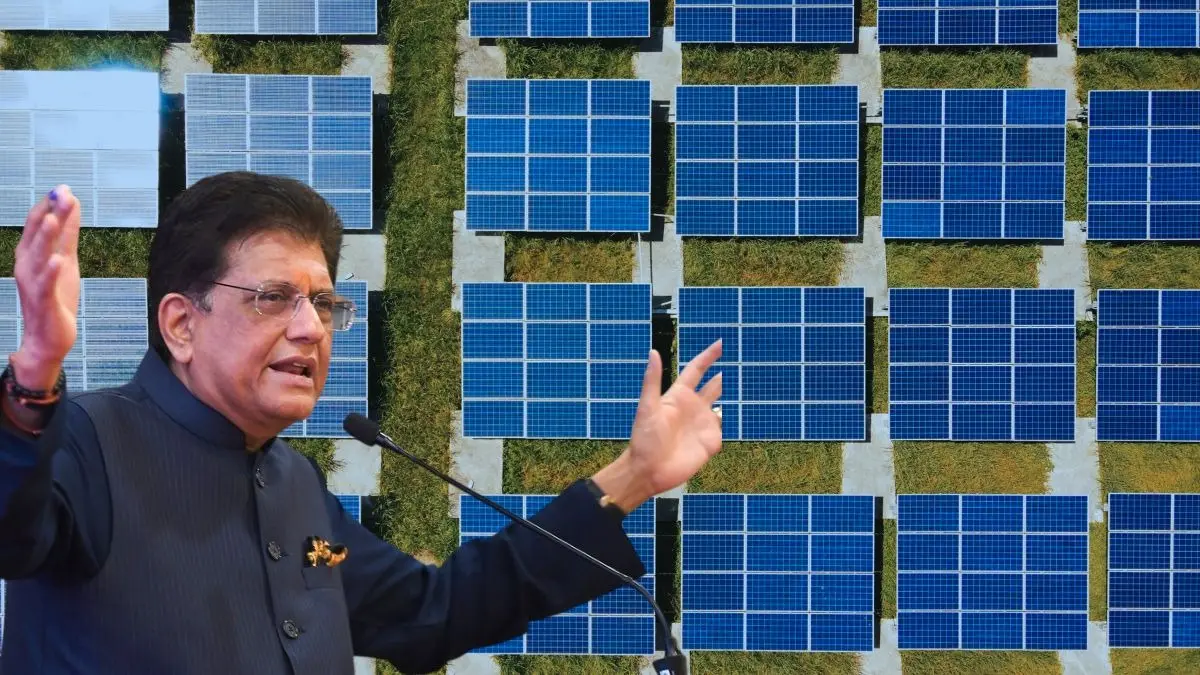
Union Minister of Commerce and Industry Piyush Goyal highlighted the transformation of India’s energy sector over the past 11 years, stating that bold vision and relentless execution have shifted the country from power scarcity to surplus and sustainability.
Addressing a briefing in New Delhi, Goyal described the progress as proof that honest intent and consistent efforts can change a nation’s destiny.
Surge in Renewable Energy Capacity
Solar power capacity has increased 46 times in the last 11 years, placing India as the third-largest globally in solar energy. Wind power capacity has grown from 21 GW in 2014 to 53 GW in 2025.
Expansion in Refining and Gas Infrastructure
Piyush Goyal said that India is working to increase its refining capacity by 20 per cent, he informed India has emerged as the fourth-largest refining hub in the world. A total of 34,238 km of natural gas pipeline has been authorised, of which 25,923 km is operational.
Advertisement
The Minister also mentioned the SHANTI Bill, which seeks to allow private players to participate in the nuclear energy sector.
Highest Coal Production and Declining Imports
India recorded its highest-ever coal production of 1,048 million tonnes in FY 2024-25, while coal imports declined by around 8 per cent, the Minister noted.
Advertisement
Five Pillars Driving Energy Transformation
Goyal outlined five key pillars supporting the sector’s transformation:
Universal Access: Electricity has been provided to every household under the Saubhagya scheme. Under the UJALA programme, 47.4 crore LED bulbs have been distributed, leading to savings on electricity bills and reduction in carbon emissions. Clean cooking gas connections have been provided to 10 crore households, while farmers have become energy providers under the PM-KUSUM scheme.
Affordability: GST on solar, wind and other clean energy equipment was reduced from 12 per cent to 5 per cent. The ethanol blending target of 20 per cent was achieved ahead of schedule. Inter-State transmission charges have been waived for the sale of solar and wind power.
Availability: Power shortages have declined from 4.2 per cent in 2013 to 0.1 per cent in 2025. A unified national grid has enabled the country to meet a record peak power demand of 250 GW.
Financial Viability: Reforms under the PM-UDAY scheme have strengthened the power distribution sector. DISCOM dues were reduced from Rs 1.4 lakh crore in 2022 to Rs 6,500 crore in 2025.
Sustainability: India has become the first G20 country to achieve the goals of the Paris Agreement. Currently, 50 per cent of the country’s installed power capacity comes from non-fossil fuel sources.
Future Initiatives for Sustainable Growth
Looking ahead to 2047, Goyal highlighted the National Green Hydrogen Mission, which targets production of 5 MMT per year by 2030 and aims to reduce fossil fuel imports by over Rs 1 lakh crore.
The PM Surya Ghar scheme is supporting rooftop solar installations in around 20 lakh households.
Recommendations of the High-Powered Committee on coal, including expediting coal exploration, mining and accelerating coal gasification, are under consideration.
Goyal expressed confidence that India’s energy sector will emerge as a global case study in managing scale, speed and sustainability as the country marches towards Viksit Bharat 2047.