
'It Didn’t Show American Power. It Showed American Weakness': Jeffrey Sachs on the US–India Trade Reset
Jeffrey Sachs views the US–India trade announcement as a retreat by Washington after months of ineffective pressure. He dismisses US claims of Indian concessions, credits India’s global diversification for shifting leverage, and says New Delhi emerged economically and diplomatically stronger, reinforcing its position as an independent global power.
- Republic Business
- 4 min read

;'%3e%3cpath%20d='m8,15.99c4.41,0,7.99-3.58,7.99-7.99S12.41,0,8,0,0,3.59,0,8s3.58,7.99,7.99,7.99Z'%20style='stroke:%23fff;%20stroke-miterlimit:10;%20stroke-width:.02px;'/%3e%3cpath%20d='m3.08,3.37l3.82,5.11-3.84,4.15h.87l3.37-3.64,2.72,3.64h2.94l-4.04-5.39,3.58-3.87h-.86l-3.1,3.35-2.5-3.35h-2.94Zm1.27.64h1.35l5.97,7.99h-1.35l-5.97-7.99Z'%20style='fill:%23fff;'/%3e%3c/g%3e%3c/svg%3e)


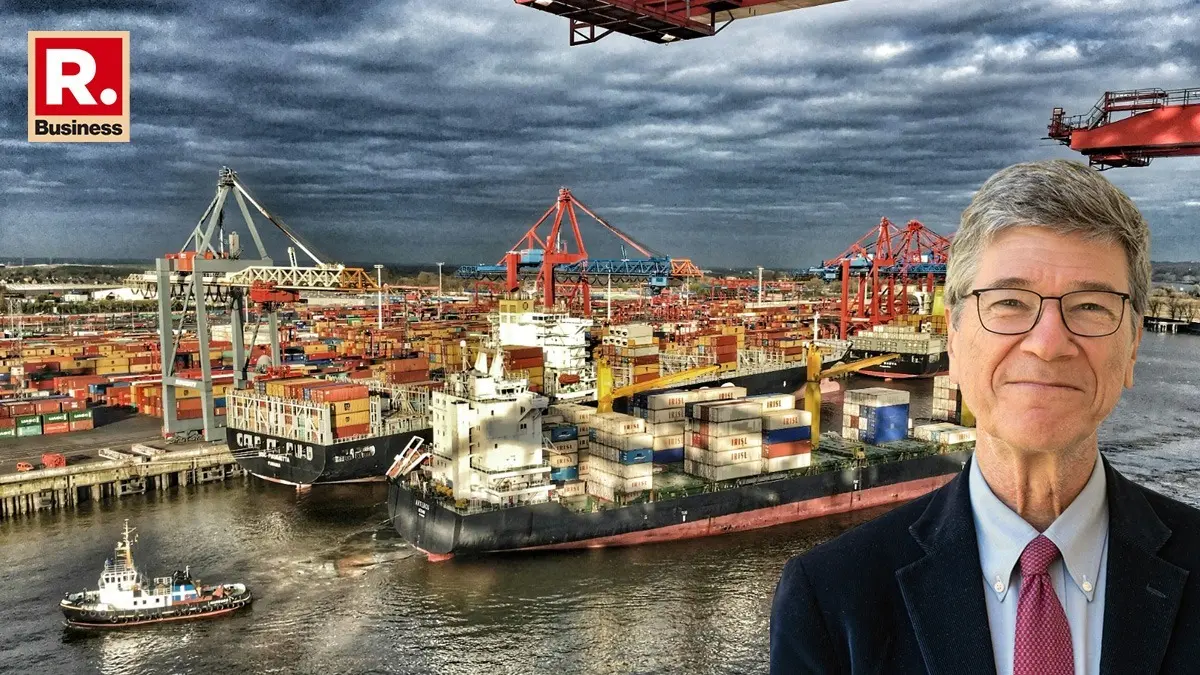
The announcement of a US–India trade deal, marked by President Donald Trump’s claim of reduced tariffs and sweeping Indian commitments, reflects a pullback rather than a breakthrough, according to economist Jeffrey D Sachs.
Speaking to Republic Media Network Editor-in-Chief Arnab Goswami, Sachs said the United States had spent months applying pressure on India with no tangible gains, before backing down from what he described as “outlandish actions” that disrupted trade and strained relations.
“The United States is unstable and irresponsible, but backing down from the most outlandish actions of this government a few months ago,” Sachs said, adding that the earlier approach “made no sense” and “antagonised India”.
Trump has claimed tariffs were reduced to 18% and that India had agreed to stop buying Russian oil and increase purchases of American goods. However, Sachs noted that none of these claims has been formally echoed by New Delhi.
Advertisement
“I wouldn’t take at face value any single statement by the US government,” he said. “Everything is just complete improvisation. A lot of baloney, a lot of malarkey.”
‘Nothing Was Gained’
Sachs was unequivocal in his assessment of what Washington achieved through months of pressure.
Advertisement
“Nothing,” he said. “Whatever is agreed today could have been agreed before. Nothing is gained.”
According to Sachs, the assumption driving US strategy, that access to the American market could force countries into compliance, has been repeatedly disproved over the past year.
“That’s Trump’s delusion, that the US market is so big, so consequential, so important that he can get every other country to fall into line,” he said. “But the US market is not very important in this way.”
Instead, Sachs pointed out that global trade has continued to expand despite US bluster, with countries strengthening ties beyond Washington.
“The world did just fine last year,” he said. “It traded more with each other.”
India’s Global Diversification
Sachs highlighted India’s expanding global engagement as a key factor behind the US softening its position.
India has moved to restore trade relations with China, concluded a trade deal with the European Union, strengthened ties with Africa, and deepened engagement through multilateral platforms.
“All of this is basically the rest of the world saying we’re not going to be played by Trump. We want open trade. We actually want rules and principles and stability,” Sachs said.
He added that even traditional US allies were recalibrating. “Even Canada has just signed a strategic partnership with China,” he noted, while Britain was in Beijing, “against Mr Trump’s orders”.
Criticism of US Trade Leadership
Sachs also delivered an assessment of key figures shaping US trade rhetoric. Referring to Peter Navarro, he said, “This man is completely incompetent. So reckless. Completely economically ignorant.”
Sachs, a Harvard professor, added, “It may be the worst PhD we ever [produced].”
He said the broader issue went beyond individual decisions. “What we’re seeing… is not a matter of a tactical decision. It’s a matter of sense that this is a group flailing around and one that has no strategy, a plan, a sense of what they’re doing.”
India’s Position Strengthened
On India’s handling of the episode, “I think India has handled it extremely well,” he said, both economically and diplomatically. Despite volatility in US policy, Sachs said India’s economic fundamentals remained strong, while its diplomatic outreach had widened.
“India has strengthened its relations with countries around the world, which is very good for India,” he said.
He also underscored the significance of India’s leadership within BRICS, calling the grouping “extremely important for India and for the world”.
“The US is 14% of world output. The BRICS is well over 40% of world output,” Sachs said, describing the bloc as a collective assertion against being “bullied by anybody”.
No Need for a Strategic Alliance
Sachs rejected the idea that India requires a strategic alliance with the United States. “The whole idea is ridiculous in my mind,” he said. “India doesn’t need a strategic alliance with the United States.”
He pointed to India’s scale and trajectory, “India is the biggest country in the world by population. It’s going to overtake the United States before mid-century in size of the economy.”
Instead, he argued, India’s interests lie in maintaining open trade and balanced global relationships. “Not some kind of alliance with an untrustworthy partner,” he said.
A Fast-Growing Global Power
Concluding his assessment, Sachs said India’s position in the global order had only strengthened through the episode. “It’s a world leader. It’s a superpower,” he said. “It’s soaring. It’s the fastest-growing large economy in the world.”