
Updated 21 January 2024 at 10:31 IST
Kashmir Saffron: Experts bet on new age tech to manage climate change impact
After growth in production between 2018-2023, saffron grown in Kashmir now awaits new age tech to help it tackle weather vagaries.
- Republic Business
- 5 min read

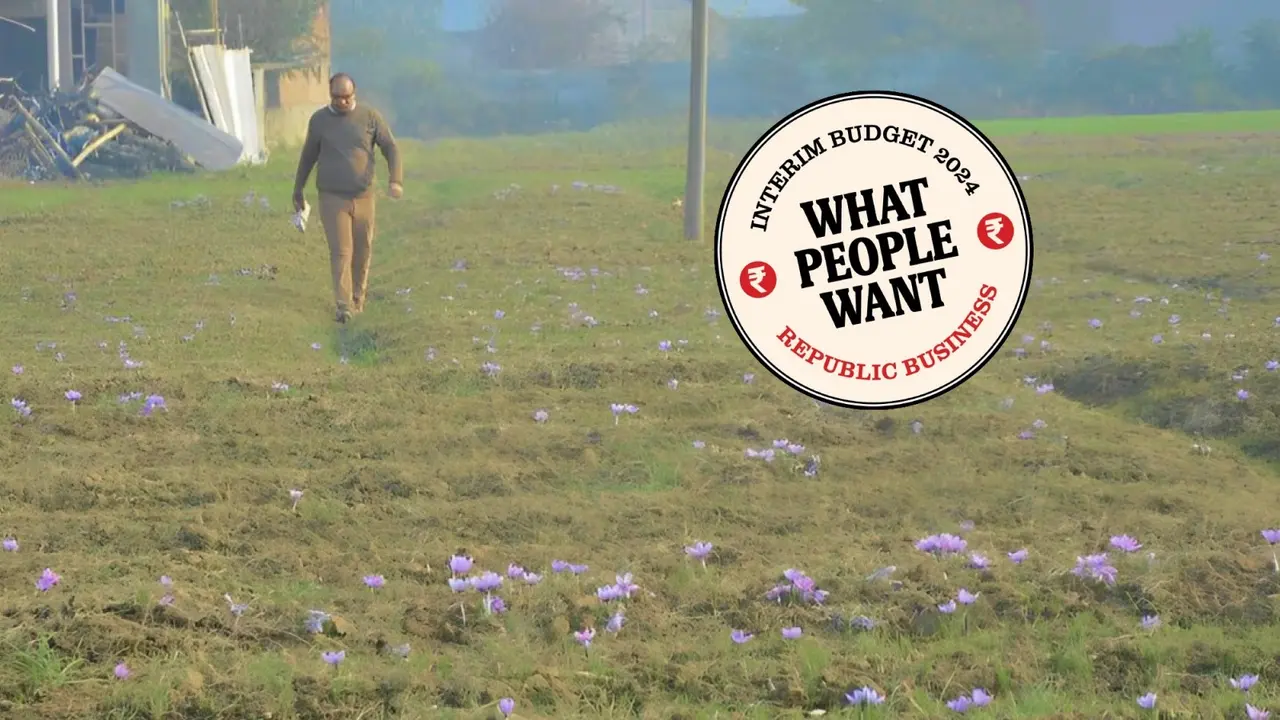
Kashmir's heritage crop endangered: Kashmir’s picturesque town Pampore is a major contributor to the average total of 14 to 18 metric tonnes (MT) saffron which the valley produces every season. The ongoing dry spell has cast a doom on growth prospects for saffron yield. One of the world’s costliest flowers, saffron is known for medicinal purposes as well as a topping to make our food and beverages exotic. Can the new age tech help beat climate change blues and boost saffron produce? Republic Business takes a deep dive.

Sprinkler irrigation system
Kashmir at present is facing three major challenges pertaining to saffron cultivation. Climate change is a major worry for thousands of valley's saffron producing growers, largely based in the Pampore and Pulwama belts. Speaking with Republic Business, Shamsul Hassan Mir, Nodal Officer (Marketing), Department of Agriculture Kashmir expressed deep concern over a prolonged and unprecedented dry spell that has cast doom on a cash-rich crop like saffron. While Mir did not share any estimates losses to the saffron crop caused by weather vagaries, the officer said hopes for a snowy end to this month may create some amount of favourable conditions for saffron cultivation.
“Climate change is for real. Even towards the end of January, we have not witnessed even a single spell of snowfall of any sort of precipitation in the valley. This untoward weather condition is worrying, which will eventually obstruct the bloom of saffron corm,” said Mir.
The suitable growth of saffron for a bumper yield, ideally requires a period of sub-zero temperatures also known as “chilling hours”, the official informed. “In Kashmir we have certain days, during the harshest winter period, when climatic conditions are decisive for the growth of saffron bulbs' lifecycle,” Mir added. Notably, the 40-day winter period, locally called as ‘chilla-i-kalan’
Advertisement
Mechanisation of labour-intensive crop
As per the official of the Jammu and Kashmir government's agriculture deportment, rapid conversion of agricultural land for commercial usage in the Valley, has also dwindled the saffron crop in Pulwama, Budgam, Kishtwar and Srinagar districts, where the crop is grown. As per data received from PHD Chamber of Commerce and Industry, area under saffron cultivation in Kashmir, during last couple of decades has remained static. The data paints a grim picture of land under saffron cultivation, putting it at a total of 3,715 hectares.
However, in its endeavor to keep a check on rapid conversion of agricultural land for commercial purposes, Kashmir's agriculture department has launched an awareness campaign among saffron growers and residents of the Pampore and Pulwama belt, Mir informed. " Locals in collaboration with the Revenue Department of Jammu and Kashmir and the agriculture department experts are at the forefront of this awarness drive.
Advertisement
Saffron is a labour-intensive crop and we need to replicate high-tech mechanisation to boost saffron production in Kashmir,” Mir said. As per experts, for starters, India's agro technology transfer with saffron producing countries such as Iran and Spain could be a step in the right direction.
As per Mir, Kashmir already has state-of-the-art post-harvest facility centres as “India International Kashmir Saffron Trading Centre” based in saffron town Pampore’s Dusso locality. “For the last three to four years, saffron production has increased considerably as compared to the last decade. Progressive farmers are to be credited for this growth.
As per rough estimates Kashmir produces 18 metric tonne (MT) of saffron annually and projections say that with help of grower-friendly and marketing-driven policies, the Kashmir saffron aims to revive its position on the world's saffron map. “It is important to enhance and intensify market linkages. Production and productivity needs to be boosted on the ground level for which the agriculture department is working round the clock for upliftment of farmers and promotion of heritage crop saffron,” Choudhary Mohammad Iqbal, Director Agriculture, Kashmir had recently said.
Post-harvest losses
In its recent pre-Budget recommendations submitted with the central government, industry body PHD Chamber of Commerce and Industry (PHDCCI) has highlighted the need for public investments in agriculture infrastructure, especially infrastructure logistics and cold chains.
“These steps would help in increasing the level of the food processing industry and rural entrepreneurship. This would lead to increased participation in global agriculture and food exports,” the PHDCCI memorandum submitted to the government revealed. It has suggested that reforms in the agricultural and food processing sector are pivotal.
Elaborating on these recommendations, in terms of the growth of a high-value crop such as saffron, AP Vicky Shaw, Chair PHDCCI Kashmir Chapter told Republic Business that the valley's topography and peculiar climatic conditions must be leveraged to boost saffron production.
“ Being cultivated at an altitude of 1,600 m to 1,800 m above mean sea level (AMSL) is the uniqueness of Kashmir saffron. This makes it unique as compared to other saffron varieties available globally,” Shaw said.
The Geographical Indication (GI) tag issued by the Geographical Indications Registry to Kashmir saffron is a shot in the arm for growers, Shaw added. "I have been interacting with some of the saffron growers in highlands of Kashmir. We all hope for an end to the dry spell, that has gripped the valley,” Shaw said.
Official figures have indicated a gradual increase in saffron production in Kashmir between 2018-2023, as the yield has gone up from 9.46 MT in 2009-10 to 15 MT in 2015-16 and 16.3 MT in 2022. With the latest worry of dwindling production due to unfavorable weather, shrinking of the saffron-growing area is a recurring concern. “ It is worrying that the area under saffron cultivation has not seen any expansion. There is a need to preserve Kashmir's heritage crop saffron for which the government and private sector have to work in tandem,” the PHDCCI Kashmir Chapter Chairperson added.
Published By : Saqib Malik
Published On: 20 January 2024 at 18:21 IST