
Know 10 Interesting Facts About India’s Budget Since 1947 as Nirmala Sitharaman Approaches a Historic Ninth
As Finance Minister Nirmala Sitharaman prepares to present the 2026-27 Union Budget, she will set a historic record by delivering her ninth consecutive budget, a milestone in India's fiscal history that began with the first post-Independence budget in 1947.
- Republic Business
- 4 min read

;'%3e%3cpath%20d='m8,15.99c4.41,0,7.99-3.58,7.99-7.99S12.41,0,8,0,0,3.59,0,8s3.58,7.99,7.99,7.99Z'%20style='stroke:%23fff;%20stroke-miterlimit:10;%20stroke-width:.02px;'/%3e%3cpath%20d='m3.08,3.37l3.82,5.11-3.84,4.15h.87l3.37-3.64,2.72,3.64h2.94l-4.04-5.39,3.58-3.87h-.86l-3.1,3.35-2.5-3.35h-2.94Zm1.27.64h1.35l5.97,7.99h-1.35l-5.97-7.99Z'%20style='fill:%23fff;'/%3e%3c/g%3e%3c/svg%3e)


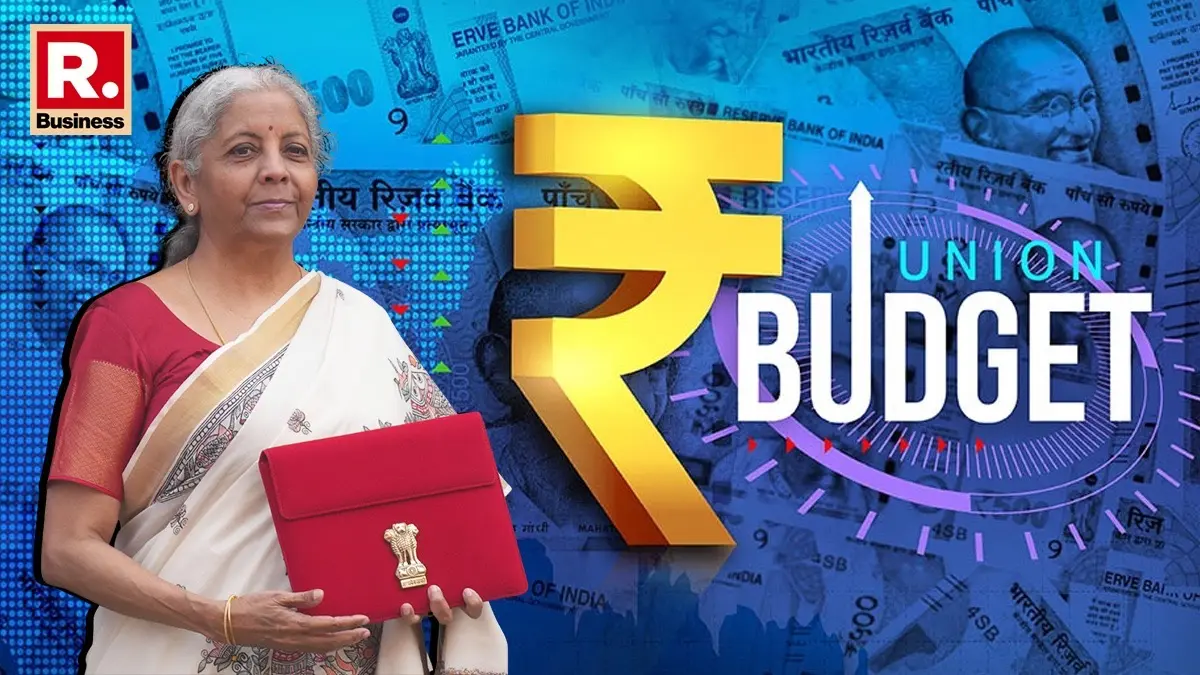
New Delhi: As Finance Minister Nirmala Sitharaman prepares to present the Union Budget 2026–27 on Sunday, February 1, Parliament is set to witness a first-of-its-kind moment in the country’s post-Independence economic history.
With the Economic Survey 2025–26 tabled in the Lok Sabha today (Thursday) and the Budget Session formally inaugurated by President Droupadi Murmu, here are ten interesting facts that trace the evolution of India’s Union Budget over the decades.
1. First budget of independent India
The first-ever Union Budget of independent India was presented on November 26, 1947, by R. K. Shanmukham Chetty, the country’s first finance minister. The budget came just over three months after independence and laid the financial foundation for a newly sovereign nation navigating economic uncertainty.
2. Nirmala Sitharaman’s record-breaking run
Finance Minister Nirmala Sitharaman is presenting the Union Budget for the ninth consecutive time, making her the first woman finance minister of India to achieve this feat. Appointed in 2019 after Prime Minister Narendra Modi’s second-term victory, she retained the finance portfolio after the 2024 elections and has so far presented eight consecutive budgets, including an interim budget in February 2024.
Advertisement
3. Budget date and time were once a colonial legacy
Until 1999, the Union Budget was presented at 5 pm on the last working day of February, following British parliamentary tradition. In 1999, then Finance Minister Yashwant Sinha shifted the timing to 11 am. The presentation date was later advanced to February 1 in 2017 by Arun Jaitley to allow ministries more time to implement policies within the same financial year.
4. India’s first budget was presented by a Scottish economist
Long before Independence, India’s first-ever budget was presented on April 7, 1860, by James Wilson, a Scottish economist and the then British finance member of the Viceroy’s Council. This pre-Independence Budget laid the groundwork for modern financial administration in colonial India.
Advertisement
5. First Sunday Budget in India’s history
The Union Budget 2026–27 will be the first budget to be presented on a Sunday. This historic departure underscores the government’s commitment to maintaining the February 1 timeline, regardless of the day it falls on.
6. Morarji Desai still holds the all-time record
Former Prime Minister Morarji Desai holds the record for presenting the highest number of Union Budgets. He presented a total of ten budgets during his tenure as finance minister under Prime Ministers Jawaharlal Nehru and Lal Bahadur Shastri. His budgets spanned multiple terms between 1959 and 1969, including both full and interim budgets.
7. Other finance ministers with major Budget tenures
Former finance minister P. Chidambaram presented the Union Budget nine times under different governments. Pranab Mukherjee presented eight budgets during his tenure, while former Prime Minister Manmohan Singh delivered five consecutive budgets between 1991 and 1995 during the landmark economic reform years.
8. Longest Budget speech on record
Nirmala Sitharaman holds the record for the longest budget speech in India’s history. Her February 1, 2020 speech lasted over two hours and forty minutes and was eventually cut short due to health reasons, with two pages remaining unread.
9. Shortest Budget speech in history
The shortest budget speech was delivered in 1977 by Hirubhai Mulljibhai Patel. His interim Budget speech contained just around 800 words, making it the briefest on record.
10. Markets will open despite Sunday Budget
Despite the budget being presented on a Sunday, both the National Stock Exchange and the Bombay Stock Exchange will hold a special trading session. This will allow investors and markets to respond immediately to policy announcements and fiscal measures outlined in the budget.
Budget session timeline
The Budget Session of Parliament for 2026 will continue until April 2 and will be held in two phases. The first phase runs from January 28 to February 13, while the second phase will take place from March 9 to April 2. The Economic Survey will be tabled on January 29, setting the tone for fiscal discussions ahead of the Budget presentation.