
OECD Projects India's FY26 GDP Growth At 7.6% Amid Middle East Crisis
In its interim Economic Outlook report, OECD noted that the evolving conflict in the West Asia has "human and economic costs" for the countries directly involved, and will test the resilience of the global economy.
- Republic Business
- 3 min read

;'%3e%3cpath%20d='m8,15.99c4.41,0,7.99-3.58,7.99-7.99S12.41,0,8,0,0,3.59,0,8s3.58,7.99,7.99,7.99Z'%20style='stroke:%23fff;%20stroke-miterlimit:10;%20stroke-width:.02px;'/%3e%3cpath%20d='m3.08,3.37l3.82,5.11-3.84,4.15h.87l3.37-3.64,2.72,3.64h2.94l-4.04-5.39,3.58-3.87h-.86l-3.1,3.35-2.5-3.35h-2.94Zm1.27.64h1.35l5.97,7.99h-1.35l-5.97-7.99Z'%20style='fill:%23fff;'/%3e%3c/g%3e%3c/svg%3e)


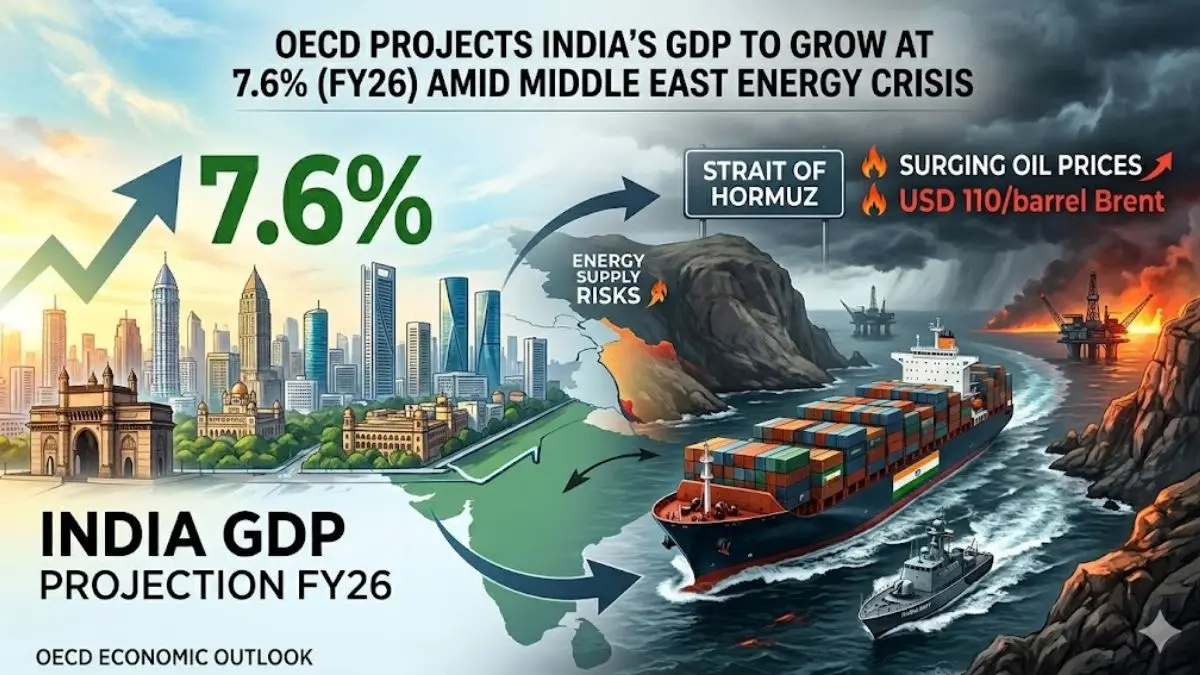
Amid the growing concerns linked to oil and gas supply in India triggered by the Strait of Hormuz crisis, the Organisation for Economic Cooperation and Development (OECD), an inter-governmental body, projected India's GDP to grow at 7.6% in FY26 and 6.1% in FY27.
In its interim Economic Outlook report, OECD noted that the evolving conflict in the West Asia has "human and economic costs" for the countries directly involved, and will test the resilience of the global economy.
While domestic markets indicate mixed investor sentiments mostly led by Middle East crisis fears, talking to Iranian State TV, Foreign Minister Abbas Araghchi recently noted that, “Many of the shipowners, or the countries that own these vessels, have contacted us and requested that we ensure their safe passage through the strait. For some of these countries that we consider friendly, or in cases where we have decided to do so for other reasons, our armed forces have provided safe passage."
"You have seen on the news: China, Russia, Pakistan, Iraq, and India. Two of its ships passed through a few nights ago, and some other countries, and even Bangladesh, I believe. These are countries that spoke with us and coordinated with us, and this will continue in the future as well, even after the war," he said.
Advertisement
Meanwhile, a drastic reduction in vessel transits via the Strait of Hormuz and the closure or damage of energy infrastructure has led to a surge in energy prices and disrupted the global supply of energy and other important commodities, such as fertilisers.
Advertisement
At the timing of writing this story, the Brent crude price stood at $110 per barrel, while the price of WTI crude was at $ 96.85 per barrel.
However, the investor sentiment might consider the fact that decline in US tariffs is likely to aid growth in th South Asian nation.
"The decline in (US) tariffs should support growth in India, though gas rationing will disrupt some production activities and fiscal support is expected to fade, with growth easing from 7.6 per cent in fiscal year (FY) 2025-26 to 6.1 per cent in FY 2026-27 and 6.4 per cent in FY 2027-28," the OECD said.
The fading deflationary impact of past food and energy price-reducing shocks will be exacerbated by the recent surge in global energy prices, OECD said, which will push inflation up from 2 per cent in FY 2025-26 to 5.1 per cent and 4.1 per cent in FY 2026-27 and 2027-28, respectively.
Amongst the emerging-market economies, India is projected to raise policy rates temporarily in the second quarter of 2026 to help offset stronger inflationary pressures, the OECD report said.
US bilateral tariff rates have declined following the US Supreme Court ruling against the tariffs imposed under the International Emergency Economic Powers Act. There are particularly large reductions for several emerging-market economies, including India. Nonetheless, the overall US effective tariff rate remains well above that prevailing prior to 2025.
The OECD report projected global GDP growth to ease to 2.9 per cent in 2026 before edging up to 3 per cent in 2027.
However, the energy price surge and the unpredictable nature of the evolving conflict in the West Asia will raise costs and lower demand, offsetting the tailwinds from strong technology-related investment and production, lower effective tariff rates and the momentum carried over from 2025.