
President Droupadi Murmu Addresses Parliament, Opens Budget Session 2026
India’s Parliament convened for the start of its annual Budget Session, and the proceedings began with President Droupadi Murmu’s address to a joint sitting of the Lok Sabha and the Rajya Sabha.
- Republic Business
- 3 min read

;'%3e%3cpath%20d='m8,15.99c4.41,0,7.99-3.58,7.99-7.99S12.41,0,8,0,0,3.59,0,8s3.58,7.99,7.99,7.99Z'%20style='stroke:%23fff;%20stroke-miterlimit:10;%20stroke-width:.02px;'/%3e%3cpath%20d='m3.08,3.37l3.82,5.11-3.84,4.15h.87l3.37-3.64,2.72,3.64h2.94l-4.04-5.39,3.58-3.87h-.86l-3.1,3.35-2.5-3.35h-2.94Zm1.27.64h1.35l5.97,7.99h-1.35l-5.97-7.99Z'%20style='fill:%23fff;'/%3e%3c/g%3e%3c/svg%3e)


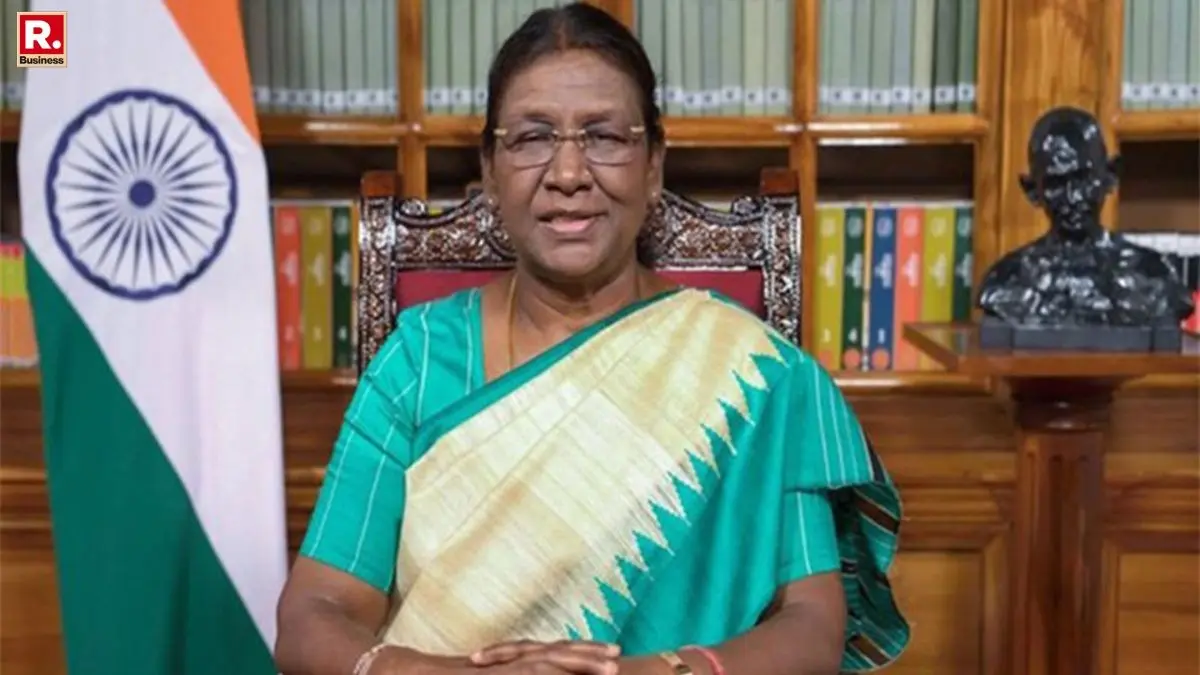
President Droupadi Murmu delivered the customary address to a joint sitting of the Lok Sabha and Rajya Sabha on Tuesday, formally inaugurating the Budget Session of Parliament for 2026. Her speech set the stage for legislative business, including debates on national policies, social welfare, and the forthcoming Union Budget.
The Budget Session is scheduled to continue until 2 April 2026 and will be held in two phases: the first from 28 January to 13 February, and the second from 9 March to 2 April. Finance Minister Nirmala Sitharaman is slated to present the Union Budget on 1 February, a Sunday this year, following the tabling of the Economic Survey on 29 January.
Key Highlights from the President’s Address
• Social Security Expansion: The President highlighted government efforts to broaden social protection, noting that an estimated 95 crore citizens now have access to social security schemes. She emphasized the government’s focus on expanding welfare coverage to vulnerable populations nationwide.
• Government Welfare Programmes: President Murmu referenced the role of public policies in promoting inclusive development and supporting citizens’ access to essential services.
Advertisement
• Economic Performance and Policy Framework: Her remarks alluded to the overall economic environment and set the tone for discussions on fiscal management, government spending, and taxation reforms during the session.
Political and Parliamentary Context
The President’s address took place amid early signs of parliamentary debate. Opposition members raised slogans concerning the VB–G RAM G Act, signalling potential points of contention in the session. Ahead of the Budget Session, an all‑party meeting was convened to outline priorities and issues that MPs intended to raise, including:
Advertisement
• Employment and unemployment trends
• Inflation and cost-of-living concerns
• Implementation and effectiveness of welfare programmes
These discussions are expected to continue during detailed deliberations on the Union Budget and related bills.
Upcoming Parliamentary Agenda
Following the President’s address, Parliament will proceed with key financial and legislative activities:
• Economic Survey 2026: To be tabled on 29 January, providing a detailed review of the economy’s performance in the previous year and laying the groundwork for fiscal planning.
• Union Budget 2026–27: Scheduled for 1 February, presenting the government’s fiscal priorities, expenditure plans, taxation policies, and proposed reforms.
• Legislative Debates and Scrutiny: Members of both Houses will examine ministry grant demands, discuss budgetary allocations, and debate legislative proposals.
The session will also see deliberations on social welfare programmes, economic policies, and public priorities, including infrastructure, education, health, and financial inclusion.
Session Structure
The Budget Session traditionally begins with the President’s address and includes two distinct phases, separated by a recess:
1. Phase 1 (28 January – 13 February): Introduction of the Economic Survey, Union Budget, and initial discussions on financial allocations.
2. Phase 2 (9 March – 2 April): Detailed examination of bills, scrutiny of ministry demands, and further debate on fiscal and policy priorities.
Lawmakers are expected to focus on ensuring the alignment of government spending with social welfare and economic development goals as discussions advance toward the consideration of the Union Budget and other legislative measures.