
Trump’s 100% Medicine Tariff Explained: What It Means for India’s Pharma Industry
President Donald Trump has announced sweeping new tariffs, including a 100% import tax on pharmaceutical drugs from October 1.
- Republic Business
- 5 min read

;'%3e%3cpath%20d='m8,15.99c4.41,0,7.99-3.58,7.99-7.99S12.41,0,8,0,0,3.59,0,8s3.58,7.99,7.99,7.99Z'%20style='stroke:%23fff;%20stroke-miterlimit:10;%20stroke-width:.02px;'/%3e%3cpath%20d='m3.08,3.37l3.82,5.11-3.84,4.15h.87l3.37-3.64,2.72,3.64h2.94l-4.04-5.39,3.58-3.87h-.86l-3.1,3.35-2.5-3.35h-2.94Zm1.27.64h1.35l5.97,7.99h-1.35l-5.97-7.99Z'%20style='fill:%23fff;'/%3e%3c/g%3e%3c/svg%3e)


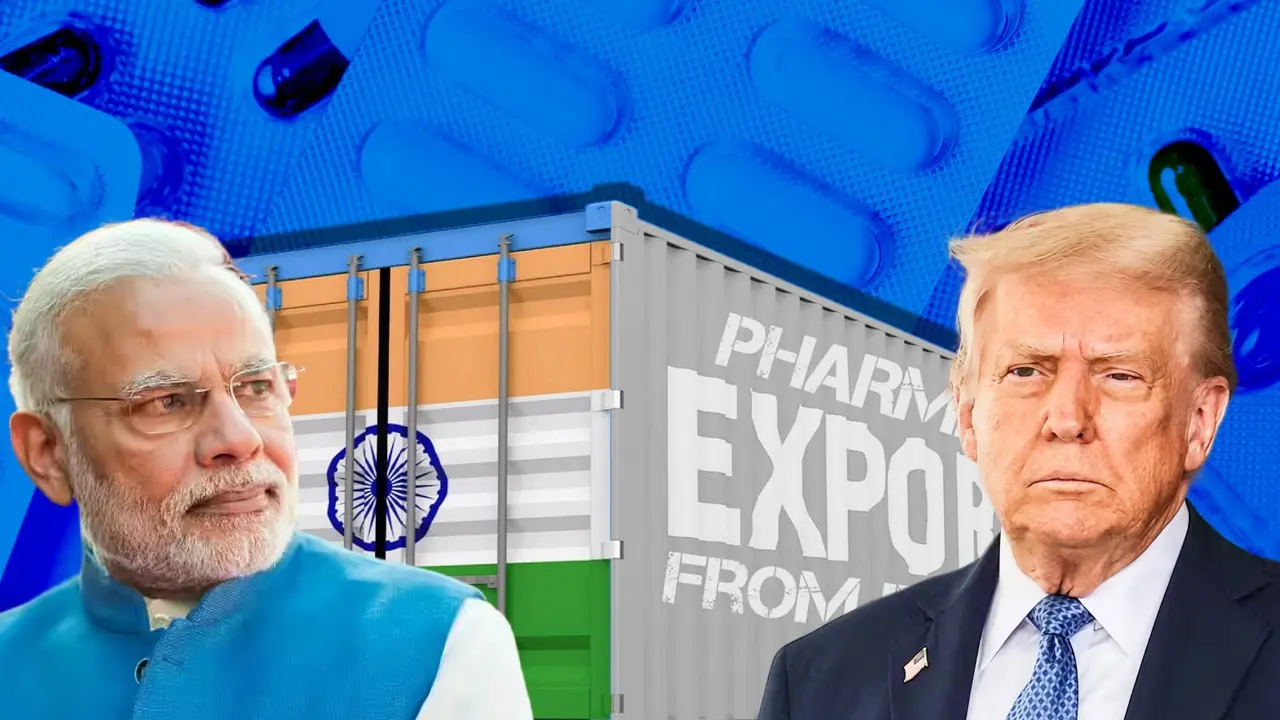
President Donald Trump said Thursday that his administration will impose 100% import taxes on pharmaceutical drugs, 50% on kitchen cabinets and bathroom vanities, 30% on upholstered furniture, and 25% on heavy trucks starting October 1.
The announcement came via his social media platform, where Trump emphasized that his commitment to tariffs did not end with the import taxes already launched in August. He said the measures were designed to reduce the government’s budget deficit and boost domestic manufacturing.
National Security Justification Under Question
While Trump did not provide a formal legal justification for the new tariffs, he appeared to stretch his powers as commander-in-chief by claiming that higher import taxes on goods such as kitchen cabinets and sofas were needed “for National Security and other reasons.”
The administration has relied on the Trade Expansion Act of 1962, under which a Section 232 investigation was launched in April to study the impact of drug and truck imports on national security. The Commerce Department also opened a similar investigation into timber and lumber in March, though it remains unclear whether furniture tariffs stem directly from that probe.
Economic Uncertainty and Inflation Risks
The tariffs arrive at a time when the U.S. economy presents a mixed picture, stock markets remain strong, but job growth is weakening while inflation is rising.
Federal Reserve Chair Jerome Powell recently cautioned that tariffs could worsen inflation:
Advertisement
“We have begun to see goods prices showing through into higher inflation,” Powell warned, adding that higher costs for goods account for “most” or potentially “all” of the increase in inflation levels this year.
Trump, meanwhile, has pressured Powell to resign, arguing that the Fed should be cutting rates more aggressively. However, Fed officials have held back, citing uncertainty created by tariffs as a key reason for caution.
Pharmaceuticals Face the Biggest Shock
The most striking announcement was the 100% tariff on pharmaceutical drugs, a sudden move that could upend global health care supply chains.
Advertisement
Trump clarified that the tariffs would not apply to companies building factories in the U.S., defining eligibility as facilities that were either “breaking ground” or already “under construction.” However, it remains unclear whether this exemption would cover companies that already operate U.S. plants.
In 2024, the U.S. imported nearly $233 billion in pharmaceutical and medicinal products, according to Census Bureau data. Doubling the price of such imports could significantly raise health care expenses for American households while also increasing Medicare and Medicaid costs.
Pascal Chan, vice president for strategic policy and supply chains at the Canadian Chamber of Commerce, warned that the tariffs could harm Americans’ health with “immediate price hikes, strained insurance systems, hospital shortages, and the real risk of patients rationing or foregoing essential medicines.”
India’s Role in Global Pharma
India, which supplies a major share of affordable generic medicines to the United States, could be directly affected by Trump’s move. The sudden 100% tariff is expected to:
Increase landed costs of Indian pharmaceutical exports, reducing competitiveness.
Squeeze margins of Indian drugmakers heavily reliant on the U.S. market.
Disrupt supply chains, particularly for medicines where India plays a dominant global role.
Create uncertainty for companies that already maintain U.S. manufacturing facilities.
The White House has claimed that earlier tariff threats prompted major companies including Johnson & Johnson, AstraZeneca, Roche, Bristol Myers Squibb, and Eli Lilly, to announce investments in U.S. production. But for Indian exporters, this abrupt move threatens both revenues and access to the world’s most lucrative pharmaceutical market.
Other Industries Under Pressure
Beyond drugs, Trump’s tariffs are also hitting home-related goods and vehicles: Cabinetry and Furniture: Higher import costs could burden U.S. homebuilders at a time of high mortgage rates and limited housing supply. The National Association of Realtors noted that while listings rose 11.7% in August compared with a year ago, the median price of an existing home still stood at $422,600.
Heavy Trucks: Trump defended tariffs on foreign-made trucks and parts, stating:
“Large Truck Company Manufacturers, such as Peterbilt, Kenworth, Freightliner, Mack Trucks, and others, will be protected from the onslaught of outside interruptions.” These moves highlight Trump’s broader push to shield U.S. industries from foreign competition, though economists warn that higher import costs will likely flow to consumers.
Legal and Political Battles Ahead
Trump has frequently used tariffs as a tool to push companies toward U.S.-based manufacturing, dismissing concerns that businesses would pass the higher costs on to consumers.
His legal authority for such sweeping actions, however, is under scrutiny. Past tariffs were justified under a 1977 law declaring an economic emergency, but two federal courts have already ruled that the approach exceeded presidential authority. The Supreme Court is scheduled to hear the case in November.
No Signs of Job Creation
Despite Trump’s repeated claims that tariffs create jobs, government data suggests otherwise. Since April, the Bureau of Labor Statistics has reported that U.S. manufacturers cut 42,000 jobs and builders reduced payrolls by 8,000.
Yet Trump remains defiant, “There’s no inflation,” he told reporters Thursday. “We’re having unbelievable success.”
Still, he acknowledged that tariffs against China had hurt American farmers, particularly soybean producers. He promised once again to divert tariff revenues to compensate farmers—similar to the subsidy programs launched during his first term in 2018 and 2019.
Implications for India
For India, Trump’s new tariff regime represents both a commercial challenge and a geopolitical test. The pharmaceutical sector, one of India’s most successful export industries, faces a direct hit. Rising costs in the US. market could also reshape investment strategies, supply chains, and future trade negotiations.
While Trump insists tariffs will revive U.S. manufacturing, for India the announcement signals a period of heightened uncertainty especially in pharmaceuticals, where its role as a global supplier of affordable medicines may be undermined.
Stock Market Impact
Indian pharmaceutical stocks took a sharp hit on Friday, September 26, after U.S. President Donald Trump announced a 100% tariff on branded or patented drug imports starting October 1, 2025, unless companies are building manufacturing facilities in the United States.At 9:40 AM, the Nifty Pharma index was down 2.38%, with top losers including Torrent Pharma, Sun Pharma, Dr Reddy’s Laboratories, Cipla, Lupin, Glenmark Pharma, Natco Pharma, Laurus Labs, and Biocon, some falling as much as 5%.