
Trump’s Tariff Revenues at Risk? What It Means for US Deficit and Investors
President Donald Trump’s $165 billion tariff windfall for the US Treasury faces uncertainty after a federal appeals court challenged its legality under IEEPA. A Supreme Court ruling against the administration could trigger massive refunds, disrupt businesses, and complicate efforts to rein in the nation’s $2 trillion fiscal deficit.
- Republic Business
- 4 min read

;'%3e%3cpath%20d='m8,15.99c4.41,0,7.99-3.58,7.99-7.99S12.41,0,8,0,0,3.59,0,8s3.58,7.99,7.99,7.99Z'%20style='stroke:%23fff;%20stroke-miterlimit:10;%20stroke-width:.02px;'/%3e%3cpath%20d='m3.08,3.37l3.82,5.11-3.84,4.15h.87l3.37-3.64,2.72,3.64h2.94l-4.04-5.39,3.58-3.87h-.86l-3.1,3.35-2.5-3.35h-2.94Zm1.27.64h1.35l5.97,7.99h-1.35l-5.97-7.99Z'%20style='fill:%23fff;'/%3e%3c/g%3e%3c/svg%3e)


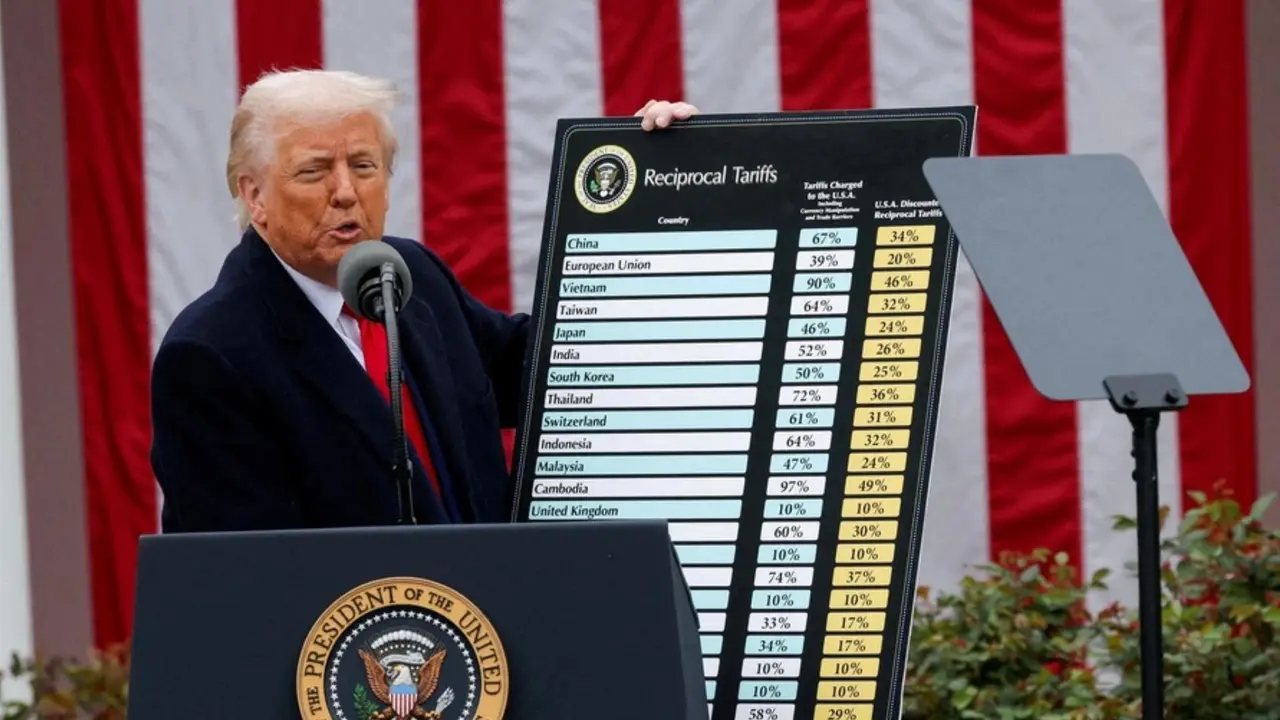
President Donald Trump’s bold strategy to curb America’s unprecedented budget deficits through sweeping tariff hikes now faces a critical legal hurdle. The tariffs, which have generated significant federal revenue, could be reversed if the Supreme Court rules against the administration, putting the nation’s finances on shakier footing.
Trump and top aides, including Treasury Secretary Scott Bessent, have argued that future federal borrowing needs will ease as Republican tax cuts, deregulation, and large-scale investments by corporations and foreign nations stimulate economic growth and increase federal revenues. While economists debate the feasibility of these projections, few dispute that tariffs have indeed created a fresh revenue stream.
Customs duties, mostly paid by U.S. importers, have totaled $165 billion in the 2025 fiscal year, according to Treasury Department data, marking a $95 billion increase from the previous year. The bulk of this surge comes from tariffs imposed under the International Emergency Economic Powers Act (IEEPA), Bloomberg Economics analysis shows.
Supreme Court Review Could Undo Gains
A federal appeals court ruling on August 29 questioned the legality of using IEEPA for tariffs. If the Supreme Court rules against the administration, Bessent warned, the government may need to refund substantial amounts to importers. Speaking this week, he expressed confidence that the court would side with the White House.
While this year’s added tariff revenue is significant, it still falls short of closing the almost $2 trillion budget gap for the first 11 months of fiscal 2025. Economists supporting Bessent’s projections estimate that the current tariff run-rate could generate $300 billion annually, about 1% of US GDP. At a time when the deficit exceeds 6% of GDP, this revenue is crucial for moving toward the goal of 3% deficits over the next decade.
Lou Crandall, chief economist at Wrightson ICAP, noted, “It’s just a wild card that you’re going to have to deal with when the time comes. If the court case goes against the Treasury and the administration doesn’t want to see the deficit continue to rise, there are going to be policy responses of some sort — we just don’t know what they are.”
Market Focus Shifts to Federal Reserve Cuts
Despite the looming legal uncertainty, bond investors have been concentrating on potential Federal Reserve interest-rate cuts, with yields on short- and long-term securities declining this month. The Trump administration is also considering reconstituting much of the tariff framework using other executive authorities, including Sections 232 and 301, to maintain revenue streams.
Tobin Marcus, head of US policy and politics at Wolfe Research, told clients, “We think bond markets should shrug off the one-time cost of tariff refunds, and we still fully expect that Trump will recreate the tariffs prospectively through other authorities if he loses in court.”
Bessent described this fallback plan on Fox Business as “more cumbersome, and I think it limits the president’s hands.” Any revamp of tariffs could impose new costs on businesses and the broader economy, potentially slowing growth, weakening the labor market, and widening the budget gap further.
Businesses Struggle Amid Tariff Shifts
Companies like Vernon Hills, Illinois-based hand2mind Inc., which makes educational toys, have felt the strain of fluctuating US duties. Marketing executive Elana Ruffman described the process as “the most infuriating thing,” recounting the challenges her family-owned firm and its sister company Learning Resources Inc. faced this year.
After Trump imposed tariffs exceeding 100% on China in April, hand2mind shifted production to India, hoping for favorable treatment under the administration. But the surtax on Indian imports later jumped to 50%, while the Chinese levy decreased to 30%, forcing costly adjustments.
Ruffman said the company has already paid over $5.5 million in tariffs this year, compared to $2.3 million for all of 2024, even after pausing production on several products to mitigate price hikes. Her company is among those suing the Trump administration over its use of IEEPA, with the case now pending Supreme Court review.
Debt Trajectory and Long-Term Implications
The Yale Budget Lab estimates that invalidation of the IEEPA tariffs could remove around $1.5 trillion in revenues over a decade, leaving remaining levies collecting $496 billion. While some economists foresee higher revenue collections in the long term, a Supreme Court ruling against these tariffs would serve as a stark reminder of the fragile US fiscal path.
The Congressional Budget Office has warned that the US could surpass post-World War II debt levels by 2029, assuming the expiration of the Trump-era tax cuts. Although the administration’s July tax legislation provides additional benefits, the tariffs were seen as a key measure to restrain borrowing.
S&P Global Ratings affirmed the US AA+ sovereign-debt rating last month, citing new tariff revenues as a stabilising factor. TD Securities strategists noted, Markets may become nervous that a significantly large refund could weigh on Treasury’s finances, especially given recent comments by several rating agencies that tariff collections benefit the longer-term US debt trajectory.
(With Inputs From Bloomberg)
Read More - Revised GST Rates To Ease Pressure On household Budgets: PwC