
Union Budget 2026-27: Expectations Run High On Tax Reforms, Growth, Defence And Tariff-Hit Sectors
Union Finance Minister Nirmala Sitharaman's 9th Budget focuses on tax reforms, fiscal consolidation, and growth as industry awaits clarity on transition provisions, debt roadmap, and relief for tariff-hit sectors
- Republic Business
- 6 min read

;'%3e%3cpath%20d='m8,15.99c4.41,0,7.99-3.58,7.99-7.99S12.41,0,8,0,0,3.59,0,8s3.58,7.99,7.99,7.99Z'%20style='stroke:%23fff;%20stroke-miterlimit:10;%20stroke-width:.02px;'/%3e%3cpath%20d='m3.08,3.37l3.82,5.11-3.84,4.15h.87l3.37-3.64,2.72,3.64h2.94l-4.04-5.39,3.58-3.87h-.86l-3.1,3.35-2.5-3.35h-2.94Zm1.27.64h1.35l5.97,7.99h-1.35l-5.97-7.99Z'%20style='fill:%23fff;'/%3e%3c/g%3e%3c/svg%3e)


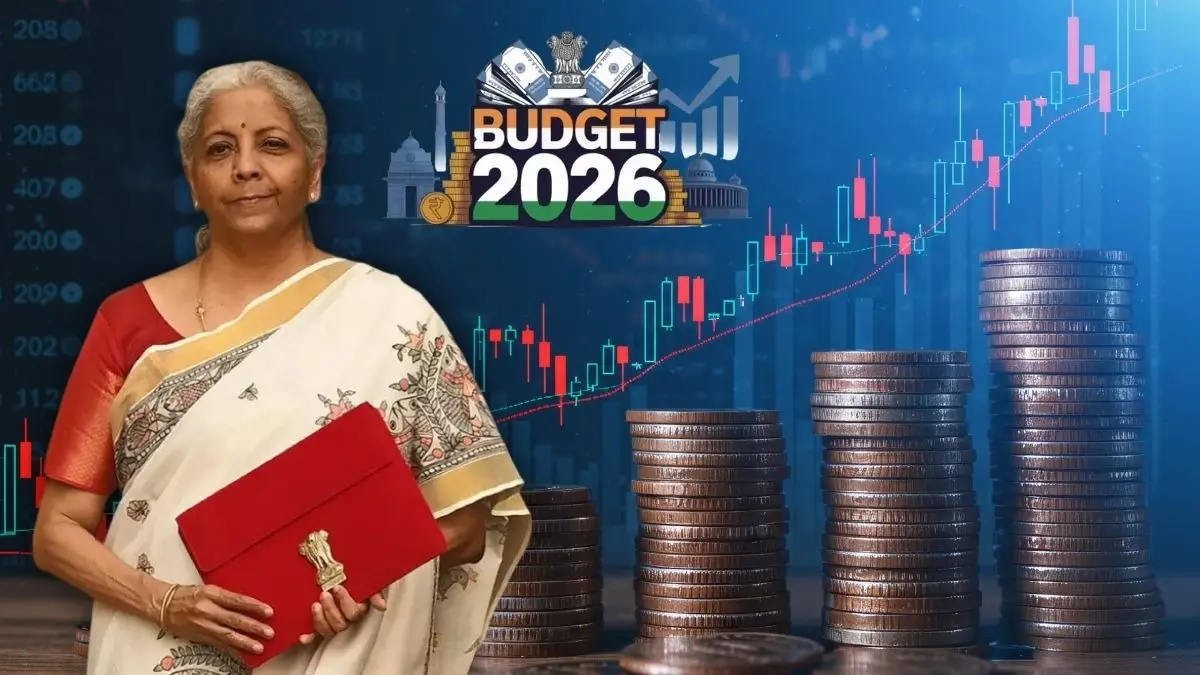
New Delhi: As the clock ticks down to the Union Budget 2026-27, the nation is bracing itself for a financial statement from Union Finance Minister Nirmala Sitharaman that promises to be a game-changer. The highly-anticipated Budget, which is to be presented on a rare Sunday, adds a historic twist to a tradition stretching back decades. The unusual timing has only heightened the sense of expectation as FM Nirmala Sitharaman is set to step into the Lok Sabha to present a historic 9th consecutive Union Budget, making her the first Finance Minister in India to achieve the feat.
The anticipation over the Budget is high, with expectations running high on tax reforms, customs duty rationalisation, and measures to sustain growth amidst rising geopolitical risks and global trade uncertainty. The finance minister's task is cut out, balancing growth, revenue, and global risks, while finding new drivers for the economy.
The Budget is also seen as a possible turning point in fiscal strategy, with the government expected to outline a clear roadmap for lowering India's debt-to-GDP ratio. It is expected to signal a shift from short-term deficit management to a more durable, long-term approach to fiscal consolidation.
Taxpayers Hope For Relief
The industry bodies and taxpayers are hoping for relief, particularly through a higher standard deduction and income tax exemption limit. The new Income Tax (IT) Act, 2025, coming into force from April 1, has raised expectations of clarity on transition provisions, rules, and FAQs to ensure smoother implementation. The limit on Section 80C, which allows deductions of up to Rs 1.5 lakh on investments, has remained unchanged for several years, and tax experts suggested that it should be raised to encourage household savings.
Advertisement
The Union Finance Minister's speech is expected to provide crucial cues on the government's stance on growth, fiscal discipline, and corporate earnings. The Economic Survey has already described AI as an economic strategy, advocating a bottom-up, sector-specific approach.
Finance Minister's Task To Navigate Global Economic Uncertainty
Amidst US President Donald Trump's tariffs coming into effect, the Finance Minister faces a daunting task to navigate the complications of a global economy fraught with uncertainty. With the fiscal deficit target of 4.4% of GDP for FY26, markets will be looking for clarity on the debt-to-GDP reduction path and whether the government signals a fiscal deficit target of around 4% for FY27. "We see fiscal consolidation to continue in FY27, albeit at a slower pace, to 4.2% of GDP, in order to preserve policy space in an uncertain world & ahead of Pay Commission implementation in FY28," said a pre-Budget note by Union Bank of India (UBI).
Advertisement
The note also outlined a shift toward debt-to-GDP targeting, with the Centre looking to reduce debt to around 50±1% of GDP by FY31. The fiscal deficit for FY26 is estimated at 4.4% of GDP, and markets will be watching for clarity on the debt-to-GDP reduction path and whether the government signals a fiscal deficit target of around 4% for FY27.
Customs Duty Reform And Ease Of Doing Business
The economists stated that the Finance Minister's task is cut out, balancing growth, revenue, and global risks, while finding new drivers for the economy. The capital expenditure is expected to remain the Budget's anchor, with a likely increase of 10-15% in the next Budget, taking the outlay beyond Rs 12 lakh crore.
Also, the Customs duty reform is expected to be a major Budget theme, with a possible overhaul similar to GST rationalisation. The reform could include fewer duty slabs, simplified procedures, and a possible amnesty scheme to resolve disputes worth nearly Rs 1.53 lakh crore. Such measures are seen as critical for improving ease of doing business and trade competitiveness.
Agriculture, MSMEs And Defence
As per the economic analysts, agriculture and MSMEs, identified by Nirmala Sitharaman in the Budget 2025 as the first and second growth engines, are expected to remain central. Other expectations included provisions linked to the 8th Pay Commission, higher tax devolution under the 16th Finance Commission, increased allocations for MSMEs, support for tariff-sensitive sectors, funding for critical minerals, and Viksit Bharat employment schemes.
Moreover, it will be seen how the defence allocation would be ensured. The experts suggested that the capex push continues under ‘Make in India’ and in the backdrop of ‘Operation Sindoor’. FY26 saw emergency defence procurement of Rs 40,000 crore and approvals worth Rs 3.3 trillion, nearly double the budgeted defence capital outlay.
Tech Industry Awaits Budget 2026 With High Hopes
The technology sector is pinning its hopes on the upcoming Budget 2026, expecting measures to accelerate AI adoption, digital infrastructure development, and innovation. The Economic Survey has already set the tone, describing AI as an economic strategy and advocating a bottom-up, sector-specific approach.
The experts believed that India is on the right track, leveraging its engineering strength to create affordable, human-centric AI solutions that address local challenges and scale globally. They sought policy support for autonomous logistics and applied AI, while GlobalLogic sees the Budget as an opportunity to shift from digital-first to intelligence-first infrastructure.
Tariff-Hit Sectors Seek Relief
Despite pressure on revenues, the capital expenditure is expected to remain a priority in the Budget. UBI projects FY27 capex at Rs 12.4 lakh crore, or 3.2% of GDP, focusing on roads, railways, and defence. FM Sitharaman faces the challenge of balancing growth, revenue, and global risks, while restoring investor confidence and finding new growth drivers. The export oriented sectors, including textiles, apparel, seafood, gems and jewellery, leather, and footwear, are seeking targeted relief and policy support in Budget 2026, citing the impact of US tariffs.
The fiscal deficit for FY26 is estimated at 4.4% of GDP, and markets will look for clarity on the debt-to-GDP reduction path and the government's fiscal deficit target for FY27. The capital expenditure for FY26 is budgeted at Rs 11.2 lakh crore, with a likely increase of 10-15% in the next Budget. The government's gross market borrowing for FY26 is pegged at Rs 14.80 lakh crore, reflecting the country's fiscal health and revenue collections. Gross tax revenue for FY26 is estimated at Rs 42.70 lakh crore, up 11% over FY25.
GST revenue in FY26 is projected to rise 11% to Rs 11.78 lakh crore, with FY27 projections highly speculative. Nominal GDP growth for FY26 has been revised down to 8% due to lower inflation, and projections for FY27 will offer cues on the inflation outlook.