
Union Budget 2026: Sitharaman Offers Full 5-Year Tax Exemption for NRIs to Boost ‘Make in India’
Finance Minister Nirmala Sitharaman’s historic Sunday budget for 2026–27 introduced compliance-friendly measures to ease tax burdens and simplify disclosures for NRIs, students abroad, and globally mobile professionals.
- Republic Business
- 3 min read

;'%3e%3cpath%20d='m8,15.99c4.41,0,7.99-3.58,7.99-7.99S12.41,0,8,0,0,3.59,0,8s3.58,7.99,7.99,7.99Z'%20style='stroke:%23fff;%20stroke-miterlimit:10;%20stroke-width:.02px;'/%3e%3cpath%20d='m3.08,3.37l3.82,5.11-3.84,4.15h.87l3.37-3.64,2.72,3.64h2.94l-4.04-5.39,3.58-3.87h-.86l-3.1,3.35-2.5-3.35h-2.94Zm1.27.64h1.35l5.97,7.99h-1.35l-5.97-7.99Z'%20style='fill:%23fff;'/%3e%3c/g%3e%3c/svg%3e)


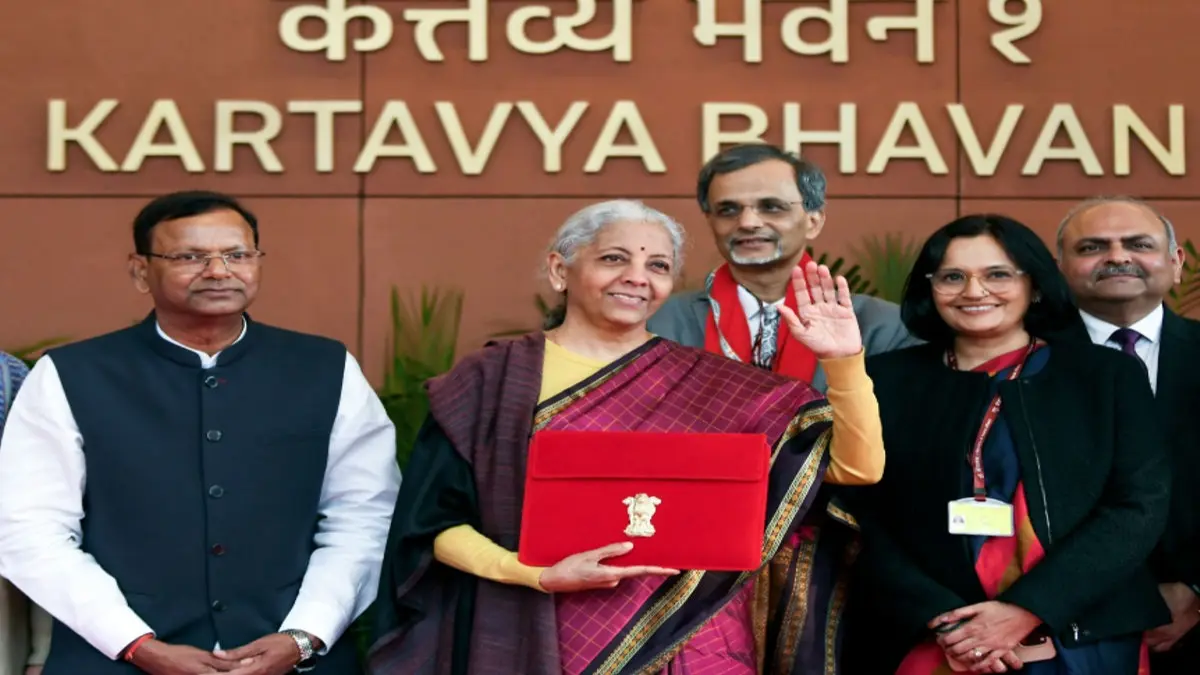
New Delhi: Finance Minister Nirmala Sitharaman presented the historic Union Budget 2026–27 in the Lok Sabha on Sunday, February 1 marking the first time India’s annual budget was tabled on a Sunday.
A key highlight for the global Indian community was the introduction of a full 5-year income tax exemption for Non-Resident Indians (NRIs) who supply capital goods to Indian manufacturers. This measure is strategically designed to boost the ‘Make in India’ initiative by attracting diaspora investment into priority sectors such as electronics and green energy.
Beyond this incentive, the budget also introduced several compliance-friendly measures aimed at NRIs, students abroad, young professionals, and globally mobile taxpayers. These reforms are focused on easing tax burdens, simplifying disclosure requirements, and addressing legacy non-compliance issues. The 1 hour and 25-minute speech was her ninth consecutive budget presentation and the third shortest on record.
Key takeaways for NRI:
One-time foreign asset disclosure scheme
To address long-standing compliance issues faced by students, young professionals, tech employees and relocated NRIs, the government announced a one-time six-month foreign asset disclosure scheme.
Advertisement
Make in India Boost
Finance Minister Nirmala Sitharaman has announced a 5-year income tax exemption for specific NRI business activities, which is focused on attracting investments in local manufacturing. NRIs providing capital goods to Indian companies will enjoy a total tax exemption for 5 years, promoting ‘Make in India’ and encouraging Indian diaspora investment in priority sectors like electronics and green energy.
TCS cut on foreign travel
The government reduced Tax Collected at Source (TCS) on overseas tour packages to 2 per cent, down from earlier rates of 5 per cent and 20 per cent, with no minimum threshold. This significantly lowers the upfront tax burden on foreign travel.
Advertisement
Under the Liberalised Remittance Scheme (LRS), TCS on education and medical expenses abroad has also been cut from 5 per cent to 2 per cent, easing remittances for Indian students studying overseas and patients seeking treatment abroad.
Higher investment limits for NRIs
In a major boost for overseas investors, the investment limit for NRIs has been increased from 5 per cent to 10 per cent. The overall sectoral investment cap has also been raised from 10 per cent to 24 per cent, expanding the room for NRI participation in Indian companies.
Simplified real estate transactions involving NRIs
To streamline property transactions involving non-resident sellers, the budget proposed relaxing the requirement for resident buyers to obtain a separate Tax Deduction and Collection Account Number (TAN).
Under the new system, Tax Deducted at Source (TDS) for non-resident property transactions will be deposited through the resident buyer’s existing TAN-based challan, removing procedural hurdles and delays.
Extended timelines for revising income tax returns
The government announced an extension of the deadline for revising income tax returns beyond December 31 on payment of a nominal fee. Filing timelines will also be staggered.
ITR-1 and ITR-2 will be due by July 31, while non-audit business cases and trusts will get time until August 31. This provides additional breathing room for taxpayers with overseas income and assets.
A historic budget day
The Union Budget 2026–27 was presented on a Sunday for the first time in India’s fiscal history. Ahead of the presentation, President Droupadi Murmu offered the customary dahi-cheeni to the finance minister, a symbolic gesture of good luck.
As India moves toward the ‘Viksit Bharat 2047’ vision, this budget places a strong emphasis on compliance simplification, global mobility and trust-based taxation, particularly for NRIs and small overseas taxpayers navigating increasingly complex finances.