
UP's Private Defence Push Gains Momentum As Entrepreneur Sahil Luthra Bets On UP Corridor
India’s push for indigenous defence manufacturing is increasingly drawing participation from new-age entrepreneurs, with emerging firms aligning themselves to government-backed industrial corridors and localisation policies.
- Republic Business
- 3 min read

;'%3e%3cpath%20d='m8,15.99c4.41,0,7.99-3.58,7.99-7.99S12.41,0,8,0,0,3.59,0,8s3.58,7.99,7.99,7.99Z'%20style='stroke:%23fff;%20stroke-miterlimit:10;%20stroke-width:.02px;'/%3e%3cpath%20d='m3.08,3.37l3.82,5.11-3.84,4.15h.87l3.37-3.64,2.72,3.64h2.94l-4.04-5.39,3.58-3.87h-.86l-3.1,3.35-2.5-3.35h-2.94Zm1.27.64h1.35l5.97,7.99h-1.35l-5.97-7.99Z'%20style='fill:%23fff;'/%3e%3c/g%3e%3c/svg%3e)


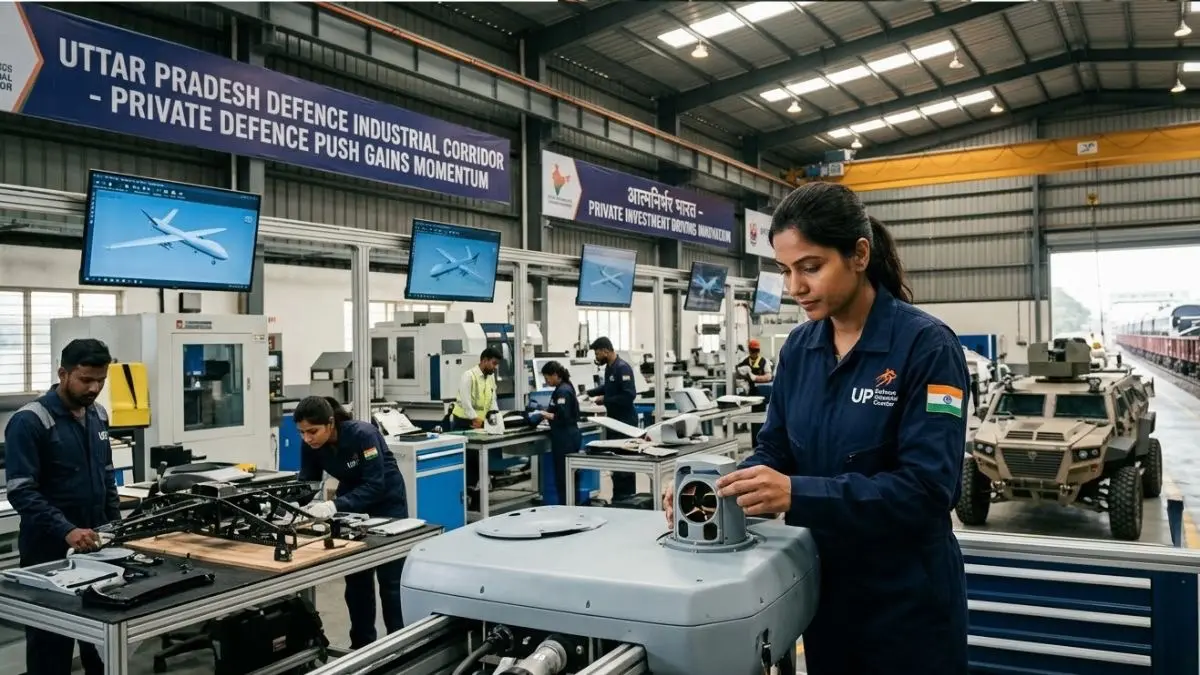
India’s push for indigenous defence manufacturing is increasingly drawing participation from new-age entrepreneurs, with emerging firms aligning themselves to government-backed industrial corridors and localisation policies.
Amongst them, Vijayan Trishul Defence Solutions Pvt. Ltd. (VTDS), is a relatively new entrant founded in 2024 by Delhi-based entrepreneur Sahil Luthra.
The development comes at a time when the Centre is accelerating initiatives such as Atmanirbhar Bharat and Make in India in defence, aimed at reducing import dependency and boosting domestic production and exports.
VTDS has positioned itself in the small arms and ammunition manufacturing segment—an area where India continues to rely significantly on imports despite recent policy support for private sector participation.
Advertisement
A key step in the company’s expansion has been the acquisition of around 20 hectares of land in the Uttar Pradesh Defence Industrial Corridor, a flagship project intended to attract private investment and build a domestic defence manufacturing ecosystem.
Industry observers note that early-stage land acquisition in such corridors often signals long-term industrial intent, given the infrastructure-led growth model being pursued by the government.
Advertisement

Luthra’s entry into defence manufacturing follows his earlier experience in land banking and real estate through ventures such as SL Investors and Developers LLP. Market analysts say such a background can offer strategic advantages in identifying industrial land and navigating regulatory frameworks—critical factors in capital-intensive sectors like defence.
However, experts also point out that transitioning from real estate to defence production presents execution challenges, including compliance requirements, technology partnerships, and long project gestation cycles.
The company and its founder have received visibility through industry platforms, including recognitions at business forums and entrepreneur lists. While such acknowledgments indicate rising profile, analysts caution that operational scale, order book strength, and regulatory clearances will ultimately determine long-term credibility in the defence sector.
There is no publicly disclosed financial data for VTDS or its promoter. Informal industry estimates place Luthra’s net worth in the vicinity of ₹1,500 crore, largely based on land assets and projected enterprise value. However, these figures remain speculative and are not backed by audited disclosures.
India’s defence manufacturing sector is expected to see sustained growth, driven by:
- Increasing capital allocation in defence budgets
- Policy support for private players
- Export targets set by the government
- Development of defence corridors in Uttar Pradesh and Tamil Nadu
Within this context, new entrants like VTDS reflect a broader trend of diversification in the private sector’s role in defence production.
According to company-level discussions, VTDS plans to expand into advanced defence technologies and explore export opportunities over time. Execution timelines and partnerships, however, will be key to translating intent into operational scale.