
US Airstrikes Hit Kharg Island Military Sites; Iran’s ‘Orphan Pearl’ Oil Hub at Risk
U.S. airstrikes targeting military installations on Iran’s Kharg Island, responsible for up to 95% of the country’s crude exports, have intensified tensions in West Asia and rattled global energy markets. Although oil infrastructure was spared, any disruption to the terminal could push oil prices sharply higher.
- Republic Business
- 4 min read

;'%3e%3cpath%20d='m8,15.99c4.41,0,7.99-3.58,7.99-7.99S12.41,0,8,0,0,3.59,0,8s3.58,7.99,7.99,7.99Z'%20style='stroke:%23fff;%20stroke-miterlimit:10;%20stroke-width:.02px;'/%3e%3cpath%20d='m3.08,3.37l3.82,5.11-3.84,4.15h.87l3.37-3.64,2.72,3.64h2.94l-4.04-5.39,3.58-3.87h-.86l-3.1,3.35-2.5-3.35h-2.94Zm1.27.64h1.35l5.97,7.99h-1.35l-5.97-7.99Z'%20style='fill:%23fff;'/%3e%3c/g%3e%3c/svg%3e)


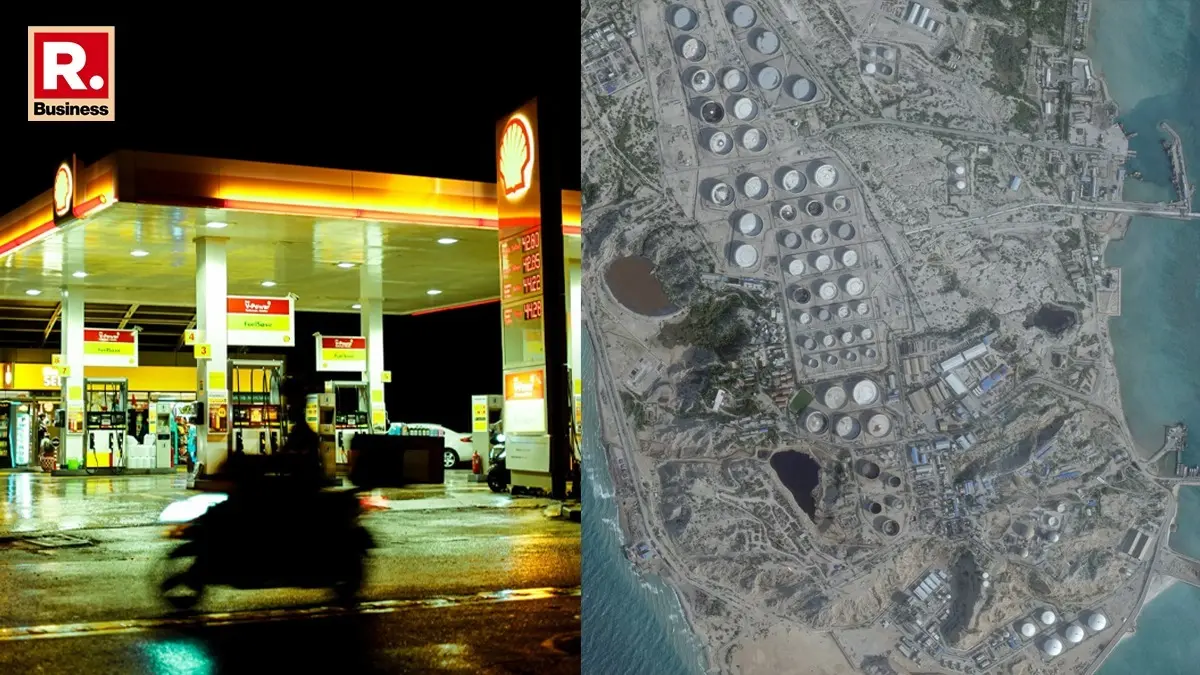
In a major escalation of the West Asia conflict, U.S. forces carried out heavy bombing raids on Saturday, March 14, targeting military installations on Kharg Island, widely regarded as the most critical node in Iran’s oil export infrastructure.
The strikes focused on military assets, including radar installations, air defence systems and outposts linked to the Islamic Revolutionary Guard Corps, but deliberately avoided damaging oil infrastructure. Even so, the attack has heightened fears across global energy markets because the island plays an outsized role in the country’s crude export system.
Iran’s “Orphan Pearl” and Its Strategic Oil Role
Despite its relatively small size and remote location in the Persian Gulf, Kharg Island functions as the central artery of Iran’s oil export network.
The island was famously described as the “Orphan Pearl” by Iranian writer Jalal Al-e-Ahmad, who used the phrase to capture the island’s striking yet lonely presence in the Gulf. Surrounded by blue waters and coral formations, the island resembles a solitary pearl resting in the sea. Yet unlike traditional Gulf pearls that were historically part of thriving coastal communities, Kharg stands isolated, geographically detached from the Iranian mainland and largely dominated by industrial oil facilities rather than civilian life. The term “orphan” reflects this sense of isolation, while “pearl” points to its immense value to Iran’s economy.
Advertisement
Economically, the island is anything but isolated.
• Kharg Island handles around 90–95% of Iran’s total crude oil exports, effectively giving it near-monopoly status over the country’s overseas energy shipments.
Advertisement
• The island’s deep-water berths allow Very Large Crude Carriers (VLCCs) to dock directly, an advantage many other Iranian ports lack due to shallow coastal waters.
• A network of subsea pipelines from major mainland oil fields, including Ahvaz and Marun, terminates at Kharg Island, feeding storage facilities capable of holding around 30 million barrels of crude.
Because of this infrastructure, any disruption to the terminal could instantly choke off most of Iran’s oil exports.
As the primary maritime "battery" of the Iranian economy, Kharg Island serves as a massive deep-water terminal housing more than 40 storage tanks with a total capacity of 30 million barrels. According to Kpler’s latest satellite tracking, Iran significantly ramped up exports ahead of the March 14 strikes to "empty" its storage and mitigate fire risks, leaving an estimated 18 million barrels, a critical 10-to-12-day global supply buffer, currently in situ.
Industry giants like J.P. Morgan, led by analyst Natasha Kaneva, warn that because the island’s specialized "T-Jetty" and "Sea Island" facilities are the only docks capable of handling Ultra Large Crude Carriers (ULCCs), its destruction would force an immediate shut-in of 50% of Iran’s national production. While S&P Global Commodity Insights notes that Tehran recently added 2 million barrels of storage capacity, analysts from Pickering Energy Partners and Goldman Sachs warn that disabling this infrastructure would "delete" 2 million barrels per day from the market "for good," likely keeping Brent crude well above $100 and threatening a further spike if retaliation spreads to neighboring Gulf hubs.
The attack was confirmed by Donald Trump, who said U.S. Central Command had conducted a large-scale bombing mission targeting military assets on the island.
Forces under the United States Central Command reportedly carried out the operation. Trump stated, “For reasons of decency, I have chosen NOT to wipe out the Oil Infrastructure on the Island… but [we] could hit oil infrastructure next if Tehran keeps disrupting energy flows.”
The statement signalled that energy facilities remain a potential target if the conflict escalates further.
Global Energy Markets Brace for Supply Shock
The possibility of a shutdown at Kharg Island has immediately triggered volatility in oil markets. Brent crude prices were already trading around $103–$105 per barrel, reflecting heightened geopolitical risk.
Several key risk indicators are now under scrutiny:
• Iran’s export volumes, normally around 1.7 million barrels per day, could disappear from global markets if the terminal is disabled.
• The Strait of Hormuz, through which roughly one-fifth of global oil supply passes, has already seen partial disruptions due to naval activity.
• A direct strike on the terminal’s loading infrastructure could push oil prices sharply higher, potentially toward $120–$150 per barrel.
Iran has warned that any attack on its energy infrastructure would be met with retaliation against oil facilities across the region. Potential targets could include energy infrastructure in Saudi Arabia or the United Arab Emirates, both key players in global oil markets.
Investors are also watching for signs of a possible U.S. ground operation to secure the island’s export jetties, an action that would represent one of the most significant military interventions in the region since the Iraq War. For now, energy markets remain in a wait-and-watch mode, balancing the fact that oil infrastructure was spared with the growing possibility that the conflict could expand further across the Gulf.