
Why Is Cheese More Expensive Than Paneer Despite 0% GST on Dairy? The Truth Every Consumer Should Know!
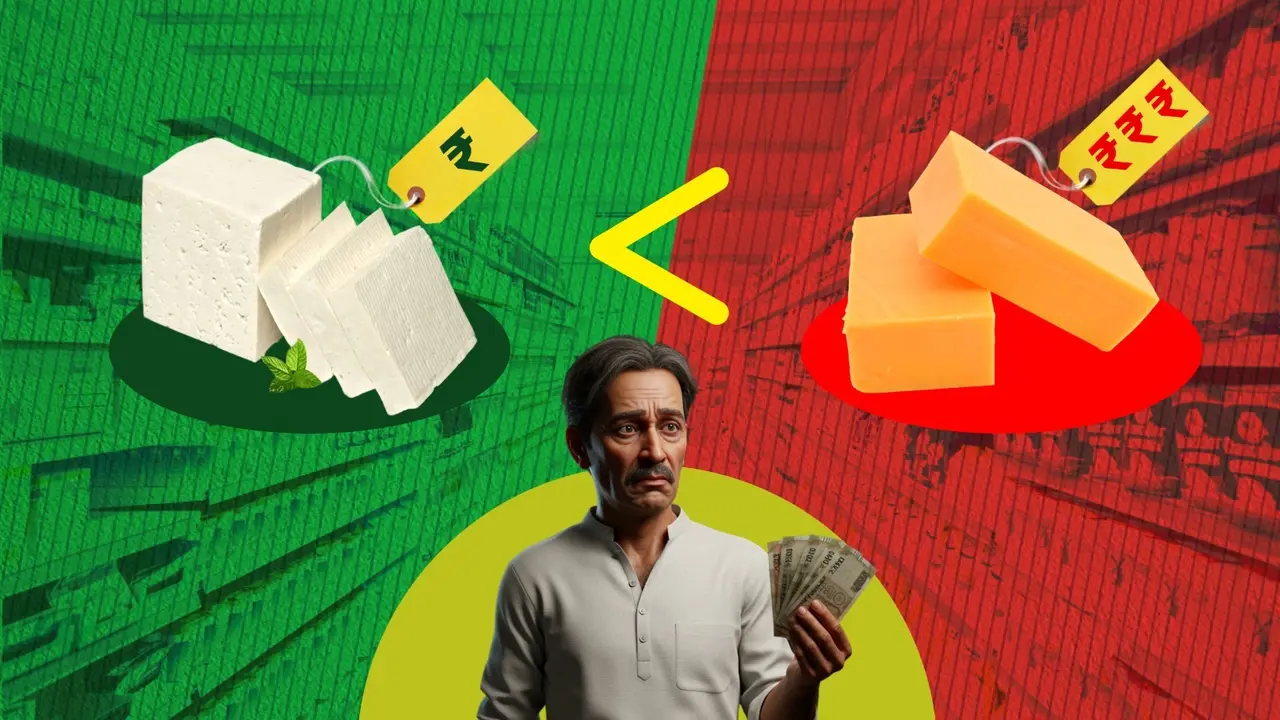
India’s new GST scheme exempts paneer and basic dairy from tax, while cheese attracts only 5%. Yet cheese remains far costlier than paneer. The answer lies not in GST but in production, storage, and import rules. Here’s a fact-based explainer every consumer should know before shopping.
- Republic Business
- 2 min read

;'%3e%3cpath%20d='m8,15.99c4.41,0,7.99-3.58,7.99-7.99S12.41,0,8,0,0,3.59,0,8s3.58,7.99,7.99,7.99Z'%20style='stroke:%23fff;%20stroke-miterlimit:10;%20stroke-width:.02px;'/%3e%3cpath%20d='m3.08,3.37l3.82,5.11-3.84,4.15h.87l3.37-3.64,2.72,3.64h2.94l-4.04-5.39,3.58-3.87h-.86l-3.1,3.35-2.5-3.35h-2.94Zm1.27.64h1.35l5.97,7.99h-1.35l-5.97-7.99Z'%20style='fill:%23fff;'/%3e%3c/g%3e%3c/svg%3e)


India’s revamped GST structure, effective September 22, 2025, slashed slabs to just 5% and 18%, while essential foods like milk, paneer, chapatis, and notebooks were moved to the 0% bracket.
Cheese, however, stayed in the 5% category, raising a question many consumers have: If paneer is tax-free and cheese is barely taxed, why does cheese cost so much more?
To decode this, you need to understand the journey of paneer and cheese from farm to plate.
Why did Cheese get more GST?
Here’s the GST status under the new slabs (effective September 22, 2025):
Paneer (unbranded/plain, fresh, UHT milk, khakra, pizza bread, chapati, etc.) → 0% GST
Exempted completely, falls under essential food items.
Branded/packaged cheese (processed cheese, cheese slices, spreads, etc.) → 5% GST
Still taxed at a minimal rate since it’s considered a processed/packaged food.
So if you buy plain paneer, no GST applies. But if you buy packaged cheese (like Amul slices, spreads), it will attract 5% GST.
Read More - GST 2.0 and You: Ways Your Daily Life Will Change From September 22
The Bottom Line for Consumers
GST may shape price tags, but it is not the main reason cheese is pricier than paneer.
So when you see paneer and cheese side by side at the supermarket, remember: paneer is local, simple, and fresh, while cheese is global, complex, and aged. The tax is only a tiny part of the story.
Advertisement
On Wednesday, Finance Minister Nirmala Sitharaman announced sweeping cuts in Goods and Services Tax (GST) rates under a new framework dubbed GST 2.0. Effective from September 22, most items will now fall under two simplified slabs, 5% and 18%, with a special 40% slab for sin and ultra-luxury goods.
The move represents the biggest revamp since GST’s launch in 2017, with the stated aim of putting more money in consumers’ pockets, boosting household demand, and insulating
Advertisement
India’s economy from global tariff shocks.
The timing is deliberate: Navratri through Diwali is the biggest consumption season in India. Lower taxes on everyday goods, cars, and consumer durables are expected to drive festive spending.