
Bangladesh Military Coup: How PM Sheikh Hasina Was Forced to Flee Dhaka Amid Mass Protests
The unrest began with demands to abolish civil service job quotas but has evolved into a broader anti-government movement, fueled by economic struggles.
- Defence News
- 5 min read

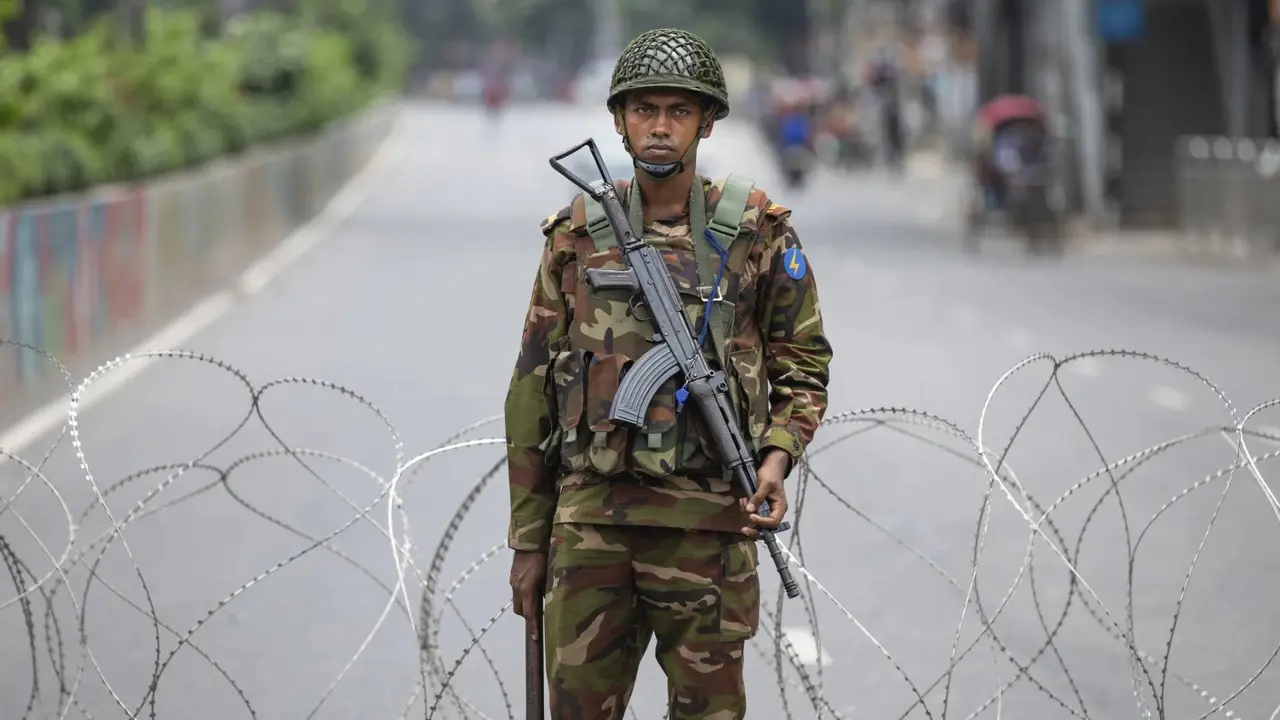
Dhaka, Bangladesh: The latest protests have become the most serious challenge Ms Hasina has faced since taking office, following a highly controversial election where her party was re-elected for the fourth straight parliamentary term. Amid increasing calls for her resignation, she has remained defiant, condemning the agitators as “terrorists” and appealing for support to "suppress these terrorists with a firm hand."
Bangladesh Prime Minister Sheikh Hasina has left Dhaka in a military chopper amid nationwide violence, local media reported on Monday. As per latest reports from Bangladesh, Sheikh Hasina has left for a location in India, though there is no official confirmation. The unrest in Dhaka and elsewhere began with a demand to abolish quotas in civil service jobs but evolved into a broader anti-government movement.
In the wake of the pandemic, Bangladesh has been struggling with the escalating cost of living. Inflation has skyrocketed, its foreign exchange reserves have dropped precipitously, and its foreign debt has doubled since 2016. Critics blame this on Ms Hasina's government's mismanagement, arguing that Bangladesh's previous economic success primarily benefited those close to Ms Hasina’s Awami League due to endemic corruption.
Critics Allege Corruption and Authoritarianism
Critics also allege that the country's progress has come at the cost of democracy and human rights. They accuse Ms Hasina's rule of being marked by repressive authoritarian measures against her political opponents, detractors, and the media. The government and Ms Hasina deny such allegations, but in recent months, many senior leaders from the BNP have been arrested, along with thousands of supporters following anti-government protests.
Advertisement

Rights groups have expressed concern about hundreds of cases of alleged enforced disappearances and extrajudicial killings by security forces since 2009. Ms Hasina's government flatly denies claims that it is behind such abuses but also severely restricts visits from foreign journalists who want to investigate these allegations.
Military's Role Under Scrutiny Amid Crisis
With Bangladesh’s security forces on a deadly collision course with angry protesters after a crackdown on Sunday, attention has turned to the country’s powerful military establishment to see how it might respond. Protesters are demanding that Prime Minister Sheikh Hasina leave office after 15 years of rule that has turned increasingly authoritarian.
Advertisement
If the violence on the street leads to instability and chaos, the military, which has sought to distance itself from the violent police reaction through weeks of unrest, would likely become a central player. Bangladesh’s army has a history of staging coups and counter-coups but has taken a less overt role in public affairs over the past couple of decades, choosing more often to exercise influence from behind the scenes.
Historical Context and Potential Military Response
Part of this shift has been attributed to Ms Hasina. Her father, Bangladesh’s first leader Sheikh Mujibur Rahman, and much of her family were killed in a deadly military coup in 1975. During her time in office, she has stacked the military’s leadership ranks with loyalists and allowed them access to lucrative government contracts and other businesses.
There are international incentives for the military as well, which has been a major contributor to United Nations peacekeeping missions, providing another important side business. Any involvement in a coup would subject the army to criticism or ostracism from the U.N., whose human rights chief responded to the recent killings by calling for restraint and accountability from those with “command responsibility.”
Possible Transition Scenarios
While the army was deployed on the streets during the crackdown to clear protesters late last month, there have been reports of discomfort in the ranks over it. Dozens of former senior officers issued a statement calling on the military not “to rescue those who have created this current situation,” which some interpret as a reference to the police and paramilitaries, and possibly to Sheikh Hasina herself.
On Sunday, the army’s chief, Gen. Waker-uz-Zaman, gathered senior officers for a meeting seen as an attempt to allay concerns. In a statement after the meeting, the army said its chief had reiterated that “the Bangladesh Army will always stand by the people in the interest of the public and in any need of the state.” Analysts suggest that if Ms Hasina’s power becomes untenable, the army would be unlikely to opt for a takeover but might aid a transition period with a caretaker government, similar to what occurred in 2007.
Who is Sheikh Hasina?
Born to a Muslim family in East Bengal in 1947, Ms Hasina had politics in her blood. Her father was the nationalist leader Sheikh Mujibur Rahman, Bangladesh's 'Father of the Nation' who led the country's independence from Pakistan in 1971 and became its first president. At that time, Ms Hasina herself had already established a reputation as a student leader at Dhaka University.
Mr. Rahman was assassinated with most of his family members in a military coup in 1975. Only Ms Hasina and her younger sister survived as they were travelling abroad at the time. After living in exile in India, Ms Hasina returned to Bangladesh in 1981 and became the leader of the political party her father belonged to, the Awami League.
She joined hands with other political parties to hold pro-democracy street protests during the military rule of General Hussain Muhammed Ershad. Propelled by the popular uprising, Ms Hasina quickly became a national icon. She was first elected to power in 1996, earning credit for signing a water-sharing deal with India and a peace deal with tribal insurgents in the south-east of the country.
However, her government faced criticism for numerous allegedly corrupt business deals and for being too subservient to India. She later lost to her former ally turned nemesis, Begum Khaleda Zia of the Bangladesh Nationalist Party (BNP), in 2001. As heirs to political dynasties, both women have dominated Bangladesh politics for more than three decades and are known as the "battling Begums," with Begum referring to a Muslim woman of high rank.