
Boeing delivers first Orca Autonomous Undersea Vehicle to U.S. Navy amid fleet expansion
Boeing successfully delivers the first Orca extra-large unmanned undersea vehicle (XLUUV) to the U.S. Navy after overcoming delays and challenges.
- Defence News
- 3 min read

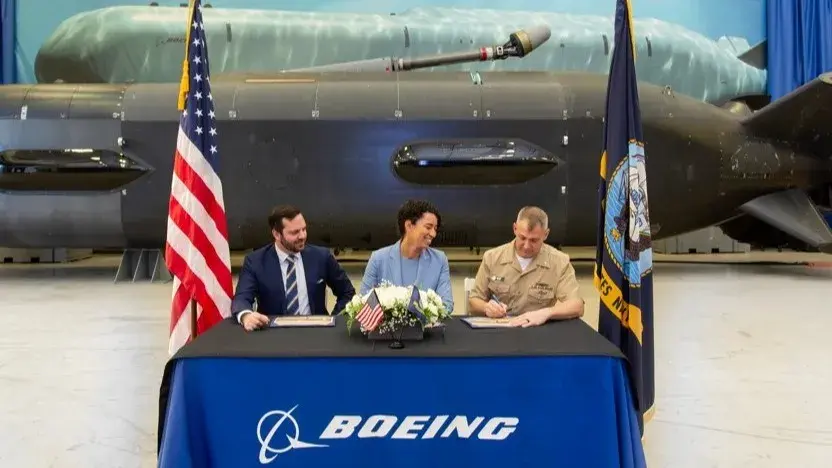
Boeing has successfully delivered the first Orca extra-large unmanned undersea vehicle (XLUUV) to the U.S. Navy, marking a significant leap in autonomous underwater capabilities. The delivery, initially planned for December 2020, faced delays attributed to distinctions between Orca and its prototype, compounded by the challenges imposed by the COVID-19 pandemic.
Collaborating with the Navy, Boeing subjected Orca to comprehensive acceptance testing, culminating in successful at-sea maneuvers above and below the surface. This milestone delivery, the first of five Orcas, represents the realization of more than a decade of pioneering work. It builds upon earlier projects such as Echo Voyager, Echo Seeker, and Echo Ranger, showcasing Boeing's commitment to advancing maritime technology.
Challenges and program dynamics
Despite its innovative features, the Orca program encountered delays and cost overruns. A Government Accountability Office (GAO) report highlighted key differences between Echo Voyager and Orca, necessitating redesigns and contributing to a program cost exceeding the original estimate by at least $242 million.
Weighing 80 tons and measuring 85 feet in length, the highly modular Orca accommodates diverse mission requirements. Core functionalities encompass guidance and control, navigation, autonomy, situational awareness, communications, power distribution, propulsion, maneuvering, and mission sensors. The vehicle's extendable mast and 34-foot-long payload section, with an eight-ton capacity, add to its versatility.
Advertisement
How Orca XLUUV will enable silent operations
Orca's hybrid diesel-electric propulsion system enables prolonged submerged operations with silent underwater movement. The combination of a diesel-electric engine and lithium-ion batteries facilitates extended sea deployments at speeds of around three knots. The shrouded propulsor enhances silent and efficient movement.
While the exact launch method remains under consideration due to Orca's size, potential options include large surface ships or piers. The Navy's Expeditionary Sea Bases (ESB) are being evaluated for potential modification to support Orca launch and recovery.
Advertisement
Orca's deployment capabilities across vast areas for extended durations position it as a valuable asset for diverse Navy operations. From targeting enemy shipyards to executing high-risk mine-laying operations in narrow waterways, Orca offers versatility in fulfilling critical missions. The delivery of the first XLUUV underscores a significant advancement in the Navy's unmanned underwater capabilities, addressing the gap between medium and extra-large UUVs post the cancellation of the Snakehead project.