
Fifth-Gen Titans Su-57 and F-35 to to Go Face-to-Face at Aero India 2025 in a Global First
In a historic first, Aero India 2025 will feature the F-35 Lightning II and Su-57 Felon, marking the debut of two fifth-generation stealth fighters.
- Defence News
- 6 min read

;'%3e%3cpath%20d='m8,15.99c4.41,0,7.99-3.58,7.99-7.99S12.41,0,8,0,0,3.59,0,8s3.58,7.99,7.99,7.99Z'%20style='stroke:%23fff;%20stroke-miterlimit:10;%20stroke-width:.02px;'/%3e%3cpath%20d='m3.08,3.37l3.82,5.11-3.84,4.15h.87l3.37-3.64,2.72,3.64h2.94l-4.04-5.39,3.58-3.87h-.86l-3.1,3.35-2.5-3.35h-2.94Zm1.27.64h1.35l5.97,7.99h-1.35l-5.97-7.99Z'%20style='fill:%23fff;'/%3e%3c/g%3e%3c/svg%3e)


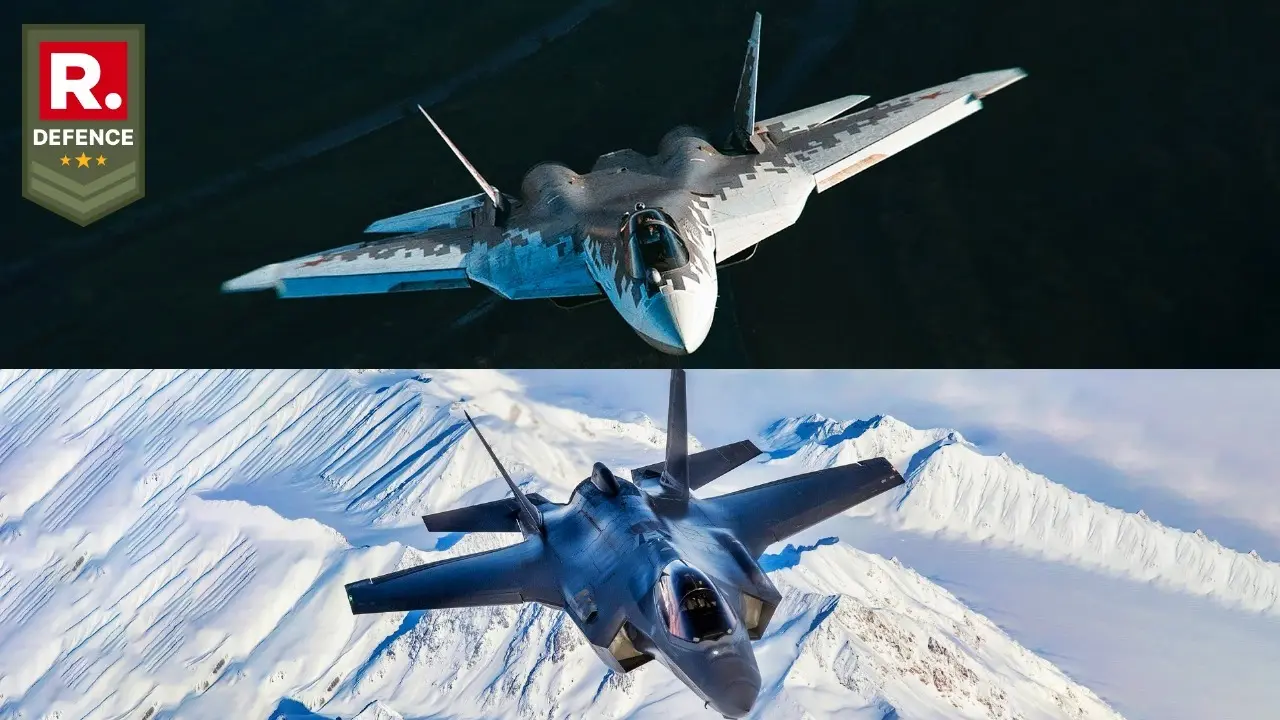
Bengaluru, India- In a historic first, the Aero India 2025 mega event will witness the participation of two of the world’s most advanced fifth-generation fighter aircraft equipped with stealth capabilities—the Russian Su-57 and the American F-35 Lightning II, the Defence Ministry announced on Sunday.
Billed as Asia’s largest air show, its 15th edition will be hosted at Air Force Station, Yelahanka, from February 10-14. Organised over 42,000 square meters, with over 900 exhibitors, including 150 foreign companies, this edition is set to be the biggest-ever Aero India to date.
"For the first time in history, Aero India 2025 will witness the participation of two of the world’s most advanced fifth-generation fighter aircraft—the Russian Su-57 and the American F-35 Lightning II," the ministry said in a statement. It marks a "milestone in global defence collaboration" and technological advancement, offering aviation enthusiasts and defence experts an unparalleled opportunity to witness these state-of-the-art warplanes in action.
The question of whether the Lockheed Martin F-35 or the Sukhoi Su-57 is better suited for the Indian Air Force (IAF) is a complex one, given that both aircraft were developed for different operational needs and strategic objectives. While the Su-57 is designed primarily for Russian defence priorities, the F-35 is tailored to meet U.S. and NATO requirements.
However, a purely technical comparison offers key insights into their capabilities and how they align with India's defence strategy.
Advertisement
On the surface, comparing these two aircraft purely on technical specifications might seem logical. However, in reality, major defence procurements are rarely based on just numbers—geopolitics always plays a hand. For instance, a U.S. president like Donald Trump could outright warn India: “Buy the Su-57, and we’ll hit you with sanctions.” In contrast, Russia might be willing to transfer critical technology, something the U.S. would never do.
So, leaving political pressure aside, let’s get down to brass tacks—how do these two stealth fighters measure up, and which one aligns better with the IAF’s needs?
Advertisement
Different Birds for Different Skies
While both jets fall under the "fifth-generation stealth fighter" label, their missions are fundamentally different.
The F-35 is an offensive strike platform. It’s built to penetrate enemy airspace, take out high-value targets, and coordinate air battles with real-time sensor fusion. It thrives in contested airspace, where it can sneak in undetected, disable enemy defences, and direct supporting aircraft from a position of tactical advantage.

The Su-57, on the other hand, is a hunter. It was designed to defend Russia’s vast airspace, intercept stealth fighters like the F-35, and support friendly forces from within defended airspace. Unlike the F-35, the Su-57 does not rely solely on stealth—it uses a combination of sensors, speed, and manoeuvrability to locate and kill its targets.
For India, the question is simple: Does the IAF need an aircraft that can take the fight deep into enemy territory or one that can secure the skies over the subcontinent?
Stealth Factor: How Invisible Are They?
Stealth is a critical factor in modern air warfare, and this is where the F-35 pulls ahead.
- The F-35 has an all-aspect stealth design, meaning it’s difficult to detect from any direction—front, side, or rear. Its radar cross-section (RCS) is just 0.0015 square meters, making it virtually invisible to conventional radar.
- The Su-57 is stealthy, but not to the same extent. It has strong frontal stealth, meaning it’s hard to spot head-on, but its side and rear profiles are not as optimized for low observability. Its RCS is estimated between 0.1 and 0.5 square meters, making it easier to detect than the F-35 from certain angles.
Bottom line: If India wants a jet that can sneak into enemy airspace and strike without being seen, the F-35 is the clear winner. But if the goal is to defend Indian skies and take out intruding enemy jets, the Su-57’s stealth is good enough for the job.
Sensors and Firepower: Who Sees First, Who Shoots First?
Fifth-gen warfare isn’t just about speed and stealth—it’s about sensor dominance.
The F-35 is a flying command centre. Its radar, infrared tracking, and electronic warfare systems are so advanced that it can detect enemy aircraft long before they see it. It also acts as a battlefield “quarterback,” feeding targeting data to other fighters, ground forces, and warships.
The Su-57 plays a different game. While it lacks the F-35’s sensor fusion capabilities, it compensates with raw detection power. It carries five different radar arrays, including two L-band radars that specialize in spotting stealth aircraft like the F-35. It also has a highly advanced infrared search and track (IRST) system, allowing it to detect heat signatures from enemy jets even if they are stealthy on radar.
In a dogfight, the Su-57’s superior manoeuvrability and infrared tracking could give it an edge. But in beyond-visual-range (BVR) combat, the F-35 would see the Su-57 first and strike before the Russian jet even knows what hit it.
Cost and Maintenance: The Hidden Price of Power
This is where the Su-57 starts to look more appealing.
- The F-35 is expensive—both to buy and to maintain. A single unit costs around $80-100 million, and its complex stealth coating requires extensive maintenance, pushing operational costs through the roof.
- The Su-57 is cheaper—by a lot. Its estimated unit cost is 40-50% lower than the F-35, and it does not require as much expensive upkeep. Russia designed it to be rugged, low-maintenance, and capable of flying more sorties per day than the F-35.
For a country like India, which must balance advanced capabilities with affordability, this cost difference is no small factor.
Technology Transfer: Who’s Willing to Share?
One of the biggest dealbreakers in any Indian fighter jet procurement is technology transfer (ToT). India doesn’t just want to buy jets—it wants to build them locally and absorb key technologies for its indigenous fighter programs.
The U.S. will NEVER share F-35 technology. If India buys the F-35, it will be completely dependent on American support and spare parts, just like how Pakistan depends on the U.S. for its F-16s.
Russia, however, is open to tech transfer. Moscow has historically been more willing to share military technology with India, making the Su-57 a more attractive option from a strategic perspective.
Final Verdict: Which One Should India Choose?
At the end of the day, the best jet is the one that aligns with India’s strategic goals.
If the IAF wants an offensive, first-strike capability: The F-35 is unmatched. It is the better stealth jet, it has superior sensors, and it dominates in networked warfare. But it is expensive, comes with geopolitical strings attached, and offers zero tech transfer.
If India prioritizes air defense and cost-effectiveness: The Su-57 makes more sense. It is cheaper, still stealthy enough for defensive operations, and comes with a chance for technology transfer.
Given India’s historical preference for multi-role, air-superiority fighters with a strong emphasis on sovereignty and self-reliance, the Su-57 seems like the more practical option. However, the ultimate choice will depend on how much India values stealth penetration over air defence, and—perhaps more importantly—how willing it is to deal with the geopolitical consequences of its decision.