
As Japan unveils world's first ship-based railgun, here’s what India and the world are up to
Japan tested the world's first operational railgun, while India is getting ready to integrate its own on mobile platforms
- Defence News
- 5 min read

'%20fill='white'/%3e%3cg%20id='1200px'%3e%3crect%20width='1200'%20height='382'%20transform='translate(-829%20-9348)'%20fill='white'/%3e%3cg%20id='Home%20Page%20Content'%3e%3crect%20width='1905'%20height='30990.4'%20transform='translate(-1181.5%20-8954)'%20fill='white'/%3e%3cg%20id='Debate%20Quicks%20+%20Poll'%20clip-path='url(%23clip0_115_35629)'%3e%3crect%20width='1224'%20height='492'%20transform='translate(-841%20-3)'%20fill='white'/%3e%3cg%20id='Entertainment%20Quicks'%3e%3cg%20id='Header+Content'%3e%3cg%20id='Section%20Header'%3e%3crect%20width='379'%20height='44'%20transform='translate(-8%20-4)'%20fill='%23A20010'/%3e%3cg%20id='Section%20Name'%3e%3cg%20id='R.logo'%20clip-path='url(%23clip1_115_35629)'%3e%3cg%20id='R.'%3e%3cg%20id='Group'%3e%3cpath%20id='Vector'%20d='M39.3895%200H0.619814C0.279658%200%200.00390625%200.275754%200.00390625%200.61591V35.3841C0.00390625%2035.7242%200.279661%2036%200.619817%2036H39.3895C39.7297%2036%2040.0054%2035.7242%2040.0054%2035.3841V0.615908C40.0054%200.275751%2039.7297%200%2039.3895%200Z'%20fill='%23D10014'/%3e%3cpath%20id='Vector_2'%20d='M33.1603%2031.2711C35.2153%2031.0652%2036.7155%2029.2199%2036.5111%2027.1495C36.3067%2025.0792%2034.4751%2023.5677%2032.4201%2023.7736C30.3651%2023.9796%2028.8649%2025.8249%2029.0693%2027.8952C29.2737%2029.9656%2031.1053%2031.4771%2033.1603%2031.2711Z'%20fill='white'/%3e%3cpath%20id='Vector_3'%20d='M5.17188%205.62891H17.2328C21.1319%205.62891%2023.8278%206.65659%2025.5407%208.41892C27.0347%209.88754%2027.7996%2011.8696%2027.7996%2014.4026V14.4758C27.7996%2018.4041%2025.7224%2021.0103%2022.5525%2022.3683L28.6379%2031.3258H20.4761L15.3381%2023.5432H12.2409V31.3258H5.17188V5.62891ZM16.9049%2017.9632C19.3099%2017.9632%2020.6942%2016.7883%2020.6942%2014.9161V14.8428C20.6942%2012.8241%2019.2365%2011.7957%2016.8685%2011.7957H12.2409V17.9632H16.9049Z'%20fill='white'/%3e%3c/g%3e%3c/g%3e%3c/g%3e%3c/g%3e%3c/g%3e%3c/g%3e%3c/g%3e%3c/g%3e%3c/g%3e%3c/g%3e%3c/g%3e%3cdefs%3e%3cclipPath%20id='clip0_115_35629'%3e%3crect%20width='1224'%20height='492'%20fill='white'%20transform='translate(-841%20-3)'/%3e%3c/clipPath%3e%3cclipPath%20id='clip1_115_35629'%3e%3crect%20width='40.0015'%20height='36'%20fill='white'/%3e%3c/clipPath%3e%3c/defs%3e%3c/svg%3e) Big Data
Big Data
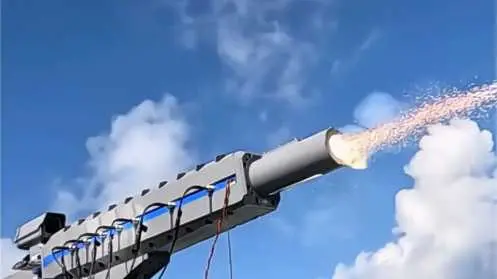
An Railgun firing a high velocity projectile
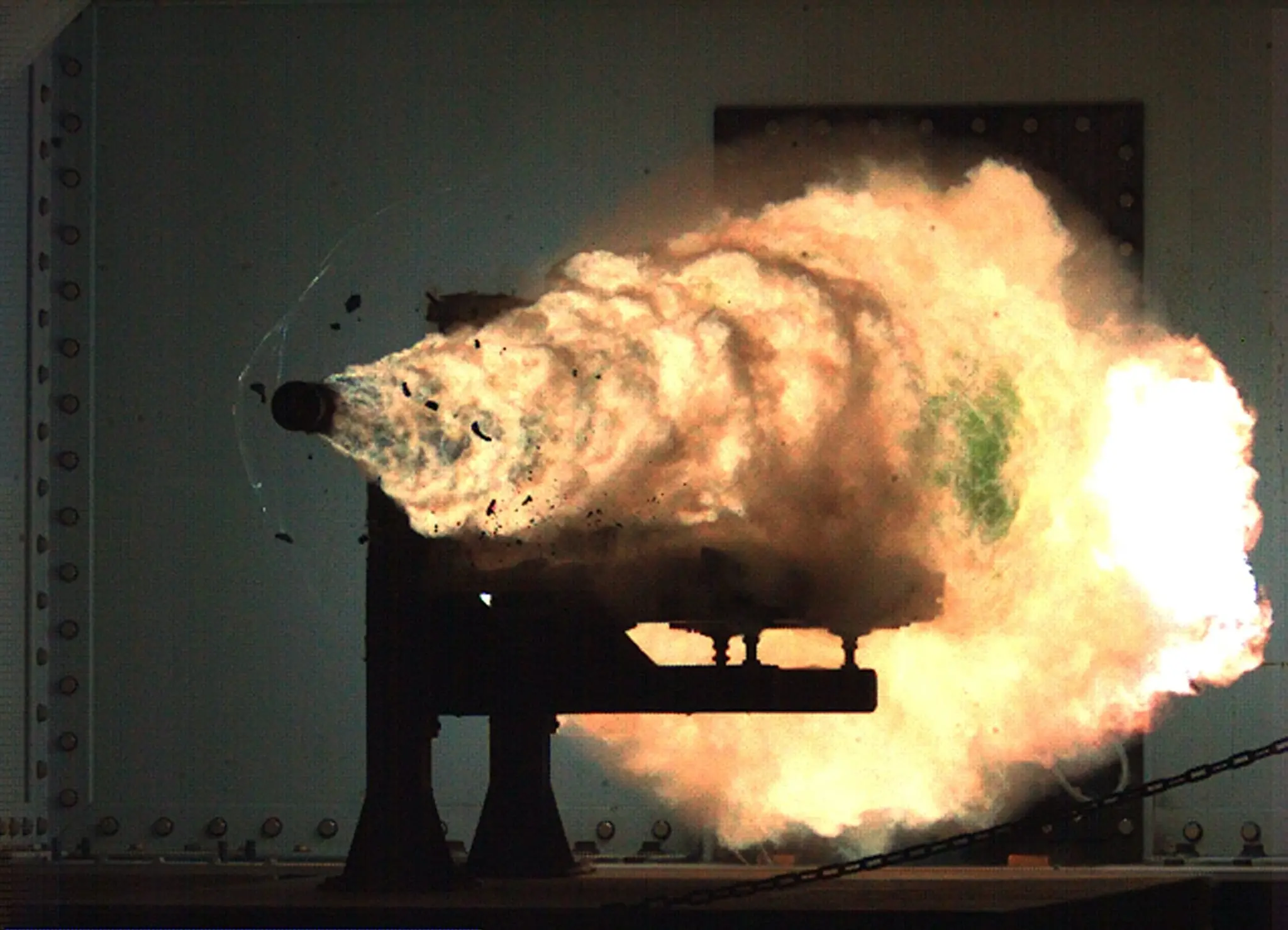
JMSDF firing world's first ship-based railgun from an unidentified Japanese vessel.
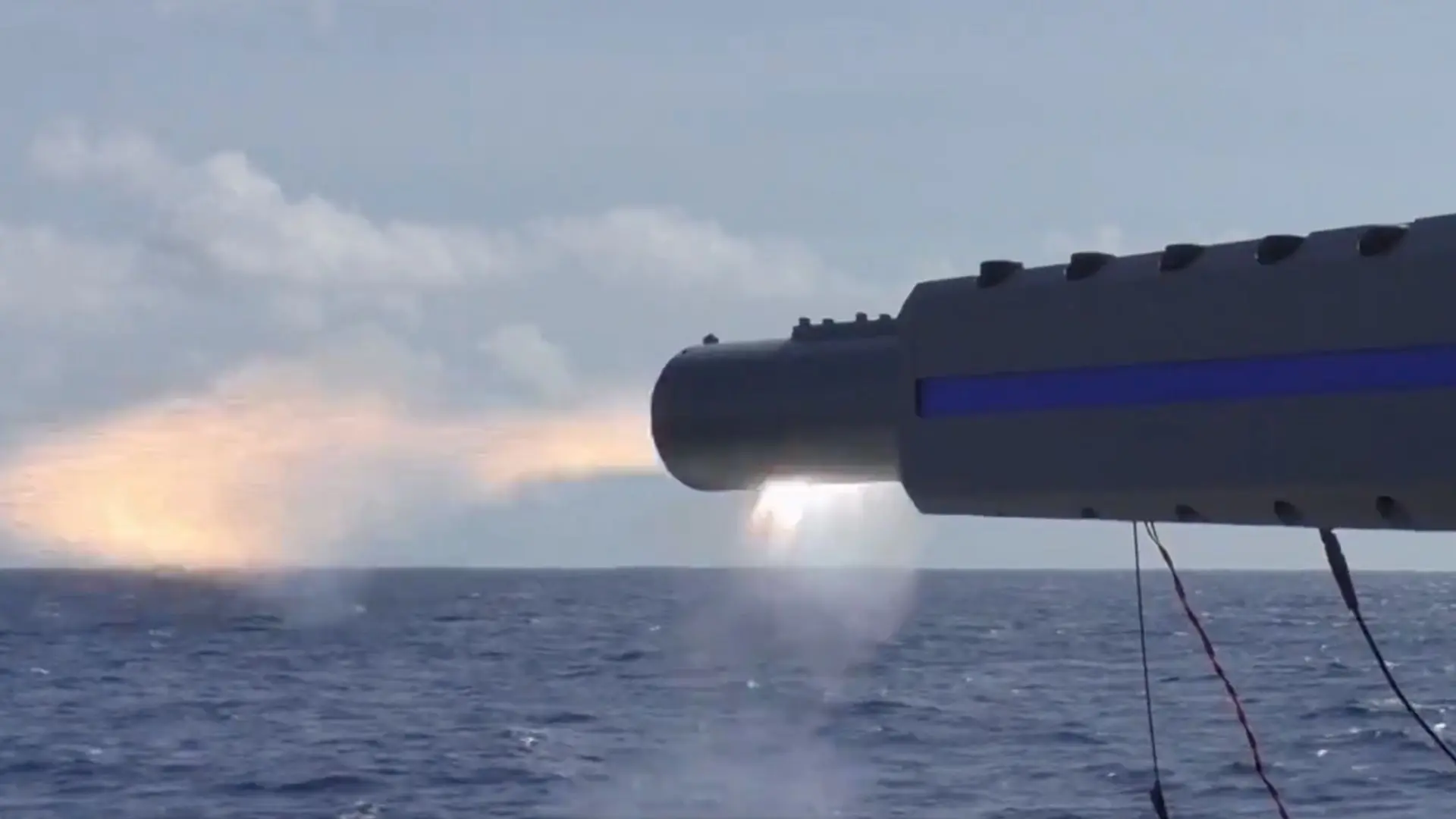
Japans’ fires world’s first ship-board railgun in collaboration with ALTA
Japan's Acquisition Technology & Logistics Agency (ATLA) recently conducted the world's first ship-board firing test of a railgun in collaboration with the Japan Maritime Self-Defense Force (JMSDF), on October 17. This represents a significant leap in naval defence capabilities, positioning Japan at the forefront of electromagnetic (EM) railgun development. Meanwhile, India's Defence Research and Development Organization (DRDO) has made its own strides in this specific technology.
This article delves into the recent advancements in electromagnetic railguns, highlighting what India and the world are up to with EM railgun development.
Japan's electromagnetic railgun program
ATLA's accomplishment in May 2023 unveiled a medium-sized electromagnetic railgun prototype, capable of firing 40mm steel projectiles at hypersonic velocities of approximately 2,230 m/s (Mach 6.5), subsequently plans in ATLA and JMSDF are underway to upgrade the railgun's charge energy from five megajoules (MJ) to 20 MJ, further enhancing its performance.
Deployment prospects and challenges
While specific deployment platforms remain undisclosed, with the test conducted by ATLA, there are indications that Japan may integrate these railguns into select Maritime Self-Defense Force destroyers. Additionally, Japan’s forthcoming multi-purpose missile defence vessels could potentially serve as hosts for this technology. However, challenges abound. Railguns must contend with corrosive saltwater, constant shocks, extreme temperatures, and other environmental factors inherent in maritime operations. Despite the progress, significant hurdles must be overcome before a fully operational naval railgun system becomes a reality.
Strategic imperatives
Japan's pursuit of new naval tech is in response to escalating threats in the Indo-Pacific region. As Japanese Defense Minister Minoru Kihara had also previously stated, Japan’s defence strategies are being formulated to ‘discourage’ other countries from changing the status quo. North Korea's expanding missile capabilities, including the development of an array of weapons including potentially hypersonic missiles, pose a grave danger to Japan's national security. Furthermore, territorial disputes, particularly in the East China Sea, underscore the need for advanced defence capabilities. China's anti-ship missile arsenal presents a significant challenge that Japan is actively addressing, and Japan also has dissent in the north with respect to joint exercises that Russia and China undertake; the centre of this dissent is the possession of the Kuril Islands with Russia.
Advertisement
DRDO's advancements in electromagnetic railgun technology
India, through the DRDO, is actively engaged in the development of electromagnetic railgun technology. ARDE, a division of DRDO, has been on the vanguard of this endeavour. They have successfully designed and installed a railgun based on a 10 MJ capacitor bank, achieving hypervelocity propulsion of over 2000 m/s.
The complex of DRDO's venture into Electromagnetic Railgun technology development is located at the ARDE in Pune. As per ARDE Director A. Raju, it stands to reshape the arsenal of land, air, and naval forces. Unlike conventional naval/land howitzers, an Electromagnetic Railgun relies on electromagnetic energy for propulsion. This sets it apart, enabling the acceleration of projectiles at extraordinary velocities. DRDO's recent report underscores the transformative potential of this technology.
The Breakthrough
ARDE has successfully designed and installed a Railgun based on a 10 MJ capacitor bank. This achievement enables hypervelocity propulsion of over 2000 m/s. Testing from a fixed firing stand further confirms the system's exceptional performance, as put forth by A. Raju himself.
“A 10 MJ railgun powered by capacitor bank has been successfully test fired with various bore sizes and projectile masses. The next level plan is weaponization of the technology by developing a 100 MJ railgun,” he added.
The Railgun offers several key advantages:
- Extended range: Surpassing conventional cannons, even the current ARDE Railgun has the capability to fire projectiles at a 200-kilometre range, compared to the standard 50-60 kilometres of high-powered conventional heavy howitzers in current service.
- Naval warfare revolution: The technology promises to revolutionise naval strike operations, providing hypervelocity projectiles with pinpoint accuracy and extended ranges. Additionally, the absence of energetic materials eliminates the need for stringent safety standards.
- Cost efficiency: By eliminating the use of gunpowder, and a plethora of other subcomponents used in traditional howitzers, the Railgun offers a more cost-effective solution for defence applications.

Future prospects
DRDO's pursuit of Electromagnetic Railgun technology positions India among the leading nations in this field. Achieving optimal results will equip India with a vital technology to address future defence challenges. Additionally, DRDO is exploring the development of its 100 MJ variant of the railgun on mobile systems; the revelations date back to December 2022, and the basic structure and components will be based on the 10 MJ version. As per DRDO sources, the future variant will be used to fire an 18 kg projectile with a similar muzzle velocity and in the future would be capable of firing a 155 mm calibre artillery round with a range of 100 to 400 km.
Global developments in the realm of EM cannons
In recent times, nations beyond Japan have shown marked progress in railgun technology. Notably, on July 19, 2023, the French Defence Procurement Agency introduced an electromagnetic cannon initiative for naval vessels, a project spearheaded by the Franco-German Research Institute of Saint-Louis (ISL) and financially supported by the Defense Innovation Agency (AID).
China, too, has notched substantial achievements in this arena; they have already demonstrated a prototype of a sizable-calibre railgun. On August 30, 2023, China's Navy reportedly conducted a successful trial of its railgun; the Chinese EM gun was able to propel a 124-kg (273-lb) projectile at speeds of 700 km/h (435 mph) in a mere 0.05 seconds.
Further, on September 28, 2023, the European Defence Agency (EDA) convened the conclusive session of the PILUM initiative. This project centres on a concept for an electromagnetic railgun (EMRG), presenting a prospective augmentation to conventional artillery systems with the additional capability of substantially heightened projectile velocities and extended-range impact.
Advertisement
Published By : Diana George
Published On: 20 October 2023 at 12:27 IST