
Pakistan’s F-16 Use Under Scrutiny Again as U.S. Sends Contractors, Releases $400 Million Ahead of Balakote Anniversay
The Trump administration has approved the release of $400 million USD to fund Pakistan’s F-16 Technical Security Team, responsible for ensuring compliance.
- Defence News
- 5 min read

;'%3e%3cpath%20d='m8,15.99c4.41,0,7.99-3.58,7.99-7.99S12.41,0,8,0,0,3.59,0,8s3.58,7.99,7.99,7.99Z'%20style='stroke:%23fff;%20stroke-miterlimit:10;%20stroke-width:.02px;'/%3e%3cpath%20d='m3.08,3.37l3.82,5.11-3.84,4.15h.87l3.37-3.64,2.72,3.64h2.94l-4.04-5.39,3.58-3.87h-.86l-3.1,3.35-2.5-3.35h-2.94Zm1.27.64h1.35l5.97,7.99h-1.35l-5.97-7.99Z'%20style='fill:%23fff;'/%3e%3c/g%3e%3c/svg%3e)


Islamabad, Pakistan - The Donald Trump administration has approved the release of $400 million USD to fund Pakistan's F-16 Technical Security Team (TST)—a group of U.S. contractors stationed in Pakistan to ensure compliance with end-use monitoring (EUM) rules. These regulations mandate that Pakistan's F-16 fleet, particularly the F-16C/D Block-52 fighters, be used exclusively for counterinsurgency (COIN) and counterterrorism (CT) operations. However, this decision has sparked renewed controversy, given past allegations of Pakistan's misuse of F-16s against India.
A Twitter user commented on the development with a sarcastic tone:
“Wow, $400 million to station U.S. contractors in Pakistan to ensure their F-16s aren’t misused—because Pakistan’s military is so trustworthy, right? Never mind the 2019 accusations of misuse against India or the 2018 U.S. aid cutoff for unreliable counter-terrorism efforts. Clearly, we need babysitters for a military with a spotless credibility record—shame on the irony!”
Renewed Debate on Pakistan's F-16 Use Against India
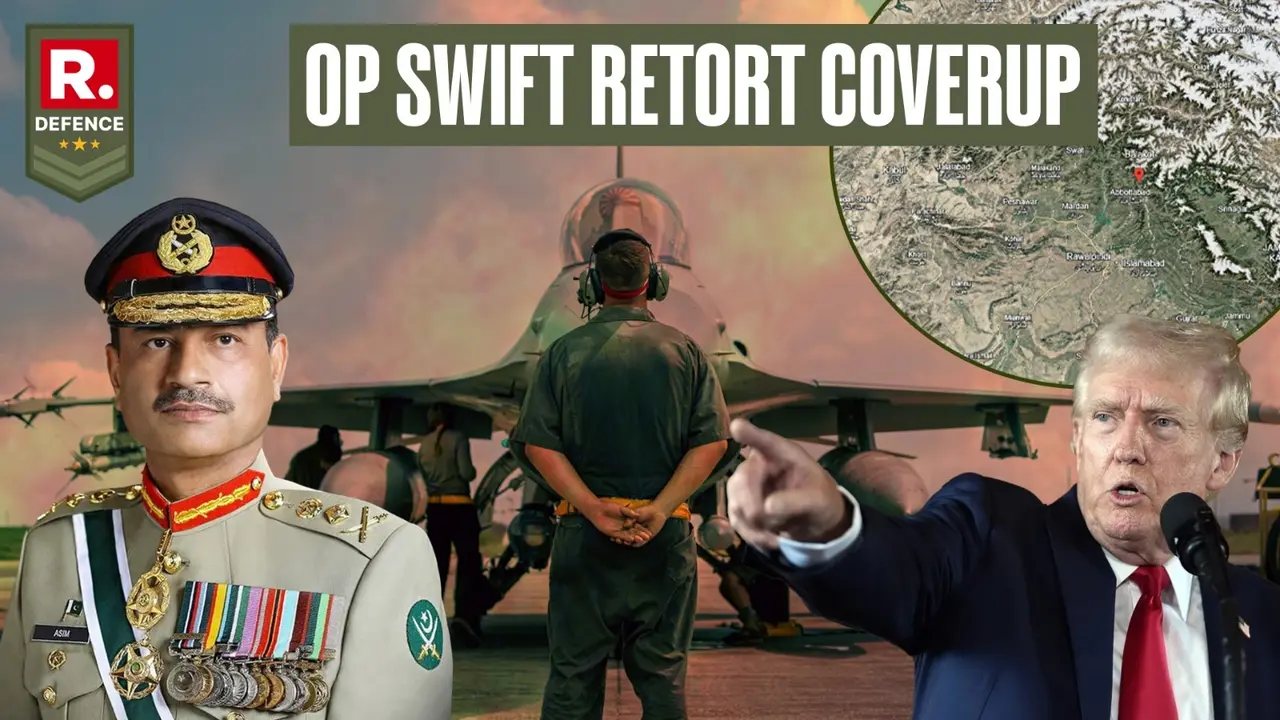
Despite Pakistan's claims that its F-16s have been deployed solely for counterterrorism, recent social media posts have reignited the debate over their alleged use against India during Operation Swift Retort on February 27, 2019. A viral image posted on Twitter features an F-16B from Pakistan's No. 9 Squadron (The Griffins), stationed at PAF Base Mushaf, Sargodha, displaying an Indian kill mark from the 2019 skirmish.

The caption reads: "Probably the hardest Pakistani F-16 picture out there. An F-16B with an Indian kill mark from Operation Swift Retort (2019)."
This image has led to renewed scrutiny over whether Pakistan violated its agreement with the United States, which explicitly restricts the use of F-16s for counterterrorism operations.
Advertisement
An old tweet from the Official account of Pakistan Air Force clearly states, “07th June holds a very special place in history of military aviation as on this day in 2002, a remarkable feat was achieved by No. 9 Squadron of PAF when an Indian Searcher II UAV was taken down by Pakistan Air Force F-16 aircraft.” This clearly implicates that the No. 9 Squadron (The Griffins) not only operates as a TACDE unit but also for combat missions.
The 2019 Aerial Skirmish and Pakistan's Cover-up Attempts
Following India's Balakot airstrike on February 26, 2019, tensions between India and Pakistan escalated. The next day saw an intense aerial engagement, during which Wing Commander Abhinandan Varthaman of the Indian Air Force (IAF), piloting a MiG-21 Bison, engaged a Pakistani F-16. While Pakistan has consistently denied losing an F-16, multiple independent reports and intelligence assessments suggest otherwise.
Advertisement
Key Evidence Challenging Pakistan’s Denial
Residents of Pakistan-occupied Kashmir (PoK) reported witnessing two aircraft crashing—one identified as an IAF MiG-21 and the other a PAF aircraft, widely suspected to be an F-16. Not only this, the Indian Air Force (IAF) presented radar signatures and electronic warfare data confirming the presence of PAF F-16s in the engagement and the subsequent downing of one aircraft.
Wreckage of an AIM-120 AMRAAM missile, which is exclusively equipped with Pakistani F-16s, was recovered on the Indian side of the Line of Control (LoC), proving F-16 involvement. Intercepted PAF radio communications revealed frantic discussions about the loss of an aircraft and a missing pilot, indicating the downing of an F-16.
Two distinct parachutes were observed descending in PoK—one was later confirmed to be Wing Commander Abhinandan's, while Pakistan failed to account for the second ejection. Additionally, Pakistani authorities blocked media access to the crash site, preventing independent verification. Satellite data from after the engagement showed unusual disturbances at PAF F-16 bases, hinting at aircraft losses or repositioning.
Balakot Airstrike: Pakistan’s Misinformation Campaign
The Balakot airstrike itself was subject to a misinformation campaign by Pakistan. Pakistan claimed no damage or casualties occurred. However, intelligence reports confirmed that the Jaish-e-Mohammed (JeM) training camp was struck, with significant militant losses. In the aftermath, Pakistan restricted access to Balakot, preventing independent observers from verifying the strike's impact.
The release of $400 million for Pakistan’s F-16 program is raising serious concerns about compliance with end-use agreements. The alleged misuse of F-16s against India directly contradicts U.S. conditions that they are used exclusively for counterterrorism operations.
The Trump administration's decision comes despite prior U.S. actions:
- In 2018, the U.S. cut military aid to Pakistan, citing failure to act against terrorist groups.
- In 2019, following the F-16 misuse allegations, U.S. officials raised concerns about the integrity of Pakistan’s military agreements.
The Bigger Picture: U.S. Foreign Aid Policies
The Trump administration has selectively released $5.3 billion in previously frozen foreign aid, with most of it allocated to security and counter-narcotics programs. The Pakistan F-16 funding falls under the State Department’s Bureau of Political-Military Affairs, which oversees arms sales and military assistance. However, humanitarian aid remains largely frozen.
The approval of $400 million for Pakistan’s F-16 program has once again highlighted Pakistan’s history of alleged military deception. With new evidence suggesting that Pakistan deployed F-16s against India in 2019, the U.S. government’s oversight of Pakistan’s military practices is now under scrutiny. If past incidents serve as any indicator, the concerns about misuse are far from baseless, and strict monitoring of Pakistan’s F-16 fleet remains a strategic necessity.