
India-Armenia Defence Deal: $4 Billion MoUs Likely For Missiles, Air Defence, Artillery
With a sharp focus on modernising Armenia’s air defence, missile systems, and artillery capabilities, India and Armenia are on the verge of signing memoranda of understanding (MoUs) valued at $3.5 to $4 billion. This partnership is a key component of Armenia's strategy to diversify its military suppliers.
- Defence News
- 3 min read

;'%3e%3cpath%20d='m8,15.99c4.41,0,7.99-3.58,7.99-7.99S12.41,0,8,0,0,3.59,0,8s3.58,7.99,7.99,7.99Z'%20style='stroke:%23fff;%20stroke-miterlimit:10;%20stroke-width:.02px;'/%3e%3cpath%20d='m3.08,3.37l3.82,5.11-3.84,4.15h.87l3.37-3.64,2.72,3.64h2.94l-4.04-5.39,3.58-3.87h-.86l-3.1,3.35-2.5-3.35h-2.94Zm1.27.64h1.35l5.97,7.99h-1.35l-5.97-7.99Z'%20style='fill:%23fff;'/%3e%3c/g%3e%3c/svg%3e)


India and Armenia are on the verge of signing memoranda of understanding (MoUs) valued at $3.5 to $4 billion, with a sharp focus on modernising Armenia’s air defence, missile systems, and artillery capabilities.
Sources told Republic Network that the next-generation Akash-NG variant, boasting significantly enhanced range and interception capabilities, is under active discussion for integration into Yerevan’s layered air defence architecture.
Demand for the supersonic BrahMos cruise missile has surged following the successful deployment of the weapon during the “Operation Sindoor,” the sources added. Negotiators are now hammering out a co-production framework that would enable licensed assembly of BrahMos components inside Armenia, marking a strategic shift toward joint manufacturing.
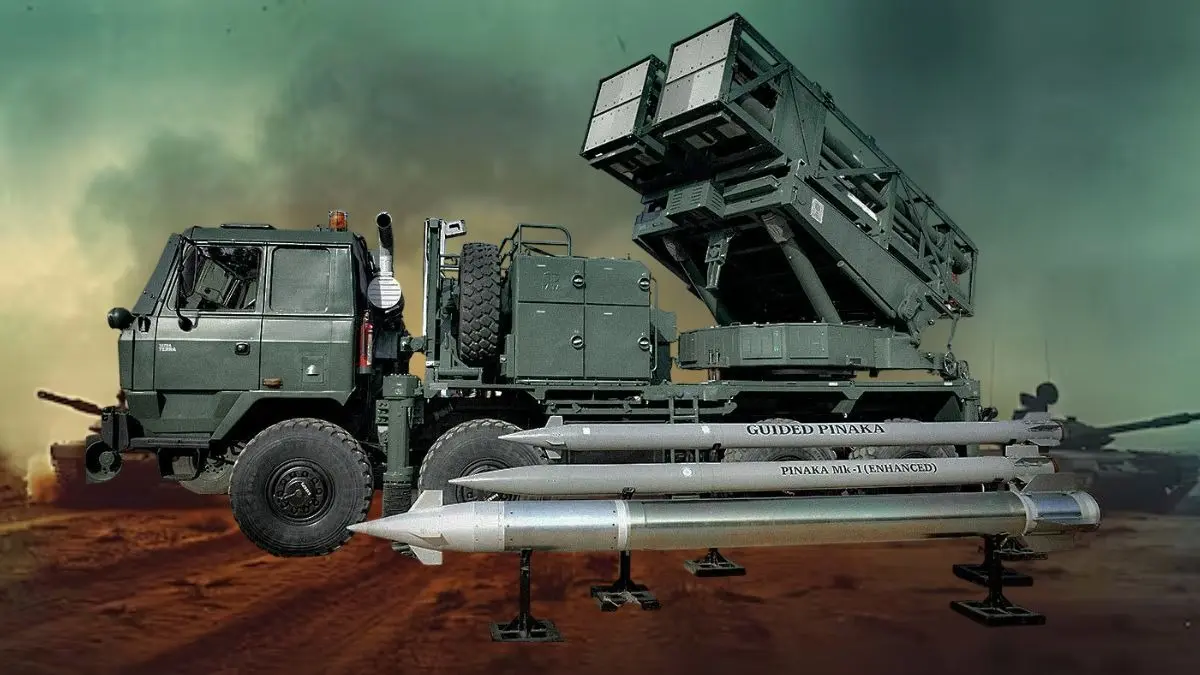
Parallel talks are advancing on the multi-barrel Pinaka rocket artillery system, to bolster Armenia’s fire support. This partnership is a key component of Armenia's strategy to diversify its military suppliers and reduce dependence on Russia.
The groundwork for such ambitious deals has been laid over the past three years. Armenia has quietly repositioned itself as India’s top defence buyer, a pivot that began in earnest after Yerevan posted its first defence attaché in New Delhi in May 2023.
Advertisement
India reciprocated by stationing its own military attaché in Yerevan in April 2024, which was the first such posting in the Caucasus.
Bilateral military commerce crossed an early milestone with a $40 million contract for four Swathi weapon-locating radars, systems now battle-tested along Armenia’s volatile frontiers and rated higher than comparable Russian or Polish counterparts.
Advertisement
As per the Institute for Defence Studies and Analyses (IDSA), since 2022, a steady stream of hardware has followed: Pinaka rocket artillery, Konkurs anti-tank guided missiles, mortars, small-arms rounds, 30–40 mm grenades, Multi-terrain Artillery Guns, 155 mm/39-caliber self-propelled howitzers, the Advanced Towed Artillery Gun System, 155 mm/52-caliber towed guns, ZEN anti-drone suites, and both Akash and Akash-NG air defence batteries.
Also Read: Indian Navy To Commission 'Ikshak'
Beyond hardware, the two capitals have woven a wider diplomatic net. On 12 December 2024, New Delhi hosted the second India–Iran–Armenia trilateral dialogue, zeroing in on trade corridors, tourism circuits and cultural programmes. A week later, on 19 December, Armenia joined Greece and Cyprus in Athens for defence-specific talks, underscoring Yerevan’s outreach to like-minded partners.
Each transaction feeds India’s broader ‘Make in India’ push to build a $26 billion defence-industrial base by the end of the decade. For Armenia, the influx of Indian systems diversifies an arsenal long dominated by legacy Soviet designs and signals a strategic reorientation toward reliable, cost-effective suppliers.
The forthcoming MoUs, when formalised, will mark the culmination of this rapid alignment and open a new chapter in South Caucasus security dynamics.