
India To Deploy Indigenous Air Defence System To Shield Delhi-NCR From Aerial Threats
India to deploy home grown multi layered air defence shield over Delhi-NCR to protect from aerial threats.
- Defence News
- 3 min read

;'%3e%3cpath%20d='m8,15.99c4.41,0,7.99-3.58,7.99-7.99S12.41,0,8,0,0,3.59,0,8s3.58,7.99,7.99,7.99Z'%20style='stroke:%23fff;%20stroke-miterlimit:10;%20stroke-width:.02px;'/%3e%3cpath%20d='m3.08,3.37l3.82,5.11-3.84,4.15h.87l3.37-3.64,2.72,3.64h2.94l-4.04-5.39,3.58-3.87h-.86l-3.1,3.35-2.5-3.35h-2.94Zm1.27.64h1.35l5.97,7.99h-1.35l-5.97-7.99Z'%20style='fill:%23fff;'/%3e%3c/g%3e%3c/svg%3e)


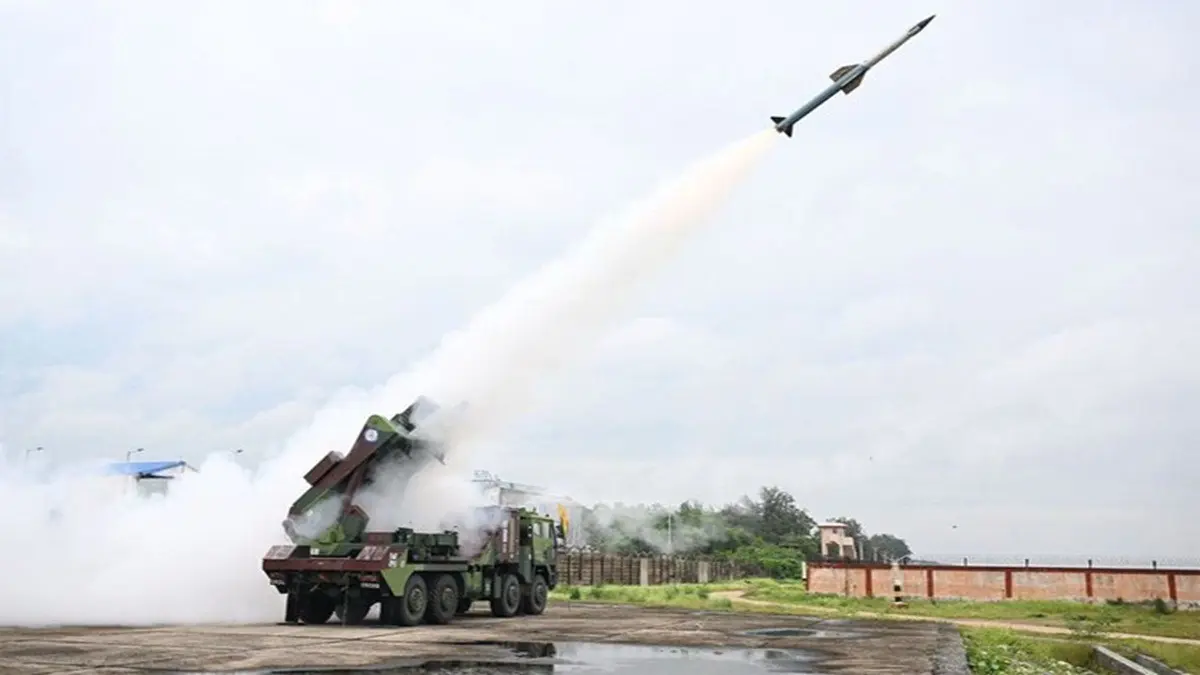
New Delhi: India is set to deploy its own Integrated Air Defence Weapon System (IADWS) over the Delhi-NCR, a move aimed at protecting the national capital region from any drone attack. Senior defence sources stated that the multilayered system will centre on homegrown missiles such as the Quick Reaction Surface‑to‑Air Missile (QRSAM) and the Very Short‑Range Air Defence System (VSHORADS), backed by a suite of radars, sensors and command and control gear .
Following the deployment of Delhi's Iron Dome, the Indian Air Force (IAF) will be responsible for operating the shield, which is intended to protect key political and strategic sites from missiles, armed drones and fast‑moving aircraft.
Earlier this year, the Indian government was negotiating the purchase of the American National Advanced Surface‑to‑Air Missile System‑II (NASAMS‑II), the system that guards Washington DC. The talks, however, stalled because the United States was asking for a “very high price”, according to defence officials. The Ministry of Defence decided to abandon the foreign deal and push ahead with an indigenous solution, a move that is being hailed as a boost for the Atmanirbhar Bharat programme.
According to the officials, the IADWS will combine three defensive layers. The innermost ring will be formed by VSHORADS, a man‑portable infrared‑homing missile capable of hitting low‑flying drones and helicopters out to about 6 km. The middle layer will be provided by QRSAM, which can engage fighter jets, cruise missiles and unmanned systems at ranges up to 30 km and features AESA radar and high‑mobility launchers. A network of advanced sensors and command nodes will tie the layers together, providing round‑the‑clock coverage for the capital.
Advertisement
DRDO’s Future Plans
The Defence Research and Development Organisation (DRDO) is leading the integration effort, working with Indian industry to develop the networking and command‑and‑control architecture. “Systems are required for such a complicated air defence system,” officials said . The DRDO has already delivered QRSAM and a Medium‑Range Surface‑to‑Air Missile (MRSAM), and is progressing with a long‑range SAM under Project Kusha. In addition, India is pressing ahead with the acquisition of its two remaining S‑400 Sudarshan squadrons and is evaluating a Russian offer for further S‑400 units as well as the S‑500 air‑defence system.
India's decision comes at a time when Pakistan is believed to have attempted to target Indian assets during Operation Sindoor in May 2025, raising concerns over aerial threats . The new shield is expected to be a template for similar 'protective bubbles' around other strategic cities, creating a more interconnected national air‑defence grid. The officials stated that the programme will move forward quickly, to have the system operational within the next few years.