
Fortifying the Siliguri Corridor, Indian Army’s Trishakti Corps Tests High-Altitude Warfare in Month-long Exercise
The Indian Army’s Trishakti Corps has concluded an intense month-long live-firing exercise, focusing on T-90 Bhishma tanks in high-altitude warfare.
- Defence News
- 4 min read

;'%3e%3cpath%20d='m8,15.99c4.41,0,7.99-3.58,7.99-7.99S12.41,0,8,0,0,3.59,0,8s3.58,7.99,7.99,7.99Z'%20style='stroke:%23fff;%20stroke-miterlimit:10;%20stroke-width:.02px;'/%3e%3cpath%20d='m3.08,3.37l3.82,5.11-3.84,4.15h.87l3.37-3.64,2.72,3.64h2.94l-4.04-5.39,3.58-3.87h-.86l-3.1,3.35-2.5-3.35h-2.94Zm1.27.64h1.35l5.97,7.99h-1.35l-5.97-7.99Z'%20style='fill:%23fff;'/%3e%3c/g%3e%3c/svg%3e)


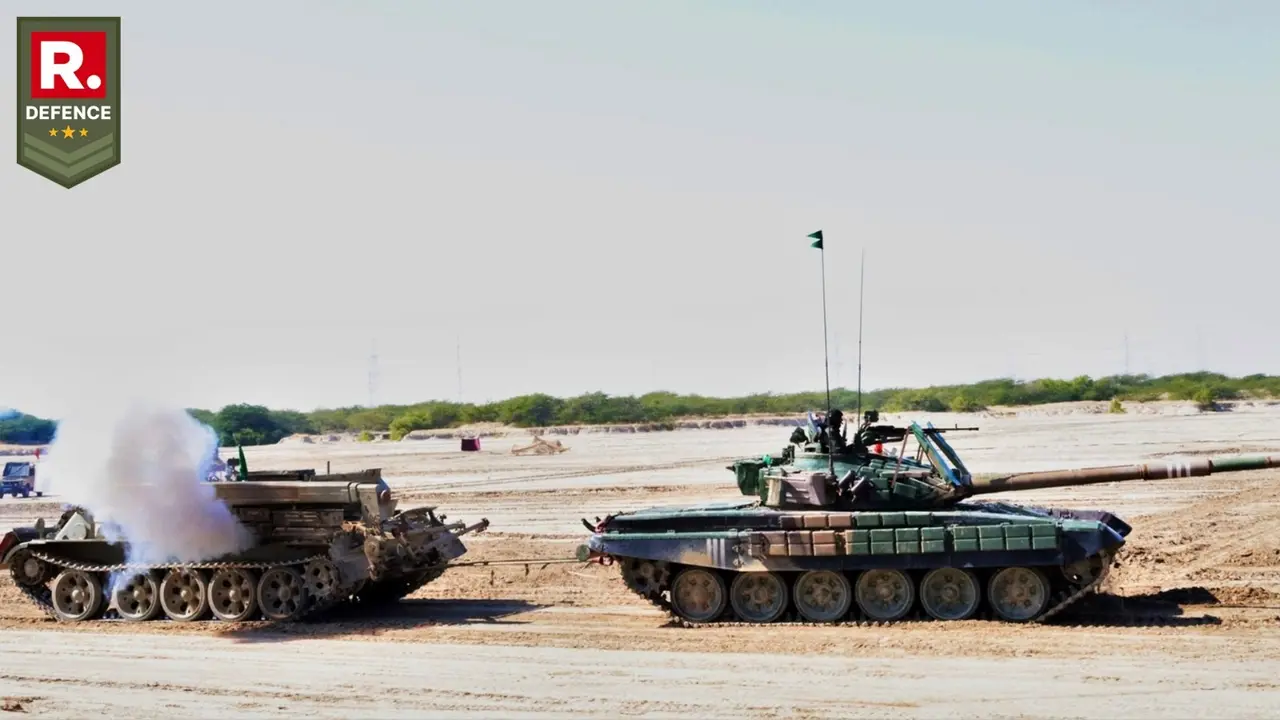
Sukna, West Bengal – The Indian Army’s Trishakti Corps has just wrapped up a month-long live-firing exercise featuring its most formidable battle machines—T-90 tanks. The exercise, designed to refine armoured warfare tactics in high-altitude terrain, underscores India’s commitment to bolstering its defences along the volatile Sikkim sector and the Siliguri Corridor, a vital lifeline linking mainland India to its northeastern states.
The drills, held at classified forward locations, focused on precision firepower, night combat, and integration of new battlefield technologies. From guided missile launches to unmanned aerial vehicle (UAV) reconnaissance, the exercise simulated real-time combat conditions, pushing both men and machines to their limits.
T-90: The Spearhead of India’s Armoured Might
At the heart of the war games were T-90 Bhishma tanks, the backbone of India’s armoured fleet. With their superior mobility, next-generation fire control systems, and enhanced protection, these Russian-origin machines are built to dominate the battlefield.

A defining feature of the T-90 is its ability to fire anti-tank guided missiles (ATGMs) with pinpoint accuracy, allowing it to destroy enemy armour at extended ranges. Equipped with thermal imaging sights and advanced sensors, the tank remains fully combat-capable in pitch-dark conditions, ensuring round-the-clock operational readiness—a crucial advantage in the mountains, where visibility can change in minutes.
Advertisement
“The high-altitude adaptation of armoured warfare is a key focus area. T-90s, when integrated with aerial assets and real-time surveillance technologies, become an unstoppable force,” a senior defence official told Republic.
This month-long high-intensity battle drill tested several advanced warfare elements:
Advertisement
- Precision strike validation – Troops fired advanced ammunition and guided missiles, assessing hit accuracy and lethality in rugged terrain.
- Man-machine teaming – Tank crews trained alongside UAVs, ensuring seamless coordination between human decision-making and real-time data from drones.
- Night combat capabilities – The Army validated 24/7 warfighting ability by deploying thermal imaging-assisted strikes, a game-changer in no-light scenarios.
- Aatmanirbharta in Defence – Indigenous systems, including locally manufactured ammunition and surveillance assets, were tested as part of India’s push for self-reliance in military preparedness.
A New Theatre of Modern Warfare
With rising security challenges along India’s northern borders, the Indian Army is fast-tracking multi-domain warfare strategies. Trishakti Corps' latest war games come on the heels of Exercise Devil Strike, an airborne and special forces drill designed to sharpen rapid deployment and precision-strike capabilities.
The back-to-back execution of these high-intensity exercises highlights India’s evolving military doctrine, which aims to integrate armour, aerial, and special forces into a single, cohesive strike force capable of operating in diverse combat environments.
A senior Army officer described the exercise as a decisive step in modernizing India's armoured forces.
“This exercise tested our ability to operate in dynamic combat conditions. The integration of T-90s with UAV reconnaissance and precision-guided firepower has added a new edge to our battlefield strategy. Our troops have demonstrated exceptional combat readiness, ensuring that the Indian Army can effectively respond to any operational contingency,” he said.
Siliguri Corridor: A Critical Flashpoint
The significance of Trishakti Corps' operational readiness cannot be overstated. The Siliguri Corridor, also known as the Chicken’s Neck, is a narrow 22-km-wide strategic lifeline connecting the rest of India to the Northeast. With Chinese military activity intensifying in the Tibet Autonomous Region, Indian forces are fortifying this region to thwart any potential encroachments.
Tensions along the Line of Actual Control (LAC) have remained high, with multiple face-offs between Indian and Chinese troops in recent years. China’s rapid militarization of Tibet, coupled with its aggressive posturing, has led India to bolster its high-altitude defences, ensuring its ability to mobilize forces rapidly in the event of any incursion.
A Legacy of Strength: The Trishakti Corps
The Trishakti Corps (XXXIII Corps) has a storied history, tracing its origins back to the British Indian Army’s XXXIII Corps, which played a pivotal role in World War II. Re-raised in 1960 at Shillong, the corps now operates under the Eastern Command, with its headquarters at Sukna, West Bengal.
Commanded by a three-star Lieutenant General, the 45,000-60,000-strong corps is one of India’s most crucial mountain warfare formations, responsible for securing the borders of Sikkim, Bhutan, and the Siliguri Corridor. For now, as the dust settles over the exercise zone, the message is clear—India’s armoured spearhead stands ready to meet any challenge, whether in the icy heights of Sikkim or the critical gateway of the Northeast.