
India Equips Cambodian Army with Infantry Training Simulator—A Power Move in Indo-Pacific to Counter China
This aligns with India’s Act East Policy and its broader Indo-Pacific strategy aimed at countering China’s growing influence in Southeast Asia.
- Defence News
- 5 min read

;'%3e%3cpath%20d='m8,15.99c4.41,0,7.99-3.58,7.99-7.99S12.41,0,8,0,0,3.59,0,8s3.58,7.99,7.99,7.99Z'%20style='stroke:%23fff;%20stroke-miterlimit:10;%20stroke-width:.02px;'/%3e%3cpath%20d='m3.08,3.37l3.82,5.11-3.84,4.15h.87l3.37-3.64,2.72,3.64h2.94l-4.04-5.39,3.58-3.87h-.86l-3.1,3.35-2.5-3.35h-2.94Zm1.27.64h1.35l5.97,7.99h-1.35l-5.97-7.99Z'%20style='fill:%23fff;'/%3e%3c/g%3e%3c/svg%3e)


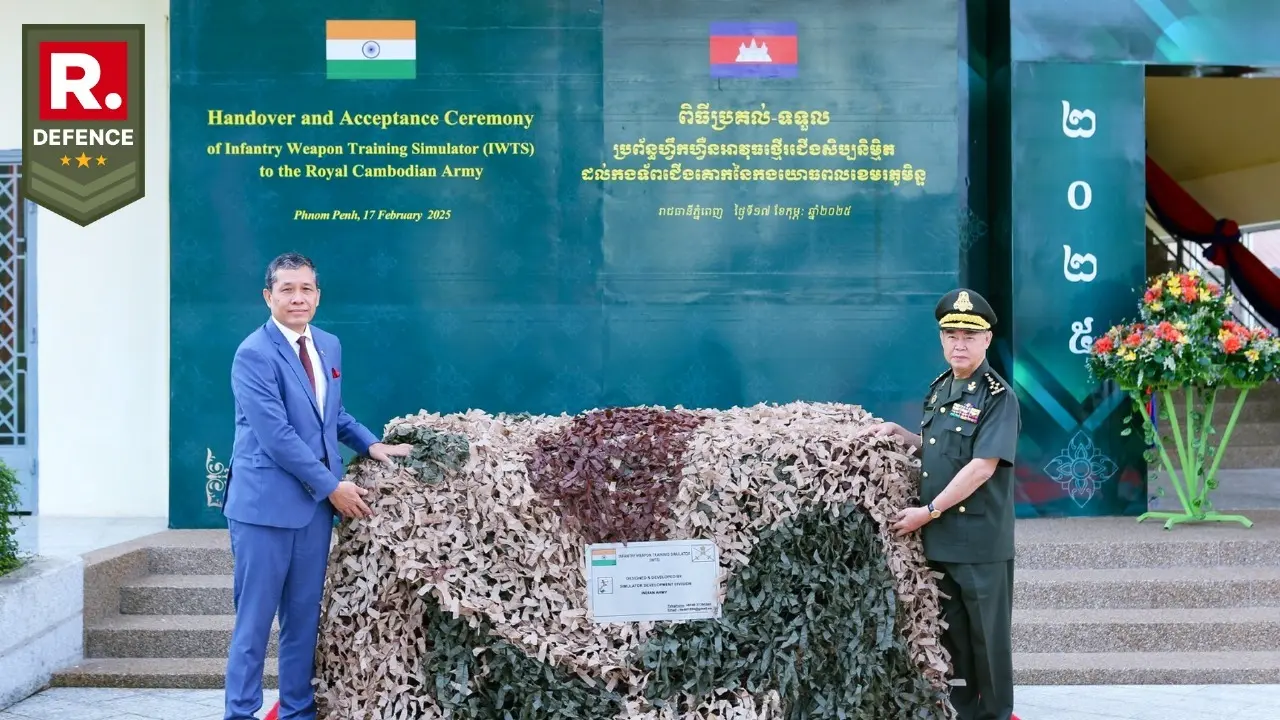
Phnom Penh, Cambodia - India’s growing defence partnership with Cambodia is a critical element of its broader Act East Policy and Indo-Pacific strategy. While historically limited, defence ties between the two nations have deepened in recent years, driven by mutual interests in regional stability, countering Chinese expansionism, and fostering military cooperation.
In a significant move towards bolstering regional security and deepening this defence cooperation, the Indian Army officially handed over an Infantry Weapon Training Simulator (IWTS) to the Royal Cambodian Army (RCA) on February 17, 2025. The ceremony, attended by senior officials including H.E. Gen. Hun Manet, the Deputy Commander of the RCA, underscores India’s commitment to enhancing Cambodia’s military training capabilities and fostering stronger bilateral ties. The donation coincided with the visit of an Indian Navy training squadron to Cambodia, marking a new chapter in India’s Indo-Pacific outreach and Act East Policy.
Enhancing Cambodia’s Military Capabilities
The Infantry Weapon Training Simulator (IWTS) is a cutting-edge system designed to facilitate marksmanship training and battle handling for soldiers. This modular, wireless system allows troops to train with various small arms, including pistols, carbines, rifles, machine guns, sniper rifles, grenade launchers, and rocket launchers.

The IWTS integrates 3D visualization software with advanced training modules such as:
Advertisement
- Marksmanship Training
- Moving Target Engagement
- Reflex Shooting
- Field Firing & Tactical Engagement
- Judgmental Training
- Annual Range Classification Courses
The system enables real-time monitoring by instructors, who can analyze training sessions, replay recorded exercises, and provide corrective feedback. This advanced simulator is expected to significantly improve the combat readiness of Cambodian forces, enhancing their capability to operate in both conventional and unconventional warfare scenarios.
India’s Growing Defence Partnership with Cambodia
India’s military engagement with Cambodia is part of its broader Act East Policy and Indo-Pacific strategy, aimed at countering growing Chinese influence in Southeast Asia. While traditionally limited, Indo-Cambodian defence ties have strengthened in recent years, driven by shared interests in regional stability and Fostering military cooperation with ASEAN partners. Another factor is Countering China’s military expansionism.
Advertisement
Cambodia’s strategic location near the South China Sea makes it a crucial player in the Indo-Pacific power dynamics. India’s increasing engagement serves to not only strengthen bilateral relations but also provide an alternative to Cambodia’s growing dependency on Beijing.
Why is Cambodia Important for India?
Cambodia lies near key maritime trade routes, making it critical to India’s regional security interests. Its proximity to the Gulf of Thailand and the South China Sea (SCS) places it at the centre of great power rivalries between China and the US-led Indo-Pacific coalition, which includes India.
Beijing has invested heavily in Cambodia’s infrastructure, including military bases, ports, and economic zones. Reports indicate that China is developing Ream Naval Base on Cambodia’s southern coast, potentially granting the People’s Liberation Army Navy (PLAN) a strategic foothold in the region.
Cambodia’s increasing economic dependence on China has led it to align closely with Beijing’s interests in ASEAN discussions, often blocking joint statements critical of China’s aggressive actions in the South China Sea.
India’s Expanding Footprint in Southeast Asia
By engaging Cambodia, India seeks to reduce Beijing’s unchecked military expansion and offer an alternative to Chinese dependency. India’s Indo-Pacific vision prioritizes defence and security partnerships with ASEAN nations, and Cambodia plays a pivotal role in this network.
The recent IWTS donation and naval engagements signify a deeper military collaboration between India and Cambodia. India’s strategic outreach aligns with ASEAN’s broader objective of maintaining a rules-based order in the South China Sea. Strengthening defence ties with Cambodia provides India with a forward presence in Southeast Asia, enhancing its ability to safeguard regional stability.
Chinese Presence at Ream Naval Base Concerning
China’s presence at Ream Naval Base is particularly concerning for regional powers. A Chinese-controlled naval facility in Cambodia could allow Beijing to:
- Project power deeper into the Indian Ocean Region (IOR).
- Strengthen its military supply chains in Southeast Asia.
- Challenge freedom of navigation in critical maritime corridors.
By deepening defence ties with Cambodia, India encourages Phnom Penh to take a more balanced approach rather than acting as a Chinese proxy within ASEAN. This strategic realignment is critical in preserving regional autonomy and preventing unilateral militarization by any single power.
India’s engagement with Cambodia also bolsters the broader ASEAN-India Defence Framework, reinforcing regional security architecture. One key benefit would be reducing China’s military influence within ASEAN by offering credible alternatives for defence cooperation.The move is also aimed at enhancing military interoperability between India and Southeast Asian nations through joint exercises, training programs, and strategic dialogues.
As China continues to deepen its hold over key strategic locations, India’s proactive diplomacy and defence cooperation with Cambodia represents a crucial step in preserving stability, free navigation, and a multipolar order in the Indo-Pacific.