
Indian Air Force set to procure 12 more Su-30MKI fighter jets in bids to enhance squadron strength
The Indian Air Force issues a tender for 12 advanced Su-30MKI fighter jets, highlighting India's commitment to bolstering indigenous defense capabilities.
- Defence News
- 3 min read

;'%3e%3cpath%20d='m8,15.99c4.41,0,7.99-3.58,7.99-7.99S12.41,0,8,0,0,3.59,0,8s3.58,7.99,7.99,7.99Z'%20style='stroke:%23fff;%20stroke-miterlimit:10;%20stroke-width:.02px;'/%3e%3cpath%20d='m3.08,3.37l3.82,5.11-3.84,4.15h.87l3.37-3.64,2.72,3.64h2.94l-4.04-5.39,3.58-3.87h-.86l-3.1,3.35-2.5-3.35h-2.94Zm1.27.64h1.35l5.97,7.99h-1.35l-5.97-7.99Z'%20style='fill:%23fff;'/%3e%3c/g%3e%3c/svg%3e)


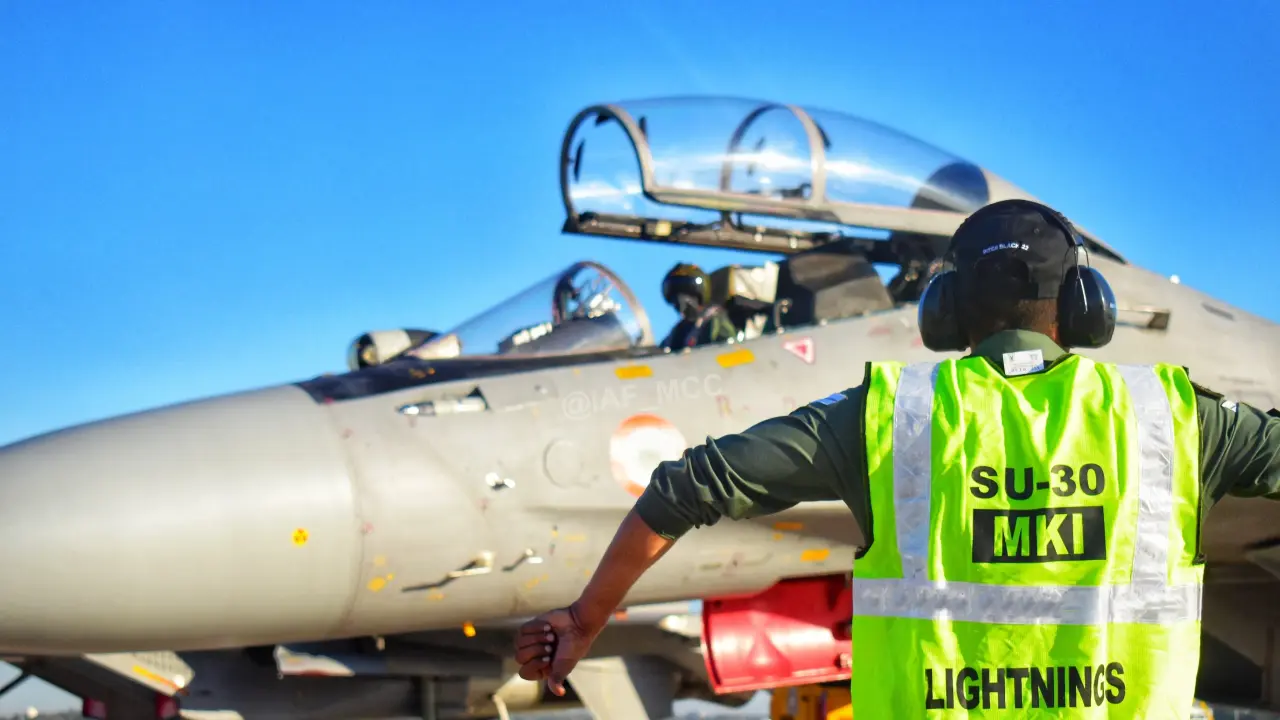
In a significant move to enhance its squadron strength, the Indian Air Force (IAF) has issued a tender to Hindustan Aeronautics Limited (HAL) for the acquisition of 12 advanced Su-30MKI fighter jets. The tender, issued in partnership with Russian manufacturers, underscores India's commitment to bolstering indigenous defense capabilities. HAL is set to respond next month, outlining project specifics in alignment with the IAF's Aatmanirbhar policies, ensuring a high percentage of indigenous content in the aircraft.
The Su-30 MKI aircraft, a modern addition to the IAF's fleet, is poised to feature cutting-edge Indian weapons and sensors. This acquisition aligns with the IAF's broader project to upgrade its Sukhoi-30 fleet, with 84 planes slated for enhancement using indigenous weapon systems, advanced radars, and avionics. The collaborative effort with HAL positions India strategically, paving the way for potential upgrades to similar aircraft in foreign countries.
The tendered Su-30MKI fighters, manufactured in India, signify a crucial step in the country's pursuit of self-reliance in defense. The IAF's fleet already boasts 272 Su-30 fighter jets, procured over different tranches since the early 2000s. These aircraft have undergone significant upgrades, integrating Indian systems such as the BrahMos supersonic cruise missile and the Astra air-to-air missile. The recent acknowledgment by Air Chief Marshal VR Chaudhari underscores the BrahMos missile's transformative impact on the IAF's firepower.
BrahMos integration galvanizes Indian Air Force
The BrahMos supersonic missile, deployed on Sukhoi Su-30 fighter jets, has played a pivotal role in recent military operations, including the Balakot air strikes. Air Chief Marshal Chaudhari emphasized the BrahMos's ability to significantly enhance the IAF's capabilities, fortifying the nation's defense in potential conflicts. Notably, efforts are underway to develop smaller versions of the next-generation BrahMos missiles, expanding their fitment to various combat aircraft.
Advertisement

The Sukhoi Su-30MKI, known by the NATO reporting name Flanker-H, is a two-seater, twinjet multirole air superiority fighter. The first Russian-made Su-30MKI variant entered the Indian Air Force (IAF) in 2002, with the inaugural Su-30MKI assembled in India joining the IAF in November 2004. Presently, the IAF boasts nearly 260 Su-30MKIs in its inventory, and it is anticipated to serve as the backbone of the IAF's fighter fleet well into the future.
Enduring deployments: Su-30s in Balakot Strikes and Border Standoff
Uniquely tailored to meet Indian specifications, the Su-30MKI incorporates a blend of Indian, French, and Israeli sub-systems, setting it apart as a specialized and versatile heavy, all-weather, long-range fighter. Its integration of cutting-edge avionics and systems aligns with its role as a multirole aircraft. With capabilities akin to the Sukhoi Su-35, the Su-30MKI has proven to be a crucial asset for the IAF, solidifying its place as a cornerstone in the nation's defense strategy beyond 2020.
Advertisement
The Su-30s have demonstrated their versatility and effectiveness in various exercises and operations, notably during the Balakot air strikes and the ongoing military standoff with the Chinese People's Liberation Army. The aircraft's deployment underscores their crucial role in ensuring national security and territorial integrity. As India continues to strengthen its defense capabilities, collaborations like the HAL tender for Su-30MKI fighters exemplify the nation's commitment to building a robust and self-reliant defense infrastructure.