
India’s Para SF and Kyrgyzstan’s Scorpion Brigade Take Counter-Terror Ops to the Next Level in Exercise Khanjar-XII
The 12th edition of Exercise Khanjar-XII is set to take place in Kyrgyzstan from March 10 to 23, reinforcing India’s growing defence ties in Central Asia.
- Defence News
- 4 min read

;'%3e%3cpath%20d='m8,15.99c4.41,0,7.99-3.58,7.99-7.99S12.41,0,8,0,0,3.59,0,8s3.58,7.99,7.99,7.99Z'%20style='stroke:%23fff;%20stroke-miterlimit:10;%20stroke-width:.02px;'/%3e%3cpath%20d='m3.08,3.37l3.82,5.11-3.84,4.15h.87l3.37-3.64,2.72,3.64h2.94l-4.04-5.39,3.58-3.87h-.86l-3.1,3.35-2.5-3.35h-2.94Zm1.27.64h1.35l5.97,7.99h-1.35l-5.97-7.99Z'%20style='fill:%23fff;'/%3e%3c/g%3e%3c/svg%3e)


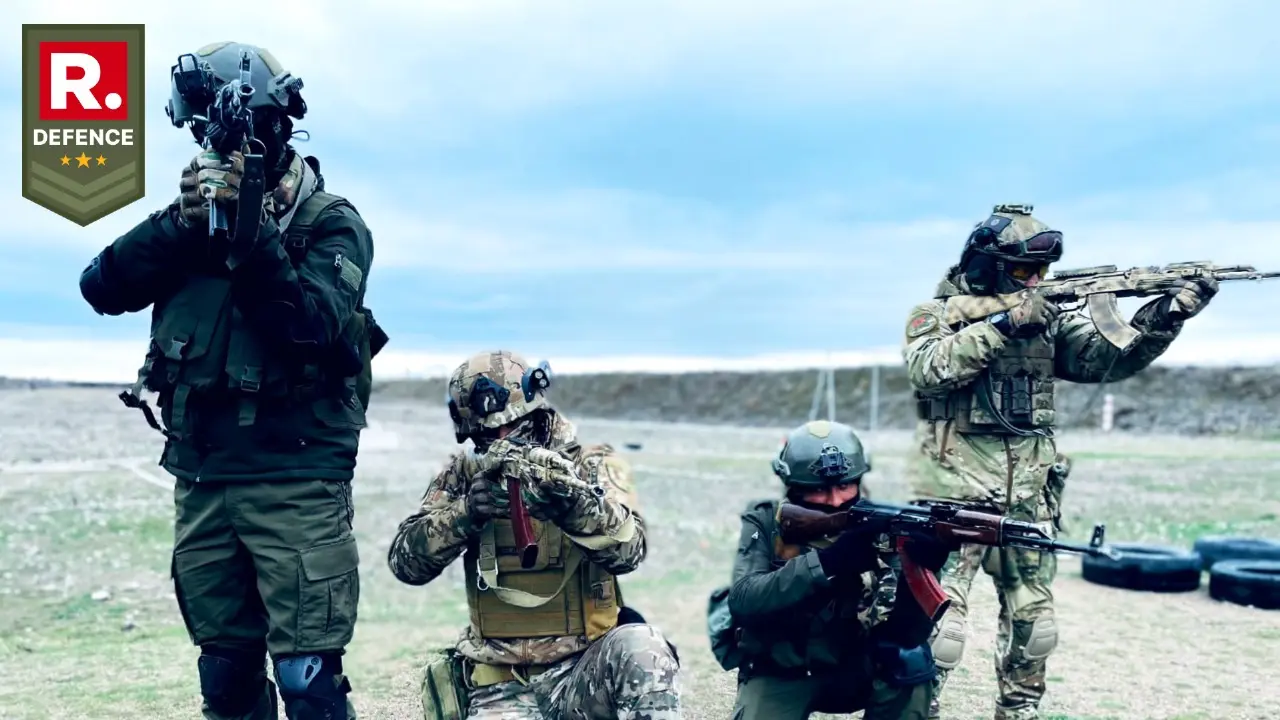
New Delhi, India - The 12th edition of Exercise Khanjar-XII, a joint India-Kyrgyzstan Special Forces drill, is all set to kick off in Kyrgyzstan from March 10 to 23. This isn't just another military exercise—it's a strategic power play that underscores India's growing defence footprint in Central Asia. With counter-terrorism, high-altitude combat, and special ops as the primary focus, both nations are sending their best troops to train in some of the toughest terrain imaginable.
What started in 2011 as a bilateral exercise has now become an annual tradition, alternating between India and Kyrgyzstan. The message is clear: the two nations are in it for the long haul, committed to strengthening their military ties amid rising security concerns in the region.
India’s Para SF Meets Kyrgyzstan’s Scorpion Brigade
This year’s edition will see India’s Parachute Regiment (Special Forces) teaming up with Kyrgyzstan’s Scorpion Brigade, an elite special forces unit feared for its covert operations, insurgency tactics, and brutal combat skills.

The Scorpion 25th Special Forces Brigade, commonly called Scorpion Spetsnaz, is considered one of Kyrgyzstan’s most lethal military units. Trained at Russia’s Ryazan Guards Higher Airborne Command School, these troops have also undergone advanced training under Russian and U.S. Army instructors. Their expertise in airborne missions, direct action raids, and close-quarters combat makes them a formidable force, perfectly suited for the extreme challenges of Khanjar-XII.
Advertisement
This year’s exercise will unfold in high-altitude, mountainous terrain, where extreme weather and thin air will push the limits of human endurance. For both India and Kyrgyzstan, mountain warfare isn’t just a skill—it’s a necessity.
War Games in the Mountains: What’s on the Training Schedule?
Khanjar-XII isn’t just about endurance—it’s about honing precision warfare skills in some of the most challenging combat scenarios. The focus areas include:
Advertisement
- Sniping and precision targeting – One shot, one kill. The forces will train for surgical eliminations in high-risk environments.
- Complex building intervention – Urban warfare tactics, including hostage rescue and counter-insurgency operations.
- Mountain warfare and survival skills – High-altitude combat strategies and surviving in extreme conditions.
- Advanced counter-terrorism drills – Real-world anti-terror ops, simulating insurgent attacks in urban and remote areas.
With terrorism and extremism on the rise, both nations recognize the importance of staying ahead in asymmetric warfare. This exercise will allow India and Kyrgyzstan to fine-tune their strategies for dealing with cross-border insurgencies and terror networks.
More Than Guns and Drills: Strengthening Military and Cultural Ties
Khanjar-XII isn’t just about combat training—it’s also about deepening military and cultural connections. One of the most significant moments in this year’s exercise will be the celebration of Nowruz, a major Kyrgyz festival marking the arrival of spring. It’s a symbolic gesture, proving that military alliances aren’t just forged in battle but also in shared traditions and mutual respect.
For India, this exercise is more than just training—it’s a diplomatic signal. Kyrgyzstan has been a consistent supporter of India on the global stage, backing India’s bid for a permanent seat at the UN Security Council and pushing for its full membership in the Shanghai Cooperation Organization (SCO). The strategic alignment between the two nations is getting stronger, and Khanjar-XII is a testament to that.
India Expands Military Engagements: Japan in the Picture
While India is busy with Kyrgyzstan in Central Asia, it’s also tightening its defence relations with Japan in the Indo-Pacific. On March 6-7, the 7th India-Japan Army-to-Army Staff Talks (AAST) were held in New Delhi, focusing on:
- Defence Cooperation Plan – Aligning long-term military strategies.
- Military education and expert exchanges – Sharing battlefield insights.
- Collaboration in niche technologies and operational training – Developing next-gen combat capabilities.
The Japanese delegation was also briefed on India’s United Nations Peacekeeping Operations and engaged in discussions with The Centre for Land Warfare Studies (CLAWS) on key geostrategic challenges.
Meanwhile, the 6th edition of Exercise Dharma Guardian, a joint Indo-Japanese military drill, is currently underway at Japan’s East Fuji Training Area. Running from February 24 to March 9, the exercise highlights the growing defence cooperation between India and Japan, especially in light of increasing security concerns in the Indo-Pacific.
With terrorism, insurgency, and shifting geopolitical dynamics, India’s military strategy is no longer just about its immediate neighbourhood—it’s about strengthening partnerships across key strategic regions. Khanjar-XII represents more than just an annual exercise—it’s India’s commitment to building a strong military network, keeping its forces battle-ready, and positioning itself as a dominant player in both Central Asia and beyond.