
INS Surat Slays Sea-skimming Capability, Enhances Indian Deterrence in China-shadowed Ocean Zone
The destroyer, part of the Visakhapatnam-class (Project 15B), executed the strike as part of a cooperative engagement.
- Defence News
- 4 min read

;'%3e%3cpath%20d='m8,15.99c4.41,0,7.99-3.58,7.99-7.99S12.41,0,8,0,0,3.59,0,8s3.58,7.99,7.99,7.99Z'%20style='stroke:%23fff;%20stroke-miterlimit:10;%20stroke-width:.02px;'/%3e%3cpath%20d='m3.08,3.37l3.82,5.11-3.84,4.15h.87l3.37-3.64,2.72,3.64h2.94l-4.04-5.39,3.58-3.87h-.86l-3.1,3.35-2.5-3.35h-2.94Zm1.27.64h1.35l5.97,7.99h-1.35l-5.97-7.99Z'%20style='fill:%23fff;'/%3e%3c/g%3e%3c/svg%3e)


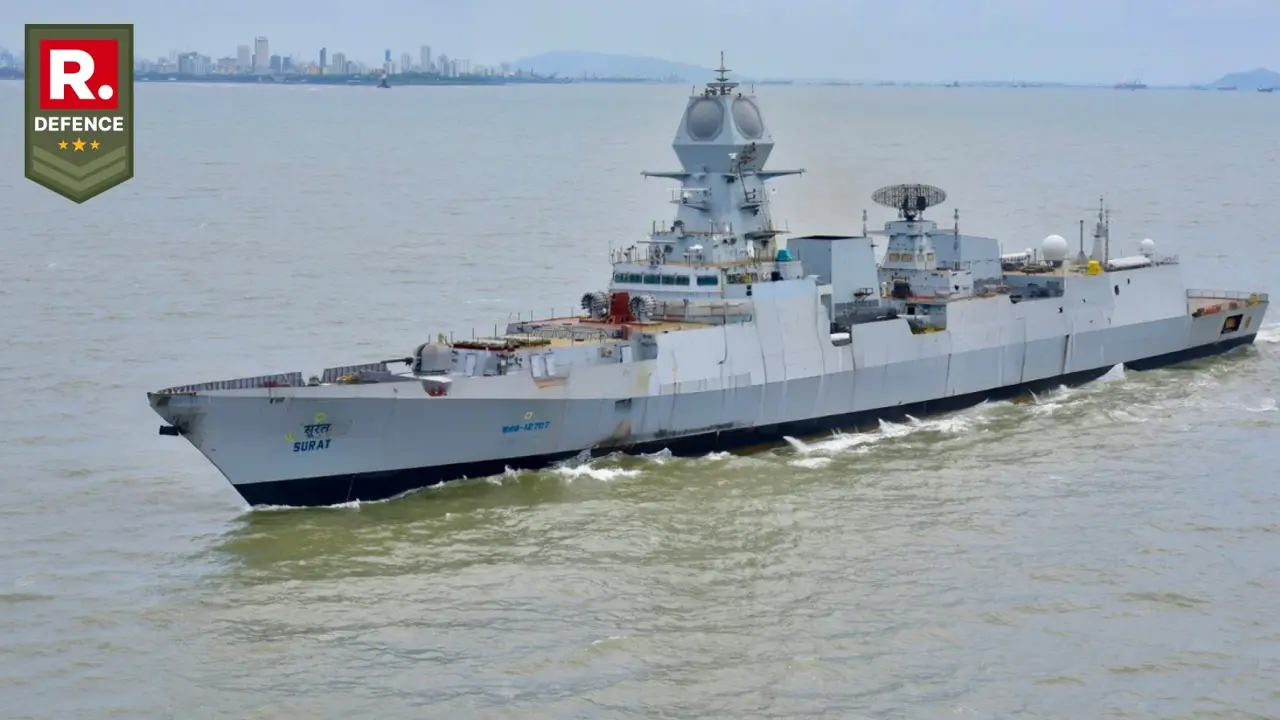
New Delhi, India - In a powerful affirmation of India’s maritime combat readiness, the Indian Navy on April 24, 2025, successfully carried out a precision cooperative engagement of a sea-skimming target using its newly commissioned indigenous destroyer, INS Surat. The operation marks a defining leap in the Navy’s technological warfighting capabilities, with the destroyer intercepting a low-flying simulated threat with clinical accuracy—demonstrating not just its firepower but also its ability to engage in network-centric warfare.
Announced through the Navy’s official X (formerly Twitter) handle, the milestone was presented as a symbol of India’s strengthening national security framework in the Indian Ocean Region (IOR). This successful test reinforced the notion that the Indian Navy’s future combat strategy will be deeply embedded in indigenous design, electronic fusion, and smart kill chains—especially vital in a region increasingly populated by near-peer threats.
Indigenous Tech Triumph: INS Surat Confirms Capability Against Modern Sea-Skimming Attacks
INS Surat, the fourth and final vessel of the Visakhapatnam-class (Project 15B) stealth-guided missile destroyers, was commissioned earlier this year on January 15, 2025. Its development was led by the Indian Navy’s Warship Design Bureau and executed by Mazagon Dock Shipbuilders Limited (MDL), a Navratna Defence PSU with decades of warship-building pedigree. The vessel’s capability to neutralize a sea-skimming target demonstrates not only its operational readiness but also the efficacy of India's maturing defence manufacturing ecosystem under the Atmanirbhar Bharat initiative.

Sea-skimming threats—typically employed by anti-ship missiles and strike aircraft—are among the most difficult to detect and intercept due to their ultra-low altitude approach. Flying at mere meters above sea level, these missiles exploit radar ground clutter and minimize infrared signatures, reducing reaction time for defensive systems. That INS Surat could counter such a target in a live engagement speaks volumes about the destroyer’s advanced sensor-to-shooter integration.
Advertisement
Barak-8 Air Defence System Likely at Heart of Test, Developed Under India-Israel Partnership
While the Navy has not officially disclosed the weapon used in the engagement, naval observers widely believe the Barak-8 Long Range Surface-to-Air Missile (LR-SAM) system was deployed. Developed jointly by India’s DRDO and Israel Aerospace Industries, Barak-8 provides the destroyer with a multi-layered defensive umbrella against sea-skimming missiles, fighter aircraft, UAVs, and helicopters. The system’s vertical launch capability and radar fusion make it especially lethal in low-altitude combat scenarios.
The cooperative nature of the engagement suggests real-time sensor-sharing between naval platforms—a tactical doctrine designed to create an extended radar and engagement envelope beyond the limits of individual ships. This capability allows one vessel to fire on a target tracked by another—highlighting seamless data integration across the Navy’s combat grid.
Advertisement
INS Surat’s milestone follows in the wake of earlier class-specific breakthroughs—such as INS Visakhapatnam’s successful BrahMos test in January 2022—marking a continuum of proven weaponization across the Visakhapatnam-class lineage. These destroyers are named after major Indian cities—Visakhapatnam, Mormugao, Imphal, and now Surat—each symbolizing a node in India’s naval power projection across its maritime frontier.
A Glimpse into India’s Destroyer Evolution: From Delhi-Class to P-15B Behemoths
INS Surat also carries historical significance as the final ship of Project 15, an ambitious destroyer-building program that began with the Delhi-class (P-15) in the 1990s, followed by the Kolkata-class (P-15A) and now the Visakhapatnam-class (P-15B) destroyers. Commanded by Captain Sandeep Shourie, the warship’s induction into service not only completes a chapter in naval shipbuilding but also sets the benchmark for India’s future destroyers—likely to come under the proposed Project 18 program.
Interestingly, naval watchers noted that the ship was originally speculated to be named after Porbandar, but the Navy opted for Surat, another historic port city, in alignment with its tradition of naming destroyers after coastal metropolises. INS Surat features advanced stealth shaping, reduced radar cross-section, electronic warfare suites, and potent land-attack and anti-air weaponry—all housed on a 7,400-ton platform.
This development gains strategic relevance in the context of growing Chinese PLAN activity in the Indian Ocean, particularly with the presence of Type 052D and Type 055 destroyers, which carry similar multi-role strike capabilities. India’s ability to now match such capabilities with indigenous ships is a visible assertion of maritime deterrence.
Watch- Indian Navy's latest indigenous guided missile destroyer INS Surat successfully carried out a precision cooperative engagement of a sea skimming target