
INS Vikrant equipped with multi-function radar and Barak-8 missiles amid strategic upgrades
INS Vikrant has received a significant upgrade with the integration of the Multi-Function Surveillance, Track, and Guidance Radar (MF-STAR) and Barak-8 MRSAMs.
- Defence News
- 3 min read

;'%3e%3cpath%20d='m8,15.99c4.41,0,7.99-3.58,7.99-7.99S12.41,0,8,0,0,3.59,0,8s3.58,7.99,7.99,7.99Z'%20style='stroke:%23fff;%20stroke-miterlimit:10;%20stroke-width:.02px;'/%3e%3cpath%20d='m3.08,3.37l3.82,5.11-3.84,4.15h.87l3.37-3.64,2.72,3.64h2.94l-4.04-5.39,3.58-3.87h-.86l-3.1,3.35-2.5-3.35h-2.94Zm1.27.64h1.35l5.97,7.99h-1.35l-5.97-7.99Z'%20style='fill:%23fff;'/%3e%3c/g%3e%3c/svg%3e)


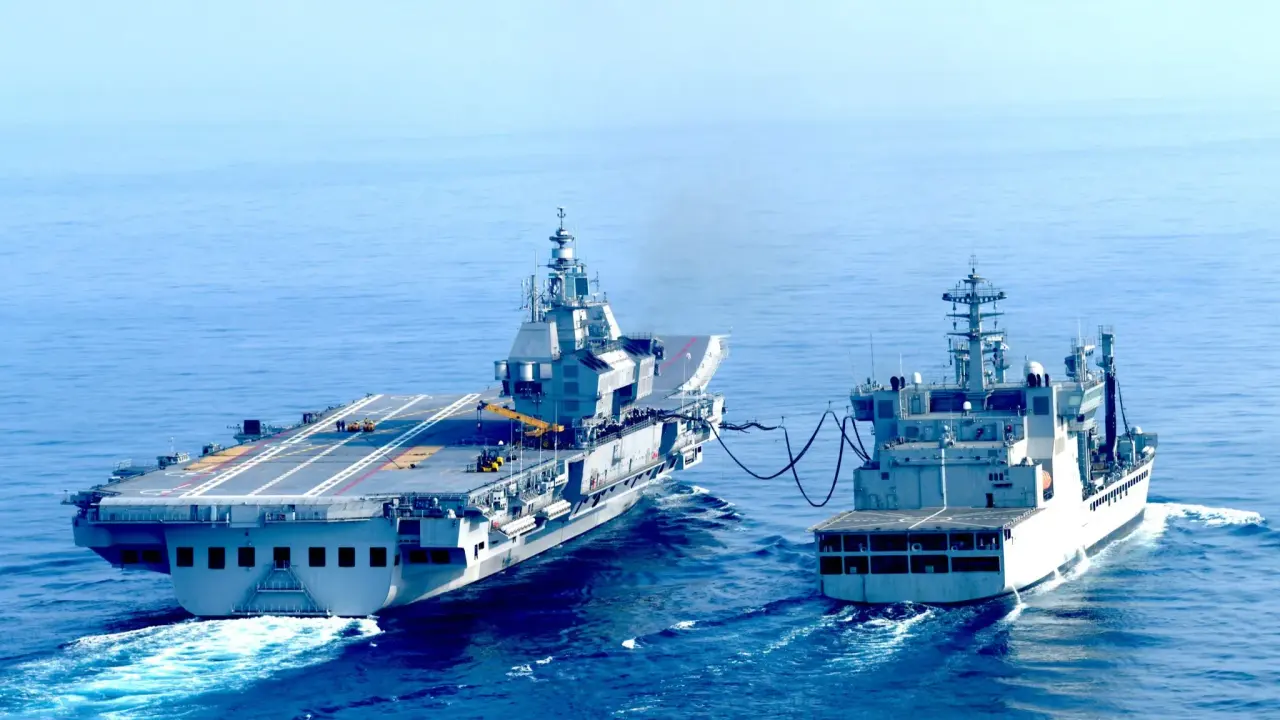
India's pride, the indigenous aircraft carrier INS Vikrant, has received a significant upgrade, now boasting sophisticated guidance radar and surface-to-air missiles. The inclusion of the Multi-Function Surveillance, Track, and Guidance Radar (MF-STAR) and Barak-8 Medium Range Surface to Air Missiles (MRSAMs) marks a crucial milestone in fortifying the nation's naval prowess. The MF-STAR-MRSAM combo, already deployed on Indian destroyers of the Kolkata and Visakhapatnam class, enhances INS Vikrant's ability to detect airborne targets, including aircraft and anti-ship missiles.
The MF-STAR, a multi-function radar system, provides comprehensive surveillance and tracking capabilities, while the MRSAM, with a remarkable range of over 80 km, ensures effective interception of targets. Images showcasing the aircraft and the newly integrated radar-missile combination were shared through the official account of INS Vikrant, underlining the Navy's commitment to transparency and showcasing its technological advancements.
INS Vikrant's role in Milan-2024
Commissioned into the Indian Navy in September of the previous year, INS Vikrant is set to play a pivotal role during Milan-2024. The aircraft carrier, weighing a formidable 45,000 tonnes and built at a cost of Rs 20,000 crore, reflects India's dedication to bolstering maritime security.

Measuring 262 meters in length and 62 meters in width, INS Vikrant has the capacity to accommodate 30 aircraft on board, further amplifying its strategic importance. Launched in August 2013, the carrier underwent structural work until its undocking on June 10, 2015. Delivered to the Indian Navy in July last year, INS Vikrant was commissioned into the force just two months later.
Advertisement
Evolution of naval aviation capabilities
The journey of INS Vikrant's air wing reflects a meticulous consideration of various aircraft options. The initial contemplation included the MiG-29K and LCA Navy, with subsequent studies leading to the conceptualization of the HAL TEDBF, unveiled at the 2021 Aero India airshow.
In 2012, discussions leaned towards the potential acquisition of Dassault Rafale M (Naval variant), emphasizing India's pursuit of advanced naval fighters. The subsequent years saw a series of evaluations and trials, including the testing of Tejas, MiG-29K, and even the Boeing F/A-18E/F Super Hornet.
Advertisement
The final decision, announced on July 15, 2023, revealed India's selection of the Rafale M, aligning with the nation's logistics system. Prime Minister Narendra Modi, during his Bastille Day parade visit to France on July 14, 2023, played a key role in announcing the acquisition of 24 to 30 Rafale fighter jets.
TEDBF prototype and Naval Tejas development
Looking ahead, the prototype of the HAL TEDBF is slated to be ready by 2026, with production commencing by 2032. The Naval Tejas serves as a crucial technology demonstrator, paving the way for the TEDBF and underlining India's commitment to advancing niche technologies for deck-based fighter operations.
Vikrant's recent upgrades showcase India's dedication to advancing its naval capabilities. With the integration of advanced radar and missiles, the aircraft carrier solidifies its role as a cornerstone in safeguarding the nation's maritime interests. The journey, from conceptualizing advanced fighters to the selection of the Rafale M, reflects India's strategic foresight in building a formidable naval air wing.