
Operation Meghdoot: The Story of How India Planted Tricolor at Siachen Glacier
The genesis of the conflict over Siachen can be traced back to the ambiguous delineation of borders following the Indo-Pakistani War of 1947-48.
- Defence News
- 7 min read

;'%3e%3cpath%20d='m8,15.99c4.41,0,7.99-3.58,7.99-7.99S12.41,0,8,0,0,3.59,0,8s3.58,7.99,7.99,7.99Z'%20style='stroke:%23fff;%20stroke-miterlimit:10;%20stroke-width:.02px;'/%3e%3cpath%20d='m3.08,3.37l3.82,5.11-3.84,4.15h.87l3.37-3.64,2.72,3.64h2.94l-4.04-5.39,3.58-3.87h-.86l-3.1,3.35-2.5-3.35h-2.94Zm1.27.64h1.35l5.97,7.99h-1.35l-5.97-7.99Z'%20style='fill:%23fff;'/%3e%3c/g%3e%3c/svg%3e)


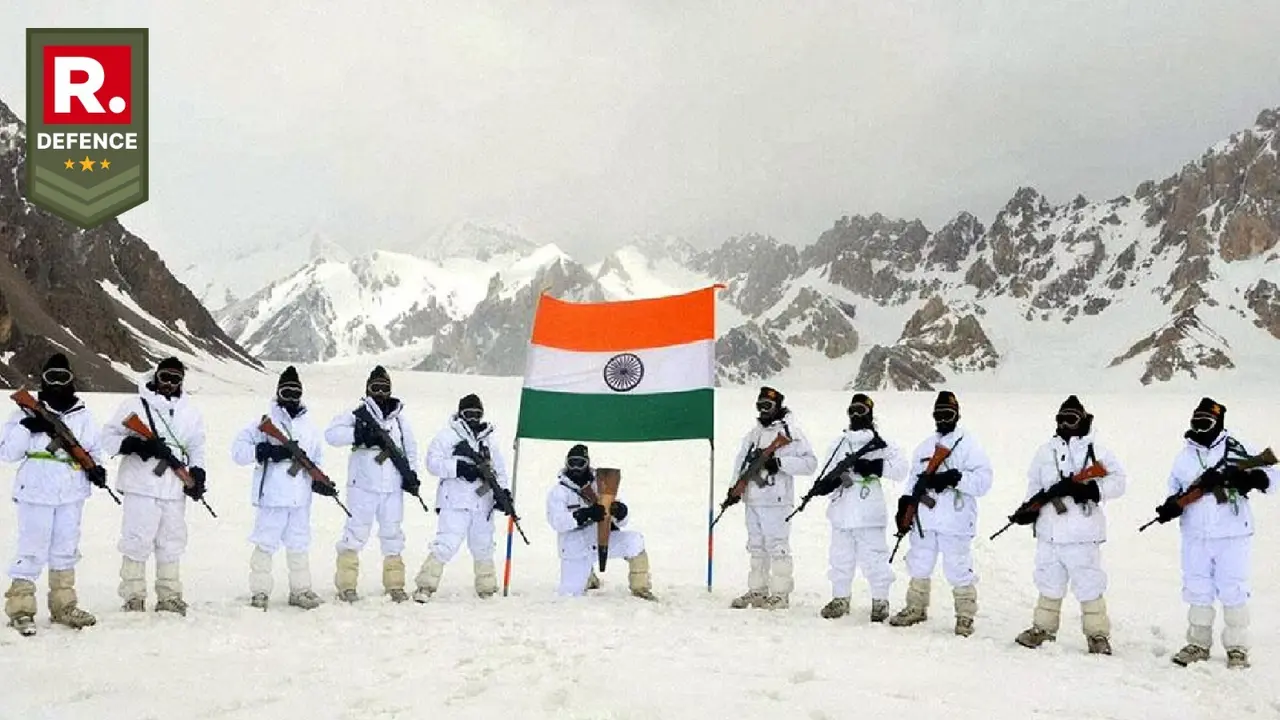
The early morning silence of April 13, 1984, in the Karakoram Range, was shattered not by the sound of gunfire or artillery, but by the hum of Indian Air Force helicopters slicing through the thin, frigid air. Below, the vast expanse of the Siachen Glacier stretched out like an icy wilderness, its crevasses and seracs forming an almost impassable barrier. But for the soldiers of the Indian Army, this inhospitable terrain was not a deterrent but the objective. Thus began Operation Meghdoot, a military endeavor as audacious as it was unprecedented, marking the beginning of one of the most challenging and enduring conflicts in the history of modern warfare.
The Origins of a Frozen Conflict

To understand the significance of Operation Meghdoot, one must delve into the geopolitical intricacies of the region. The Siachen Glacier, located in the eastern Karakoram Range in the Himalayas, lies at the crossroads of India, Pakistan, and China. The glacier itself is a desolate expanse of ice, stretching approximately 76 kilometers in length, making it the longest glacier in the Karakoram and the second-longest in the world’s non-polar regions.
The genesis of the conflict over Siachen can be traced back to the ambiguous delineation of borders following the Indo-Pakistani War of 1947-48. The ceasefire line, later known as the Line of Control (LoC), was drawn up to the point known as NJ9842, after which the border was left undefined, with the vague instruction that it should run "thence north to the glaciers." This ambiguity was to become the crux of the issue, as both India and Pakistan laid claim to the glacier and the surrounding areas.
In the decades that followed, the strategic significance of the Siachen Glacier grew, particularly as advances in mountaineering and cartography made the region more accessible. By the late 1970s, both India and Pakistan began to assert their claims more aggressively, with Pakistan even permitting foreign expeditions to the glacier, effectively signaling its ownership. This escalation of activity set the stage for what would become a dramatic and prolonged conflict in one of the world’s most forbidding landscapes.
Advertisement
The Decision to Act
By the early 1980s, Indian intelligence had become increasingly concerned about Pakistan’s intentions in the region. Reports indicated that Pakistan was planning to send its troops to occupy key positions on the glacier. In response, the Indian Army began to prepare for a preemptive operation to secure the glacier before Pakistani forces could do so.
Operation Meghdoot was conceived in utmost secrecy, with only a handful of top military officials aware of its details. The operation was named after Meghdoot, the divine messenger in Kalidasa’s classic Sanskrit play, symbolizing the communication of vital information across the vast distances of the subcontinent. The name was fitting, as the success of the operation would hinge on speed, secrecy, and the ability to swiftly relay crucial information.
Advertisement
The logistical challenges of mounting an operation in the Siachen region were immense. The area is characterized by extreme altitudes, with the average elevation of the glacier being over 18,000 feet. The harsh weather conditions, with temperatures often plunging to minus 60 degrees Celsius, made the region practically uninhabitable. The thin air and treacherous terrain added to the difficulties, making conventional military operations nearly impossible.
The Execution of Operation Meghdoot
On the morning of April 13, 1984, the operation was set in motion. Indian Air Force helicopters, flying at the very edge of their operational limits, began airlifting soldiers of the Kumaon Regiment to the Bilafond La and Sia La passes, which commanded strategic access to the glacier. These troops were soon followed by other units, including the Ladakh Scouts and the Garhwal Rifles, who were tasked with securing additional positions along the glacier.
The first Indian troops to land on the glacier were immediately confronted with the harsh realities of high-altitude warfare. The soldiers, many of whom had never before operated at such altitudes, faced severe physiological challenges, including altitude sickness, frostbite, and the ever-present danger of avalanches. Despite these difficulties, the Indian forces quickly established control over the key passes and ridges, effectively securing the glacier.
What was most remarkable about Operation Meghdoot was not just the speed and efficiency with which it was executed, but the fact that it was accomplished without a single shot being fired. The Pakistani forces, caught off guard by the swiftness of the Indian operation, were unable to mount an effective response. By the time they attempted to move into the area, the Indian Army had already secured the high ground, giving them a significant tactical advantage.
While Operation Meghdoot was a resounding success for India, it marked the beginning of a protracted and costly conflict. The Siachen Glacier would soon become the world’s highest battleground.
The Indian Army, now firmly entrenched on the glacier, had to contend with not only the Pakistani forces but also the brutal environment. The conditions on the glacier were so extreme that the majority of casualties on both sides were due to the harsh weather and terrain rather than enemy fire. Soldiers had to endure the constant threat of frostbite, hypoxia, and avalanches, all while maintaining their defensive positions.
The cost of the conflict, both in terms of human lives and resources, was significant. The Indian government, recognizing the strategic importance of holding the glacier, invested heavily in maintaining a permanent presence in the region. This included the construction of high-altitude outposts, the deployment of specialized equipment, and the development of sophisticated logistics to ensure the supply of food, water, and medical supplies to the troops stationed there. Not that far from Siachen, Pakistan, till this day, continues to occupy Indian territory.
The Strategic Significance of Siachen
The strategic importance of the Siachen Glacier cannot be overstated. The glacier lies at the intersection of three nuclear-armed states—India, Pakistan, and China—making it a critical point of geopolitical interest. By maintaining control over Siachen, India has been able to partially prevent Pakistan from linking up with China in the Karakoram region, effectively limiting any potential collusion between the two countries in this strategically sensitive area.
Moreover, India’s control of Siachen has allowed it to dominate the Saltoro Ridge, which overlooks Shaksgam Valley, a region ceded to China by Pakistan in 1963. This control has provided India with a significant advantage, enabling it to monitor Chinese movements in the region and maintain a strategic buffer between its northern borders and the restive areas of Jammu and Kashmir.
From a broader perspective, the Siachen conflict has also underscored the lengths to which India is willing to go to defend its territorial integrity. The sacrifices made by Indian soldiers on the glacier have become a symbol of national pride and resilience, highlighting the country’s commitment to safeguarding its borders, no matter how remote or inhospitable the terrain may be.
The Legacy of Operation Meghdoot
As the years have passed, Operation Meghdoot has come to be seen as one of the most significant military operations in India’s post-independence history. The operation not only secured India’s control over the Siachen Glacier but also demonstrated the country’s military capabilities and strategic foresight in one of the most challenging environments on earth.
The legacy of the operation is also reflected in the ongoing presence of Indian troops on the glacier. Indian soldiers continue to guard the glacier, enduring the same harsh conditions that their predecessors faced, in a testament to the enduring importance of the operation.
For the soldiers who have served on the Siachen Glacier, the operation is more than just a military maneuver—it is a reminder of the sacrifices made in the defense of the nation’s borders, no matter how distant or desolate they may be. As India continues to navigate the complex dynamics of its relationships with Pakistan and China, the lessons of Operation Meghdoot remain as relevant today as they were on that cold April morning in 1984.
What is the central lesson? The central lesson is the fact that it is better to preempt the enemy, instead of waiting for the enemy to act and then respond.
(Article based on conversation with Lt Gen Sanjay Kulkarni (Retd.) who was awarded Shaurya Chakra for his service to the nation during Operation Meghdoot).