
Made-in-India Naval Thrust: DRDO, Indian Navy Successfully Conduct First Salvo Launch Of Twin Anti-Ship Missiles From Helicopter
DRDO and the Indian Navy successfully conducted the maiden salvo launch of 2 NASM-SR anti-ship missiles from a helicopter off Odisha, meeting all test goals and proving waterline hit capability with indigenous systems.
- Defence News
- 3 min read

;'%3e%3cpath%20d='m8,15.99c4.41,0,7.99-3.58,7.99-7.99S12.41,0,8,0,0,3.59,0,8s3.58,7.99,7.99,7.99Z'%20style='stroke:%23fff;%20stroke-miterlimit:10;%20stroke-width:.02px;'/%3e%3cpath%20d='m3.08,3.37l3.82,5.11-3.84,4.15h.87l3.37-3.64,2.72,3.64h2.94l-4.04-5.39,3.58-3.87h-.86l-3.1,3.35-2.5-3.35h-2.94Zm1.27.64h1.35l5.97,7.99h-1.35l-5.97-7.99Z'%20style='fill:%23fff;'/%3e%3c/g%3e%3c/svg%3e)


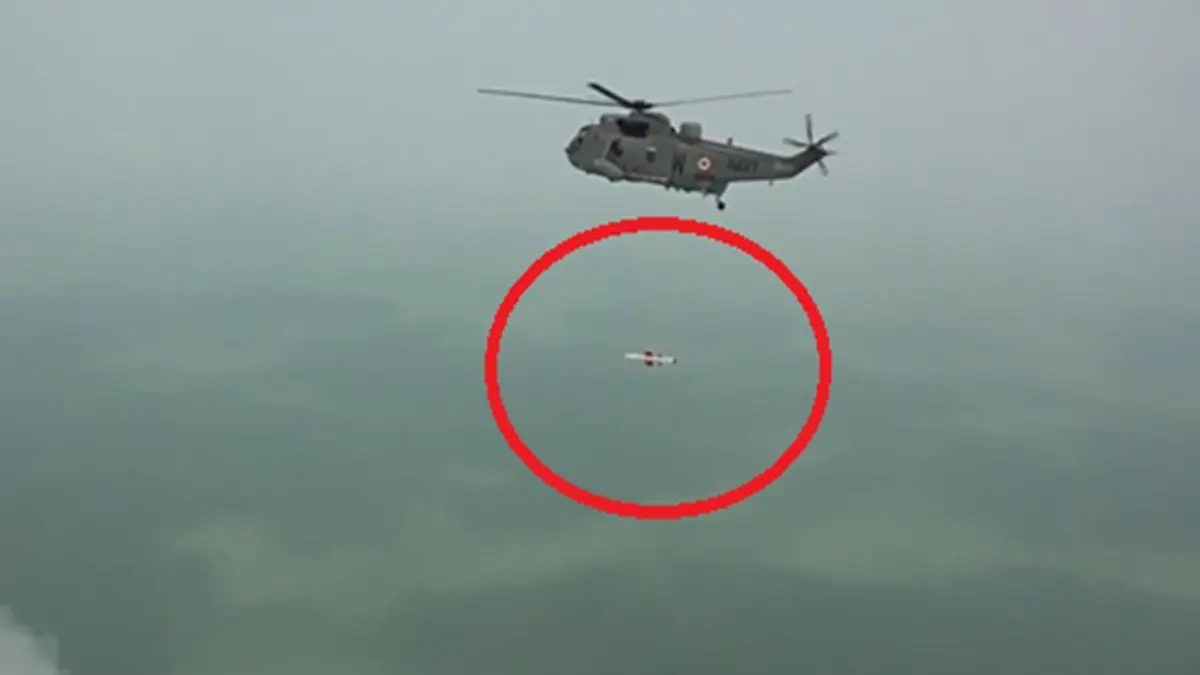
New Delhi: The Defence Research and Development Organisation (DRDO) and the Indian Navy have successfully carried out the first-ever salvo launch of the Naval Anti-ship Missile-Short Range from a naval helicopter, a major boost to India’s maritime strike capability. According to officials, the trial was conducted off the Bay of Bengal coast in Odisha, showcasing India’s growing prowess in indigenous defence technology.
The Ministry of Defence, in a statement, confirmed that the exercise saw 2 NASM-SR missiles fired in quick succession from the same helicopter platform, a first for the country’s advanced air-launched anti-ship systems. The back-to-back launch was designed to validate the missile’s operational readiness in rapid-fire scenarios that a warship or helicopter crew might face during combat.
Senior scientists from DRDO, representatives from the Indian Navy and Indian Air Force (IAF), and Development-cum-Production Partners were present to witness the test, underlining the joint effort behind the system, which has been years in the making and now moves closer to induction into the armed forces.
All Test Objectives Met: DRDO
According to DRDO, every objective set for the trial was fully achieved. The data gathered by the Integrated Test Range at Chandipur through radar, electro-optical tracking systems, and telemetry confirmed the missiles’ performance with precision. Further, beyond proving the salvo capability, the missiles also showcased their ability to strike at the waterline, a critical feature for inflicting maximum damage on enemy vessels.
Advertisement
The NASM-SR is powered by a solid propulsion booster paired with a long-burn sustainer, giving it the reach and endurance needed for naval engagements. As per the officials, its critical subsystems, including the seeker, integrated avionics module, and advanced navigation suite, have been developed indigenously. The guidance system relies on a fibre-optic gyroscope-based Inertial Navigation System (INS), a radio-altimeter, and sophisticated control algorithms. A high-bandwidth 2-way data link and jet-vane control further enhance its accuracy and manoeuvrability, all crafted by DRDO labs in partnership with Indian industry.
Defence Minister Compliments DRDO
Raksha Mantri Shri Rajnath Singh extended his compliments to DRDO, the Indian Navy, the IAF, and all industry partners involved in the successful trial. He noted that the development of NASM-SR would substantially augment the capabilities of the defence forces. Secretary, Department of Defence R&D and DRDO Chairman Dr Samir V Kamat also congratulated the teams associated with the salvo launches, calling it a proud moment for India’s defence research community. The successful test signals another step towards reducing import dependence and equipping the Navy with home-grown, cutting-edge weapons.
Advertisement
The officials stated that the missile system has been spearheaded by the Hyderabad-based Research Centre Imarat, working alongside other DRDO establishments such as the Defence Research and Development Laboratory in Hyderabad, High Energy Materials Research Laboratory in Pune, Terminal Ballistics Research Laboratory in Chandigarh, and ITR Chandipur. Production is currently being undertaken by Development-cum-Production Partners with support from a network of Indian industries and start-ups, reflecting the government’s push for self-reliance in defence manufacturing.