
Germany's Chamber of Commerce warns of steepest economic downturn in 20 years
The European Commission's assessment further reinforced these apprehensions, identifying Germany as the primary drag on euro zone growth for 2024 and 2025.
- Economy News
- 2 min read

;'%3e%3cpath%20d='m8,15.99c4.41,0,7.99-3.58,7.99-7.99S12.41,0,8,0,0,3.59,0,8s3.58,7.99,7.99,7.99Z'%20style='stroke:%23fff;%20stroke-miterlimit:10;%20stroke-width:.02px;'/%3e%3cpath%20d='m3.08,3.37l3.82,5.11-3.84,4.15h.87l3.37-3.64,2.72,3.64h2.94l-4.04-5.39,3.58-3.87h-.86l-3.1,3.35-2.5-3.35h-2.94Zm1.27.64h1.35l5.97,7.99h-1.35l-5.97-7.99Z'%20style='fill:%23fff;'/%3e%3c/g%3e%3c/svg%3e)


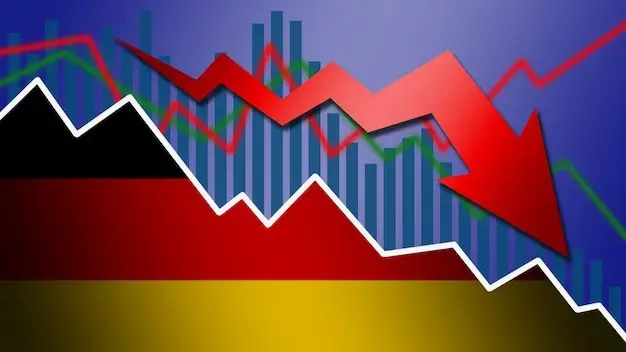
Germany economic downturn forecast: Germany's DIHK Chambers of Industry and Commerce predicted that Europe's largest economy is poised to contract by 0.5 per cent this year, marking its deepest recession in two decades.
The grim forecast, outlined by a DIHK poll encompassing over 27,000 companies, indicates a pervasive pessimism among German businesses, with 35 per cent anticipating a deterioration in their prospects over the next 12 months. Conversely, only 14 per cent foresee an improvement, citing challenges such as soaring energy costs, bureaucratic hurdles, a scarcity of skilled workers, and sluggish domestic demand as key factors impeding economic growth.
"The prevailing sentiment among companies is increasingly bleak," remarked the DIHK in Berlin, underscoring that this would mark only the second instance of consecutive annual contractions in Germany's post-war history.
Echoing these concerns, DIHK head Martin Wansleben emphasized the gravity of the situation, labeling it as a "clear alarm signal" demanding urgent attention from both Germany and Europe.
Advertisement
The European Commission's assessment further reinforced these apprehensions, identifying Germany as the primary drag on euro zone growth for 2024 and 2025. The Commission revised down its growth projections to 0.3 per cent for 2024, significantly lower than the 0.8 per cent anticipated in November, followed by a modest uptick to 1.2 per cent in 2025 after last year's 0.3 per cent recession.
Ahead of the government's forthcoming economic growth forecast, Finance Minister Christian Lindner expressed dismay over the bleak projections, cautioning that the nation faces social risks if immediate action is not taken to rectify the situation. Strikes across the country underscore the growing dissatisfaction among Germans with their economic circumstances.
Advertisement
In response to these challenges, the ruling coalition led by Chancellor Olaf Scholz aims to unveil proposals to bolster Germany's competitiveness by spring. Potential measures include tax reforms and streamlining bureaucratic processes.
DIHK's Wansleben also called for a suspension of legislation mandating German companies to monitor human rights and environmental standards in global supply chains, citing excessive burdens on large corporations. Additionally, he cited the adverse impact of soaring interest rates, triggered by efforts to combat inflation amid geopolitical tensions arising from the conflict in Ukraine.
(With Reuters inputs.)