
‘Institutional Use Of Caste Discrimination Is Dangerous’: Suspended Alankar Agnihotri After SC Stays UGC 2026 Regulations
When asked about the role of the government and the University Grants Commission (UGC), Agnihotri dismissed the need for a full rollback of existing mechanisms. "There is no need for a full rollback. The administration committee is capable of doing it," he said.
- Education News
- 4 min read

;'%3e%3cpath%20d='m8,15.99c4.41,0,7.99-3.58,7.99-7.99S12.41,0,8,0,0,3.59,0,8s3.58,7.99,7.99,7.99Z'%20style='stroke:%23fff;%20stroke-miterlimit:10;%20stroke-width:.02px;'/%3e%3cpath%20d='m3.08,3.37l3.82,5.11-3.84,4.15h.87l3.37-3.64,2.72,3.64h2.94l-4.04-5.39,3.58-3.87h-.86l-3.1,3.35-2.5-3.35h-2.94Zm1.27.64h1.35l5.97,7.99h-1.35l-5.97-7.99Z'%20style='fill:%23fff;'/%3e%3c/g%3e%3c/svg%3e)


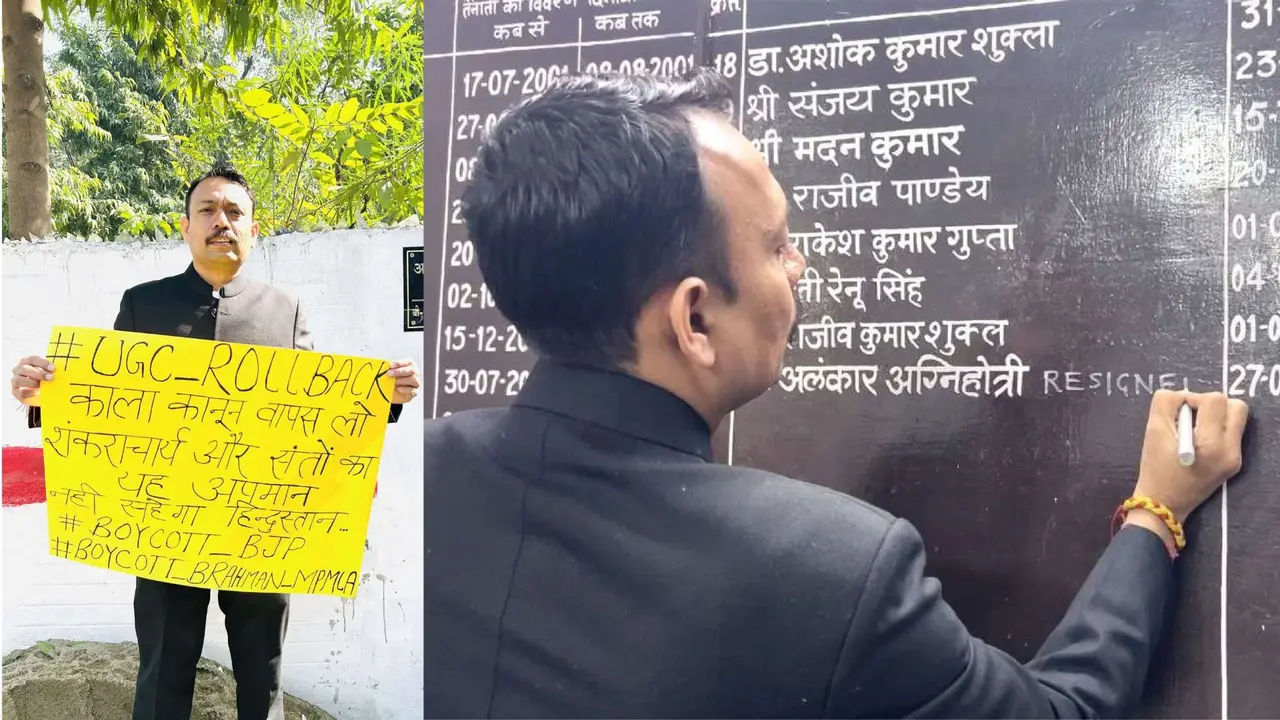
Bareilly: As the SC on Thursday stayed the UGC's new Regulations, 2026, Suspended City Magistrate of Bareilly Alankar Agnihotri termed the institutional misuse of provisions related to caste-based discrimination in education, warning that such practices could have serious social consequences, even leading to internal unrest in the country.
Speaking to ANI, Agnihotri said that caste-based discrimination should never be used as an institutional tool and should remain confined to appropriate vocabulary and discourse. He alleged that the clause related to caste discrimination is increasingly being treated as a self-inflicted crime, where families are targeted irrespective of merit.
"If your son is good at studies, then he will be accused and his salary will be exploited. Similarly, if your daughter or daughter-in-law studies in a university, then she will be accused and her salary will be exploited. Daughters and daughters-in-law will have to commit suicide," Agnihotri said.
He further claimed that such practices affect society as a whole and warned that prolonged conflicts between social groups could harm national unity.
Advertisement
"If two groups are fighting, then it will be a loss for the nation. A civil war situation develops in the country, which protects us from the enemies of our country. In a few years, our country will be unsafe due to the internal threat," he added.
When asked about the role of the government and the University Grants Commission (UGC), Agnihotri dismissed the need for a full rollback of existing mechanisms. "There is no need for a full rollback. The administration committee is capable of doing it. If it is implemented in any way, then the entire country will be in a full rollback," he said.
Advertisement
He also criticised the authorities' negligence in addressing internal provisions, alleging that this neglect was responsible for growing problems in the country. "All the problems in the country will be caused by these people. These people are responsible. They should see that their children are going to commit suicide," he said.
Referring to legal remedies, Agnihotri said officials who feel aggrieved should approach the judiciary. "When an official has to leave his post, then he should go to the Supreme Court. I would like to thank him. I would like to thank all the citizens of the country who are standing behind me," he said, adding that people from all communities were supporting him.
"I would like to thank all the Sikhs, Hindus, Muslims, and Christians who are standing behind me. All they have done is for the benefit of the people. They have gone to serve the people," he added.
Responding to questions on whether discrimination exists in colleges and universities, Agnihotri questioned the effectiveness of existing laws, citing the Scheduled Castes and Scheduled Tribes (Prevention of Atrocities) Act.
"You have seen the SC-ST Act, how much it is being used. I don't believe that the Supreme Court removed the rules. This is the fake government which went against the orders of the Supreme Court and reset the rules," he alleged.
He further claimed that such actions could fuel social resentment. "Now the General, OBC will take revenge on this basis. Now the society will take revenge," he said.
Meanwhile, Uttar Pradesh Minister Om Prakash Rajbhar also responded to the developments, asserting that the constitutional framework and judiciary must be respected.
"No one can point a finger at the Supreme Court order. Today, the Supreme Court granted a stay. Everyone has the right to voice their opinion in the Supreme Court. The state and central governments are complying with the constitution.
No one can point a finger at the Supreme Court order," Rajbhar said.
Amid nationwide uproar, the SC stayed the University Grants Commission (Promotion of Equity in Higher Education Institutions) Regulations, 2026.
The new UGC regulations, notified on January 23, were challenged by various petitioners as being arbitrary, exclusionary, discriminatory and in violation of the Constitution as well as the University Grants Commission Act, 1956.
The Top Court said that, for now, the 2012 UGC regulations will continue to apply. The Court opined that there is complete vagueness in Regulation 3 (C) (which defines caste-based discrimination), and it can be misused. "The language needs to be re-modified," the Court said.The new regulations, introduced to curb caste-based discrimination in colleges and universities, require institutions to establish special committees and helplines to address complaints, especially from students belonging to the Scheduled Caste (SC), Scheduled Tribes (ST), and Other Backward Classes (OBCs) categories.