
Antarctica: Largest fish breeding ground comprising 60Mn icefish discovered in Wedell Sea
Home to the Neopagetopsis ionah species of icefish, the colony consisted of 60 million of those creatures breeding some 535 to 420 metres below the Wedell Sea.
- Entertainment News
- 2 min read

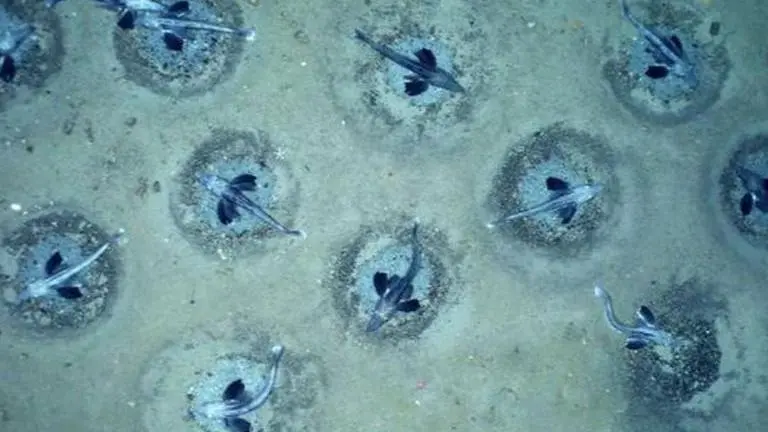
Researchers scanning the sea bed of Antarctica's Wedell Sea have discovered the world's largest fish breeding ground covering an area of 240 square kilometres. Home to the Neopagetopsis ionah species of icefish, the colony consisted of 60 million of those creatures breeding some 420 to 535 metres below the German research vessel Polarstern. It is worth mentioning the discovery was made in February 2021 and was published in the journal Current Biology on January 13.
Researchers call the discovery a spectacular one
Autun Purser, a deep-sea biologist at the Alfred Wegener Institute and lead author of the research said in an official report, "The idea that such a huge breeding area of icefish in the Weddell Sea was previously undiscovered is totally fascinating". Icefish are a fairly unique creature as they have a see-through body, have transparent blood making them the only invertebrates that do not have red blood cells. Interestingly, they also have evolved to possess an anti-freeze protein which helps them survive in extremely low temperatures.
The observations to discover these unique creatures were made using the Ocean Floor Observation and Bathymetry System (OFOBS), which is basically a car-sized camera that is designed to scan floors of ice-covered seas. When the camera transmitted images from the Wedell seabed, the discoverers found different types of fish nests including "active" nests, containing between 1,500 and 2,500 eggs, and were being guarded by an adult fish. The active nests were also found to have unused nests in their vicinity along with a few dead fish.
"After the spectacular discovery of the many fish nests, we thought about a strategy on board to find out how large the breeding area was, there was literally no end in sight. The nests are three-quarters of a metre in diameter, so they are much larger than the structures and creatures, some of which are only centimetres in size", Purser said in a statement. "We covered an area of 45,600 square metres and counted an incredible 16,160 fish nests on the photo and video footage", Purser added. The experts estimate the biomass of this icefish colony to be a whopping 60 thousand tonnes and said that they serve as a major source of food for the seals.