
As Brahmastra flounders, where does it leave the planned 3-part Astraverse?
Years before 'Brahmastra Part 1: Shiva' even started filming, its makers had gone so far as to announce it would have up to two sequels, the 'Astraverse'
- Entertainment News
- 5 min read

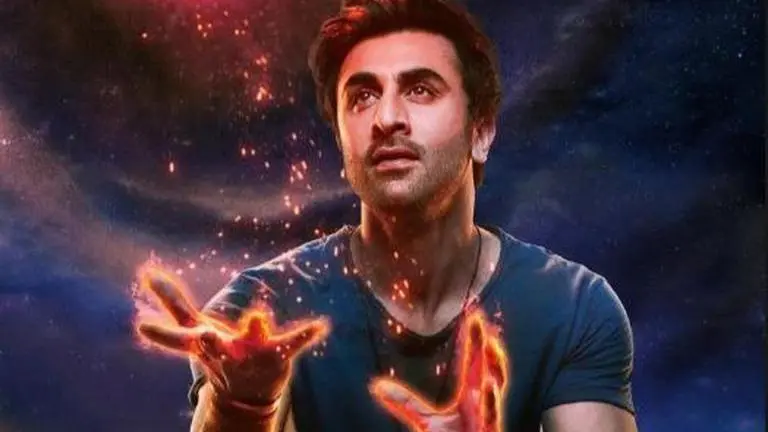
Ayan Mukerji’s latest directorial ‘Brahmastra Part 1: Shiva’ has hit the theatres but the movie seems to have taken a blow in terms of attracting a wide audience. With over five years of preparation and a budget exceeding Rs 400 crore, the movie which was touted as a mega-spectacle is being bombarded with poor reviews.
It was in 2017, when Karan Johan, one of the producers of the film, had even confirmed that the movie will pan out into a trilogy, which is a fairly presumptive claim to make given that industry convention dictates that future films and shows are greenlit based on how the 'pilot' performs.

[Ranbir Kapoor, Alia Bhatt (left) and Ayan Mukerji (right) on the sets of Brahmastra; Image: Instagram/@ayanmukerji]
“We have part two and part three ahead of us, we have the potential to really take the storytelling in many diverse directions even beyond ‘Brahmastra,’ and there is no way to do it at the scale at which I hope to do it, unless our audience base does not increase”, the director told Variety, clearly aware that a lot hinges on the first part. He envisioned that Brahmastra, starring Ranbir Kapoor and Alia Bhatt in the lead roles, will lay foundation for the Astraverse, which the makers are planning to transform into something akin to Disney’s Marvel Cinematic Universe (MCU).
Advertisement
Will 'Astraverse' survive a sluggish Brahmastra: Part 1?
In normal circumstances, when a film or TV venture expands into a franchise, it's generally because a pilot project took off. The Brahmastra makers, however, were quick to predict the future of this saga years before the first film's release. What’s also worth noting is that the movie, which is an original concept, has no connections to any known source material that would guarantee it a proven storyline, apart from prima-facie drawing from Indian mythology.
The Harry Potter franchise, for instance, saw its first movie (Harry Potter and the Sorcerer’s Stone) release in 2001. Based on J.K. Rowling’s creation, the pioneering movie turned out to be a blockbuster and the magical run ended a decade later with ‘Harry Potter and The Deathly Hallows- Part 2’ in 2011 and over $7 billion in total global revenue. In Harry Potter's case, had the first movie been a disappointment, the makers could have at least hoped to turn it around for the second - The Chamber of Secrets.
Advertisement
However, there are numerous examples of even popular source material being unable to overcome a disastrous adaptation - Eragon, a contemporary of Harry Potter - is one such. In contrast, Ayan Mukherji has already confirmed that the development of the second installment of the planned franchise will begin soon after the release of Part 1.

[Emma Watson (left), Daniel Radcliffe (middle) and Rupert Grint (right); Image: AP]
To add to that, the Brahmastra team [Spoiler alert], at the end of the first installment, is purported to have even revealed a title for 'Part 2'. While the date of release is not clear, Ayan Mukherji has touted that new and more powerful characters will be introduced. We've been here before, even in the case of the franchise Brahmastra most wants to emulate...
Even Marvel can't guarantee sequels
While the Marvel juggernaut may seem unstoppable to many, it has thus far failed to launch what ardent fans believe to be its 'first family'. A brainchild of Stan Lee and Jack Kirby, 'The Fantastic Four' is a strange case of the MCU failing over and over again. The first attempt predated Iron Man (widely held to be the starting of the MCU). Released in 2005, Fantastic Four featured stars like Chris Evans (later to play Captain America), Jessica Alba among others, and grossed a somewhat respectable (by those days' standard) $333.5 million. It was followed by Fantastic Four: Rise of the Silver Surfer in 2007 which, despite raking in a little over $300 million, failed to convince Fox Studios to splurge for a third installment.

[A still from Fantastic Four (2005); Image: 20th Century Fox]
Interestingly after much fanfare, Fox tried to breathe life into the same franchise again in 2015 leveraging the stardom of Michael B Jordan and Miles Teller, but the reboot again underperformed and plans for another sequel in 2017 were dropped. Clearly, even the unstoppable Marvel cannot guarantee sequels if the original films don't work.
The same is also true of TV series these days. While on one hand, it appears too many shows are greenlit without enough scrutiny and become also-rans, the really big-budget star-studded endeavours require some selling. The recently-released Game of Thrones spin-off/prequel 'House of the Dragon' was only approved for a second season once the pilot episode attained landmark viewership and rave reviews. This, despite GoT being a worldwide phenomenon and the spin-off being based on a best-selling book by the same author, George RR Martin.
Coming back to Brahmastra and the Astraverse, it's not as though there haven't been films for which multiple parts have been announced right from inception. Another 'magnum opus', by SS Rajamouli, was always pegged as a part 1 and part 2. In Bahubali's case, part 1 turned out to be a mega hit and wowed audiences with a compelling story, thrilling action, expansive war scene, and an unmissable 'why did Katappa...?' tease at the end.

[A still of Prabhas from the movie Baahubali; Image: Instagram/@actorprabhas]
When ‘Baahubali: The Conclusion’ released in 2017, the two collectively became the highest-grossing Indian movies of all time. Made at a combined budget of over Rs 400 crore, the two movies collectively generated over Rs 1,000 crore worldwide. It mattered less that the part 2 wasn't as well received as well. Baahubali's Part 1 did the leg-work.
Will Brahmastra Part 1 be able to do the same and open the doors for its sequels? Or will the makers' proclamations turn out to be entirely premature?