
Fossils 'taller than giraffe' excavated in China show giant rhino species that roamed Asia
New rhino species found in China were the cousins of modern-day species of rhinos and were heavier than African elephants weighing more than 20 tons.
- Entertainment News
- 3 min read

;'%3e%3cpath%20d='m8,15.99c4.41,0,7.99-3.58,7.99-7.99S12.41,0,8,0,0,3.59,0,8s3.58,7.99,7.99,7.99Z'%20style='stroke:%23fff;%20stroke-miterlimit:10;%20stroke-width:.02px;'/%3e%3cpath%20d='m3.08,3.37l3.82,5.11-3.84,4.15h.87l3.37-3.64,2.72,3.64h2.94l-4.04-5.39,3.58-3.87h-.86l-3.1,3.35-2.5-3.35h-2.94Zm1.27.64h1.35l5.97,7.99h-1.35l-5.97-7.99Z'%20style='fill:%23fff;'/%3e%3c/g%3e%3c/svg%3e)


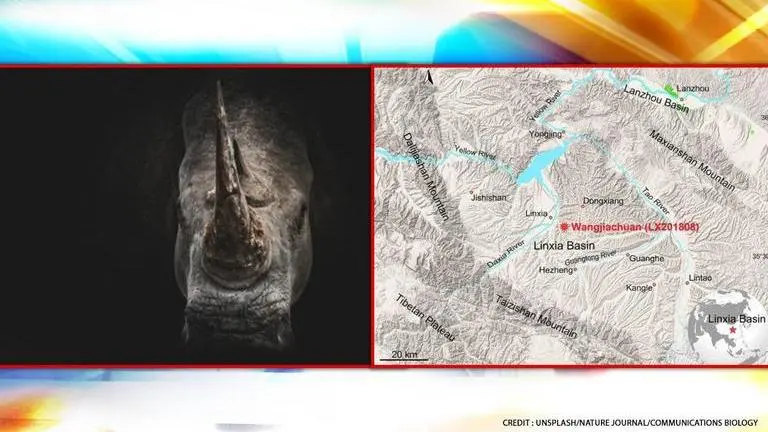
Scientists have discovered the fossils of a new giant rhino species which was “taller than giraffe” that roamed Central Asia nearly 26.5 million years ago. Standing 20 feet tall and weighing more than 20 tons, this mammoth ancient rhino entered Asia via the Tibetan region and has been considered as one of the largest land mammals that ever lived. The skull and legs of the now-extinct creature were longer than the modern rhinos or any other reported land mammals to date. In the study published on June 17, in the scientific journal communication biology in Nature, scientists state that the Tibetan region, millions of years ago was open woodland with humid or arid climatic conditions which was suitable for the survival of these giant rhinos.
[Credit: Nature journal/Communications Biology]

“The Tibetan region likely hosted some areas with low elevation, possibly under 2000 m during Oligocene, and the lineage of giant rhinos could have dispersed freely along the eastern coast of the Tethys Ocean and perhaps through some lowlands of this region,” researchers said in the study.
These species that are the cousins of the modern-day species of rhinos termed Paraceratherium Linxiaense were heavier than African elephants and were known to exist from northwest to southwest China.
Scientists found a completely preserved skull of the species from the Linxia Basin in Gansu Province, China, located at the northeastern border of the Tibetan Plateau. P. Linxiaense rhinos are renowned for their gigantic sizes, at times standing 16 feet tall and with 7 foot-long neck that is longer than the giraffes. They were mostly hornless. The giant rhino has been found to be closely associated with the species of rhinos that inhabited Pakistan Pakistani P. Bugtiense. It spread across northwest China and the Indian-Pakistani subcontinent as it had dispersed from the low elevated Tibetan plateau.

[Credit: Nature journal/Communications Biology]
Advertisement

[Credit: Nature journal/Communications Biology]
New species of rhino differed from others
A fully preserved skull and jawbone were dug in 2015 near the village of Wangjiachuan, 10.8 km southwest of the town of Dongxiang County, China. After analysis, scientists found that the new species of rhino differed from other species of Paraceratherium as it had a deeper nasal notch, proportionally larger height, short muzzle bones, and a diastema anterior to cheek teeth.
Advertisement
The nose of the Paraceratherium Linxiaense was found to be flat and straight, with a short distance from the orbit which was also much deeper than those of other species of Paraceratherium. The dorsal surface of the skull of giant rhinos was shallowly depressed. Most fossils were unearthed brown sandstones of central China’s Linxia Basin. Researchers found that all six species of Paraceratherium were sisters to Aralotherium, an extinct hornless rhinoceros which is closely related to Paraceratherium but is one of the largest terrestrial mammals that ever existed.
[Images Credit: Nature journal/Communications Biology/ https://www.nature.com/articles/s42003-021-02170-6]